
The putative putsch by the Nepali Congress this week to get the Maoists to abandon their alliance with the UML in the governing coalition has had far-reaching consequences.
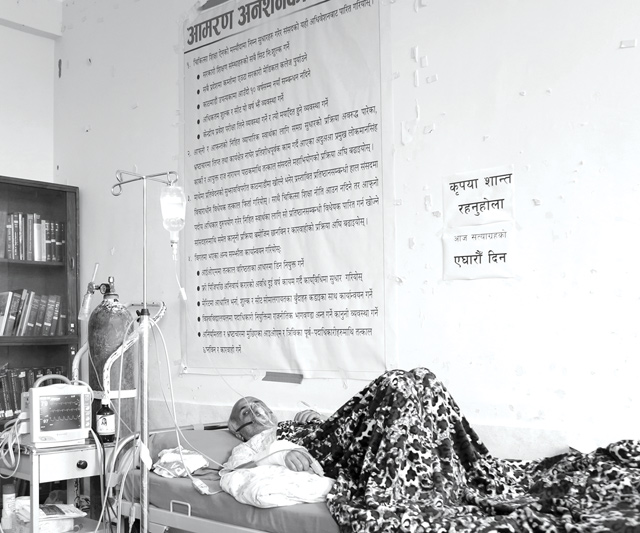
It has brought fresh uncertainty about the new government, final fate of the Constitution, inclusion of dissatisfied Madhesi and Janajati elements into mainstream politics, endorsement of budget-related bills, long-delayed appointment of Supreme Court justices, ratification of ambassadorial appointees and, most urgently, meeting the demands of Govinda KC, the physician who has now been on a hunger strike for 13 days.
While the ruling and opposition parties are at loggerheads over whether to form a new government, the parties who are willing to do so are halting the process of the parliamentary hearing of the 11 justices nominated for Supreme Court.
The Supreme Court will be a critical arena for writ petitions in the coming days since the rival parties are consulting legal experts about the constitutional crisis and the no-confidence motion in parliament. The Maoists and Nepali Congress do not want to start the hearing process of the 11 justices, since many of them are closer to the UML.
This delay also impacts on one of Govinda KC's demands, which calls for the impeachment of Lokman Singh Karki, Chief of the Commission for the Investigation of Abuse of Authority (CIAA). Another contempt of court case against Karki is also sub judice in the Supreme Court, which has summoned him. If found guilty in the contempt case, Karki could even be suspended from his CIAA post.
Although assorted politicians, Speaker Onsari Gharti Magar and some members of Parliament’s Social Justice and Human Rights Committee visited the fasting doctor this week, the government has not bothered. Some of KC’s current demands persist from past hunger strikes, and include those that had been either ignored or only partially implemented.
On this eighth fast, some of KC’s demands are more serious and zero in directly on the source of interference and corruption in the medical education sector. KC has long known that Karki has a conflict of interest in medical education because of the involvement of his immediate family members in this lucrative sector. KC also knows full well that top politicians own or benefit monetarily from medical colleges, and they are beholden to Karki.
Hence, among his demands for health sector reform, KC is also asking for Karki’s impeachment. It is probably for this reason that parliament members and the government are not responding, because conceding to the impeachment process would invite Karki’s wrath. They also probably feel – rightly so – that cobbling together a two-thirds majority for impeachment is impossible in the current fractious climate.