
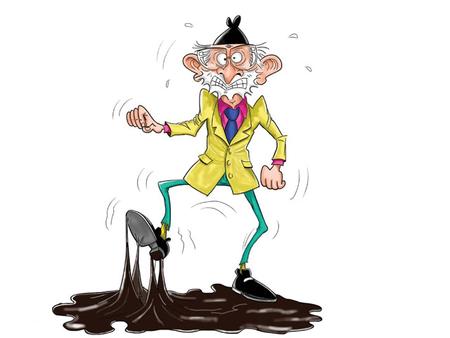
Cartoon: Diwakar Chettri
Nepalis are squeezed: between boulders, revolutionary leftists and oppressive rightists, between tradition and modernity, and as we’ve recently realised, between the Indian and Eurasian tectonic plates.
If you think about it, we are also sandwiched between seamlessly corrupt, inefficient governments and arrogant less-than-transparent donors. Which is probably why, when the earthquake hit on 25 April, most people didn’t turn to the government or donors for help, they turned to each other. People want to give directly to survivors through volunteers on the ground.
The lack of a better alternative is probably what spurred on the ‘resilient’ Nepali nature in all the relief work as well. It’s a rubbish place to be as a people, unable to trust our own government and bureaucracy and to be equally suspicious of other governments and foreign organisations here to ‘help’.
For many years now, those who work for the government and bureaucracy have been almost unanimously considered corrupt, greedy, and inefficient by Nepalis, and also by foreign aid organisations and governments. Increasingly, however, the latter bunch – the donors—are also considered opaque and inefficient in a classier and less-obvious way.
As Nepalis, we pour our frustrations rightly on this government and bureaucracy, considering any corruption and inefficiency on part of this state is paid by our tax money. And to think that our money supports red tape is infuriating. But none of this is ‘new’ news, and the lack of state presence long predates the earthquake. Not only have we known this, but well-meaning foreigners have spent millions of dollars in efforts to create an ‘accountable’ state for us. But, surely, accountability would be best learnt if the donors implementing the programs led by example. That way, the beneficiaries might actually take the lesson seriously, instead of signing up just for the free ride.
The holier-than-thou position of much of Nepal’s aid regime is the real problem. That wouldn’t be the case were our government more capable, but it isn’t. The donor argument is that working through the government invites dealing with corruption and delays. Unfortunately, instead of trying to strengthen the government and make it accountable, many donors are quick to bypass it, deepening the accountability crisis. So when the Nepali government says, for example, that not giving directly to the PM Relief Fund is a way to profit from Nepal’s disaster, one can’t help but feel there is an ounce of weight to the argument.
For example, one wonders why the PM’s Relief Fund has collected a mere $39 million even as individuals like Joanna Lumley raised $50 million for Nepal. That money went to the Disasters Emergency Committee, a coalition of 13 UK charities working on relief in Nepal. Granted if that money came into the PM Relief Fund perhaps some of it would be siphoned off, against which we may have been able to rally. But can we guarantee that all the $50 million which Ms Lumley has selflessly worked to raise will even make it to Nepal? The answer is probably not. And we probably won’t be able to say a thing about it, either.