
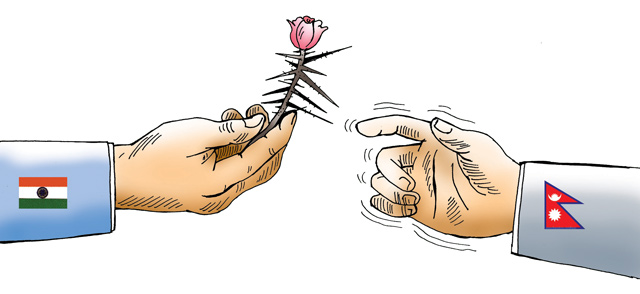
Eight months after an earthquake and four months into an Indian blockade, as a new year dawns, Nepal is in crisis. The state, as usual, is nowhere to be seen.
Agitating Madhesi cadre blockade border points with India’s support, using violence to escalate protests and incite confrontation. Instead of exercising restraint, the police go on a shooting spree, killing innocents.
Ordinary Nepalis and earthquake victims have been left to fend for themselves as political forces battle it out. The blockade has pushed millions of Nepalis to destitution, and the economy has been irreparably hurt. We might be heading towards imminent state failure if things continue at this pace.
And yet, we can’t really expect anything different from a country where the intellectual leadership defends the rights of political groups to wield terror, violence and even a blockade against their own people. What else can one expect in a country where people are expendable for the sake of pursuing some abstract, untenable political goal? What does democratic process mean when after years of war and political turmoil, Nepal finally gets a constitution through popular vote but is told to throw the document into the bin instead of improving on flaws because it doesn’t satisfy few groups?
The truth is that even if the government is able to fulfil all the demands of Province 2 activists including demarcation that stands at odds with claims of other ethnic groups, there will be no respite because we would have given legitimacy to political blackmail and violence.
For years we were told that Nepal can only achieve development and democracy if we get a new constitution through a Constituent Assembly. A civil war was fought to achieve this goal, but after the conflict ended we were told federalism was the answer.
The last decade was spent trying to figure federalism out. And now we are being told we need a new framework for defining Nepali nationalism. Whenever Nepal has tried to settle these issues through a democratic process, political forces who lost have trampled on them.
Ultimately we have to make a decision: do we want to continue the impasse by letting brute force decide our political fate, or do we want to evolve through continuous practice of democracy, accommodating grievances through inclusive policies and accountable politics? The second option is not possible in this endless and unstable transition.
Corrupt and incompetent leaders, weak institutions, structural discrimination over decades of authoritarian rule, economic inequality are key internal factors driving conflict and instability in Nepal. But it has to be said that being landlocked with an overbearing neighbour has been the bane of Nepal’s existence, and from which much of our current problems of state-building and democratic consolidation arise.