
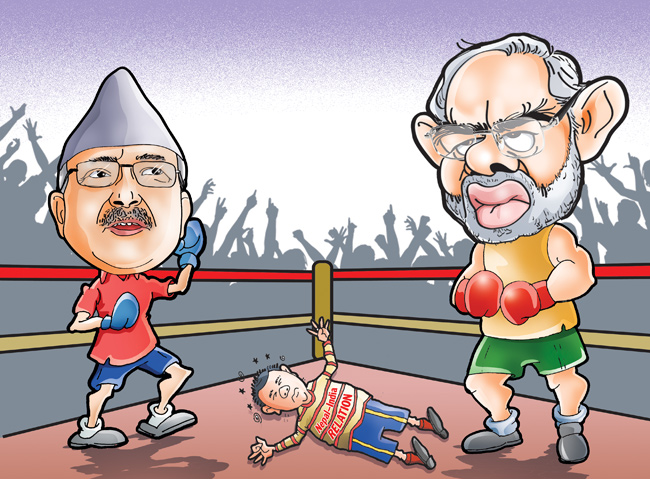
India’s External Affairs Minister Sushma Swaraj stirred a debate this week over her Nepal remarks in India’s Upper House. Her comments were widely criticised for being misleading.
To those who missed her speech, you can watch it in the online version of this column on the Nepali Times website.
The operative paragraph was: “The interim constitution ensured naturalised citizenship to Indian women married to Nepali men, but this provision is missing in the new constitution.”
The truth is that the new constitution has retained the provision about naturalised citizenship through matrimony. Why did Swaraj have to propagate that falsehood? Did she deliberately distort the truth to justify the Madhesi protests which in turn is used to justify the Indian blockade of our borders to pressure Kathmandu on the constitution?
These are important questions, but what is even more crucial is: why does she – or the Madhesi people – believe that Indian women married to Nepali men will be deprived of naturalised citizenship under the new constitution?
This misunderstanding appears to have stemmed from the alteration of just one word: ‘existing’ to ‘federal’. The interim constitution stipulated that foreign women married to Nepali men can apply for naturalised Nepali citizenship as per ‘existing’ laws.
The same line has been repeated in the new constitution, but ‘existing’ has been replaced with ‘federal’. Will this minor alteration have big implications? Not really. Laws in a federal Nepal will be known as ‘federal’ laws.
But leaders of the Madhesi parties have misinterpreted this change and been able to convince many in the Indian establishment that this is discrimination and reduces the Madhesi people to second-class citizenship. Swaraj seems to have bought that.
Madhesis want deletion of the word ‘federal’ and more clarity in the clause of naturalised citizenship through matrimony. They believe ‘federal’ is a semantic ploy and they are not ready to trust the state that this word will never be used to pass discriminatory laws against them in future.
Why do only Madhesis want clarity in the citizenship clause? Why do non-Madhesis not see it as a ploy? These questions are important to make sense of the Madhes unrest.
It is true that the state has in the past doubted the Madhesi people’s allegiance to Nepal, and Madhesis are suspicious of the state. Their perception of constitutional clauses is guided by this very distrust of the state. So building trust between Kathmandu and Madhes is probably more important than tweaking the statute.