 |
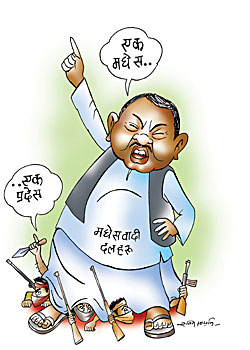
Right now the Madhesi leaders are busy giving speeches about identity. Meanwhile in the cities and villages of the Madhes there is a rising dissatisfaction with both the Kathmandu centric system and Madhes parties. The rising anarchy and the wrong promotion of the slogan 'all Madhes, one state' by the Madhesi leaders has allowed the security situation to deteriorate at an alarming rate. Neither the leading party nor the Madhesi parties have done anything substantial since the elections to improve the Tarai situation. The social relations are now strained not just between Madhesi and Pahadi but also among the Madhesi themselves.
As a result, the Madhes is now trapped in a whirlwind of violence and unrest because of Madhesi leaders' irresponsible behaviour, the State's short-sightedness, inter-racial conflict and absence of Madhesi civil society. If this continues, the Madhes might as well become Nepal's Bihar, a region that is synonymous in India with social injustice and underdevelopment- where the guns rule and the common people have no hope for of being liberated from unrest.
It is chiefly the responsibility of the State to manage the conflict in the Tarai, to narrow the gap between Kathmandu and the Madhes. But neither the state nor the Madhes leaders have realised this. The agreement made with the United Madhesi Morcha on 28 February 2008 is now collecting dust. This lack of commitment has made it easier for the Madhesi parties and the armed groups to rally against the government.
The CA has become a battleground for the Madhesi leaders to fight for their rights. But before they do so they have to condemn violence. They must give up supporting armed groups in Tarai while remaining safe in the cities. They must realise this will backfire in the future and damage them. As representatives of the Tarai, they must take the initiative to stop the killings, robberies and rapes that take place every day in the Tarai in the name of politics. There is an urgent need for these leaders to give up the illusion that these armed groups can be useful. One day the Madhesi parties themselves could be the targets of these armed groups.
The social structure, personal grudges, squabbles about property and ethnic competition are causing this carnage. The Madhesi need to understand this so they can free Madhes from this vicious cycle of violence and insecurity. Conflict resolution should be addressed at a local level. The elders, the respected and the women should play mediating roles to solve fights in villages. Issues of land reform should first be discussed locally, involving people from different sects and ethnicity including the dispossed dalits.
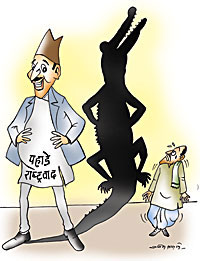
Another burning issue is the relationship with the Pahadi. Is there a place for them in the Madhes? Do Pahadi people need to fear the Madhesi? How can this be changed? What does the Pahadi community expect from the Madhesi leadership and the society? Except for few radical groups, most Madhesi people understand that in the end they have to live together with the Pahadi. At this sensitive time, one positive step could be the formation of a Pahadi- Madhesi United Civil Society.
The leaders of the armed groups in the Tarai will eventually have to understand the aspirations of the Madhesi people. They neither want the country to disintegrate nor do they want violence. What they really want is their rights and peace. Most suspect that the armed groups are, in fact, business profiteers and not politically motivated. True politics is only possible when you stay among the people and win their hearts. Giving orders from a mobile phone while one stays at a hotel in Bihar may scare the people for a while but it won't win their belief.
It is hard to say whether the government's effort to invite the armed groups for dialogue is genuine. But it perhaps offers them a chance to give up their guns and join mainstream politics. The people in Madhes are waiting for a new peaceful leadership.
In the past six months, there have been 100 murders, 126 abductions and 77 bomb explosions in the Madhes. This poses a serious challenge. If we are to save the Madhes from a long-term low intensity conflict then the state, Madhes leadership, society, the Pahadi community living in the Tarai and also the armed groups, all have to make an effort. Otherwise the Madhesi people will suffer. The true struggle for identity and representativeness will be lost and political stability in Nepal will just be a dream.