
July 1914
In 1914, Nepali Gurkha battalions (‘Gurks’) and Allied forces were deployed in what would prove to be a disastrous campaign to take control of the high ground of the Gallipoli peninsula in order to threaten Constantinople, the capital of the Ottoman Empire. This is the fourth installment of a series of flashbacks of the involvement of Gurkhas in the First World War.
Interactive timeline by Ayesha Shakya
The casualties suffered at Gallipoli by both sides at the end of the first week of June 1914 were appalling. After the failure of the assaults mounted in late May and early June by the Allies, they were exhausted. The Ottoman forces, which had attempted to take advantage of this by launching a counter-attack, had found resistance greater than they anticipated.
In the bloody fighting that ensued, all three Gurkha battalions (1/6th, 1/5th and 2/10th) were engaged, often using their khukuris to good effect. The Ottomans lost an estimated 10,000 men in a week, but the casualties on the British side were also terrible, around 7,000.
With both sides badly punished, only a few small-scale attacks were launched by the warring sides during the rest of June and Allied progress was slow. Towards the end of the month, however, the right flank had been pushed forward and Hunter Weston decided now to take the left flank forward as well. Three brigades, including 29th Indian Brigade, were ordered to drive the enemy back 1,000m from their position northwest of Gurkha Bluff. They would advance along Gully Spur and Gully Ravine.
The first assault of the Battle of Gully Ravine began on the morning of 28 June 1915. The battle went well on the left but very badly on the right. The 2nd/10th Gurkhas followed up the heavy bombardment which the British guns had maintained for about two hours and moved under a cliff, then, using all the cover available, climbed to the top of the cliff and routed the defenders. It was, perhaps, the most successful set-piece attack of the whole campaign, for the battalion took five lines of Ottoman trenches.
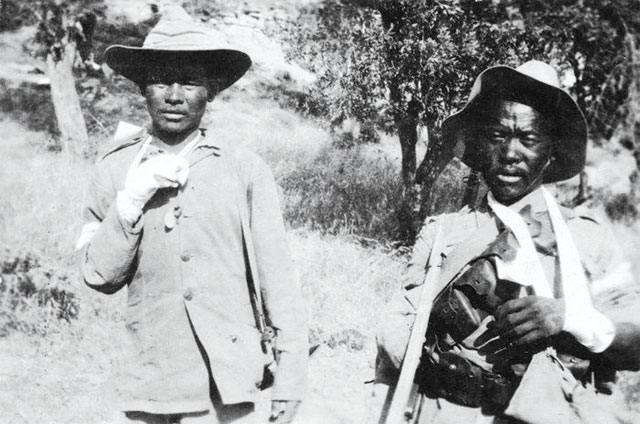
The 1/6 Gurkhas on Gurkha Bluff were heavily involved, as were other Gurkha units. The battalion moved over and extended the line, by which time the Ottoman troops had been pushed back half a mile. Then the enemy counter-attacked. These counter-attacks hit each Gurkha battalion in turn, and for eight days and nights the struggle continued, with hand-to-hand fighting, in which the Gurkhas again used their khukuris to deadly effect.