
Timeline by Ayesha Shakya
Part 3, June 1915
On 14 May, the 69th Punjabis and 89th Punjabis were withdrawn from the conflict and embarked the next day for Egypt en route to France. This was said to be because they contained a significant proportion of Muslim troops and could not be relied upon not to mutiny in sympathy with the Ottoman army.
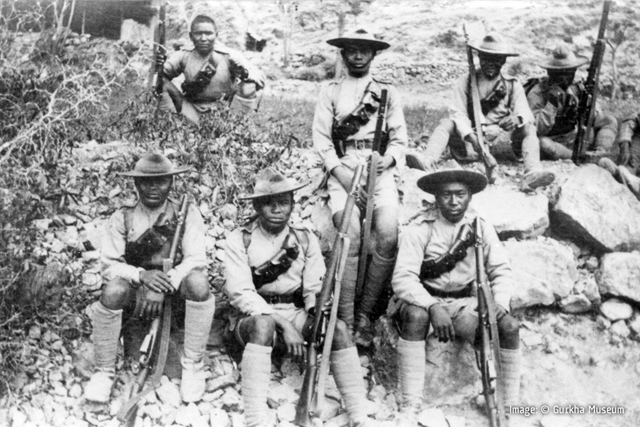
In the short time they had been on the peninsula, the 89th Punjabis had suffered over 100 casualties, while the 69th Punjabis, which had not been engaged in the front line, had nevertheless lost 10 killed and 23 wounded. These units were replaced, although not until 2 June, by the 1/5th and 2/10th Gurkha Rifles from Nepal.
For a week or so, the ANZAC sector had been relatively quiet. Even so, casualties in the Cape Helles sector had mounted. The attacking forces and the enemy were by now both in trenches which in the case of the former stretched from short to shore, raids and counter-raids were taking place with increasing intensity.
On 19 May, the enemy made a night attack on the ANZAC forces. Four divisions of up to 40,000 men descended from the heights above the beaches to crush the ANZACs. But the attack went horribly wrong and the intended victims were able to destroy the oncoming Ottoman forces which suffered heavy casualties with some 10,000 killed or injured.
The next day, when they came out under a white flag to collect their dead and wounded, the Allied troops were willing to help and even give the wounded and prisoners cigarettes and chocolates. Charles Bean, a Sydney Morning Herald journalist who became the official historian of the Gallipoli campaign for the Australians, wrote in his diary that ‘the Indians with the mules down here also take the prisoners chocolates – they give our men some also’.
On 24 May, a truce was agreed. Hunter Weston was promoted to lieutenant general and made a corps commander. His VIII Corps consisted of the long-suffering 29th Division, the RND, the 42nd Division and the 29th Indian Infantry Brigade. As for the Gurkhas, by the end of May, all of the original company commanders of the 1st/6th Gurkhas had been killed or wounded, and even the other two battalions which had hardly been engaged as yet had also suffered losses. By this time, the two battles of Krithia had been fought to no avail, so that the beach-head remained pitifully small. As on the Western Front, gains were counted in yards and only under the protection of the overhanging cliffs could the Allied troops seek respite from enemy fire and, to some extent at least, from the heat. For as the summer advanced, the weather became hotter and the major concern became the temperature and the flies, and the putrid, unburied dead. Dysentery spread rapidly and claimed victims by the score, while lice added to the discomfort of the soldiers.
On 2 June 1915, the 1st/5th and 2nd/10th Gurkhas arrived to replace the two withdrawn and re-deployed Punjabi battalions of 29 Indian Brigade. What would come to be known as the Third Battle of Krithia was planned for 4 June, and the new arrivals were soon in action. The objective was the capture of Achi Baba, a feature some 200m high, which commanded both the Helles beach-head and the Narrows. After two barrages from the Allied guns directed at the Ottoman defences with a view to destroying any barbed-wire entanglements, the 1st/6th Gurkhas and 14th Sikhs of the Indian Brigade, together with the Lancashire Fusiliers, went forward at noon, advancing on the extreme left along Gully Spur, with the 29th and 42nd Divisions in the centre, the RND on the right centre, and the French on the right.
The Allies had about 30,000 men and the enemy had up to 28,000, half of them in the front line. The French attack failed quickly, three battalions of the RND went forward, but the fourth, the Collingwood Brigade, which made the second assault was wiped out in less than 30 minutes and the other three battalions took ‘frightful casualties and lost all but ten of their officers’. The Manchester Brigade of the 42nd Division advanced strongly as did the 29th Division on their left, but eventually, the Manchesters were marooned and forced to retreat.