
Timeline by Ayesha Shakya
Exactly a hundred years ago in May 1915 the allied forces, stiffened by reinforcements from the Indian 29th Brigade, which included three Nepali Gurkha battalions, clustered on the beaches of Gallipoli in Turkey and launched an assault on the heights above. This is the second in a series the Nepali Times is running in memory of the Nepalis who fought and died in this disastrous campaign. It is part of David Seddon’s forthcoming book, Nepal, the Gurkhas and the Great War.
Reinforcements Arrive – Early May 1915
After the initial landings and encounters with the defending Ottoman forces towards the end of April 1915, the Allies on the beaches at Gallipoli were significantly strengthened by the arrival of the HQ and five battalions of the Royal Naval Division under Major General Archibald Paris, and the French Brigade Coloniale from Kum Kale, commanded by Major General Masnou.
These were shortly followed by other reinforcements, including the 29th Indian Infantry Brigade with its three Gurkha battalions (1/5th, 1/6th and 2/10th) and one Sikh battalion (14th Sikhs) under Brigadier General Cox. The Indian Army was barely 5,000 men in a campaign that involved a deployment that grew from an initial 25,000 to nearly half a million Allied troops engaged by the end of the campaign. Yet it had a significant impact on the course of operations.
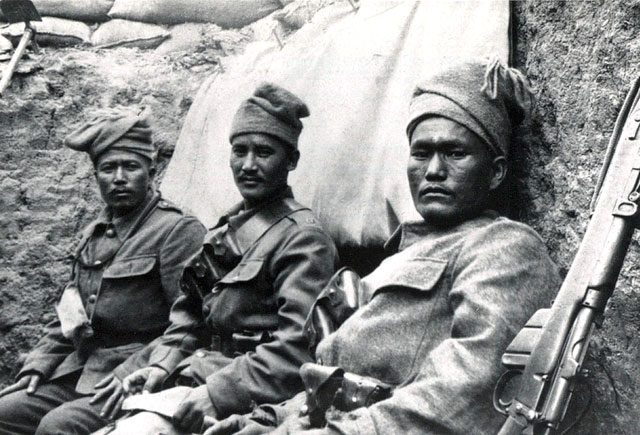
The Indian Army was also represented by the 7th Indian Mountain Artillery Brigade, the Indian mule corps and a medical establishment. The first Gurkhas ashore were of the 1/6th commanded by the Honourable Charles Bruce, and were placed in the immediate reserve. But within a few hours suffered their first casualties: one Gurkha rifleman killed and 21 others wounded. They were moved into the frontline on 9 May, relieving the British 87th Brigade on the extreme left of the line. It came immediately under fire.
With the arrival of the one brigade of the 42nd Division, the Indian Brigade, and two further ANZAC brigades the Allied forces at Gallipoli now numbered around 75,000 men – a combination of English, Scots and Irish, Australians and New Zealanders, French, Algerians and Senegalese, Sikhs, Punjabis and Nepalis and the Zionist Mule Corps. Many of these were already exhausted.
However, General Ian Hamilton and his force were now significantly better prepared than they had been at the outset for the next phase of the assault on the Ottoman positions. These, under the overall command of the German General Liman von Sanders, with several other Turkish generals, including Mustapha Kemal (later to become Kemal Ataturk) supporting him, had also been reinforced in the interim and posed a formidable threat to the invading Allies. An attempt was now made by the Allies, however, to move off the beach and into the hills.
The Second Battle of Krithia 11-17th May 1915
On 12 May 1915, the first battalion of the 6th Queen Elizabeth's own Gurkha Rifles, having landed at Cape Helles only a week or so before, led the assault. This was their first major operation on Krithia, a bluff overlooking the beach which had been converted into a stronghold by the Ottoman forces whose machine gunners were doing untold damage to the invasion attempts. Two previous attempts to capture it by the 1st Dublin Fusiliers and the Royal Marines had already failed.
The rocks were sheer and 300m high, but, with support from the Royal Navy which bombarded the defenders, the Gurkhas managed to scale the cliffs, and after a hard fight in which 12 Ottoman soldiers were decapitated as well as a number shot and 18 Gurkhas were killed and 42 wounded, the 1/6th managed to advance 200m and capture a prominent feature, which was later renamed ‘Gurkha Bluff’ in an order signed by General Hamilton himself. They then dug in.
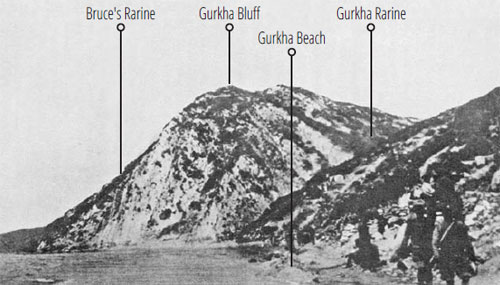
A despatch written by General Sir Ian Hamilton, Commander-in-Chief of the Mediterranean Expeditionary Force, described in detail what happened next. ‘During the night of the 10th/11th May, the 6th Gurkhas started off to seize this bluff. Their scouts descended to the sea, worked their way for some distance through the broken ground along the shore and crawled hands and knees up the precipitous face of the cliff. On reaching the top they were heavily fired on. As a surprise the enterprise had failed, but as a reconnaissance it proved very useful. On the following day Major-General H. V. Cox, commanding 29th Indian Infantry Brigade, submitted proposals for a concerted attack on this bluff (now called Gurkha Bluff). At 6.30 p.m. on the 12th May, the Manchester Brigade and the 29th Divisional artillery opened fire on the Turkish trenches and, under cover of this fire, a double company of the 1/6th Gurkhas once more crept along the shore and assembled below the bluff. Then, the attention of the Turks being taken up with the bombardment, they swiftly scaled the cliffs and carried the work with a rush. The machine-gun section of the Gurkhas was hurried forward, and at 4.30 am, a second double company was pushed up to join the first.