Timeline by Ayesha Shakya
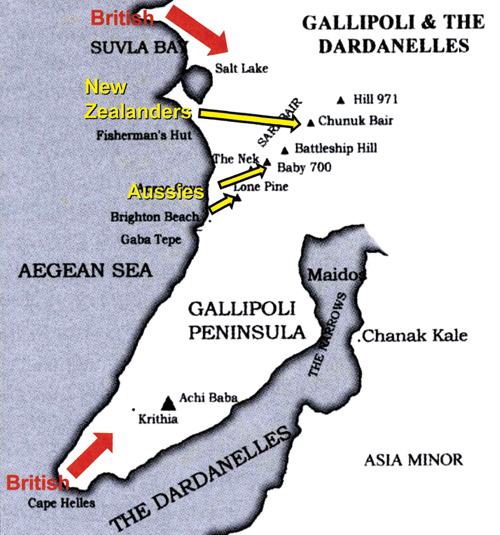
The Gallipoli Campaign had started on two main fronts, Anzac and Helles, and for three months since the invasion of 25 April 1915, the Allies had attempted to carry the offensive on the Helles battlefield at enormous cost for little gain. In August 1915, the British command proposed a new operation to reinvigorate the campaign by capturing the Sari Bair ridge, the high ground that dominated the middle of the peninsula above the Anzac landing. New assaults on Ottoman positions on the peninsula were planned, with the offensive to start on 6 August. It was hoped that the arrival of fresh troops would give the commander of the Allied forces one more chance to advance, this time from Anzac Cove north of Helles.
For this offensive the commander of the Mediterranean Expeditionary Force, General Sir Ian Hamilton, was provided by Kitchener with three British New Army divisions: the 10th (Irish) Division, the 11th (Northern) Division and the 13th (Western) Division — all previously untried in battle. He was later reinforced with two Territorial Army divisions; the 53rd (Welsh) Division and the 54th (East Anglian) Division and one division of dismounted yeomanry; as well as the 2nd Mounted Division.
It was becoming a big war. The aged Sir Frederick Stopford was sent out as supreme commander of IX Corps at Gallipoli. He had actually retired in 1909 and had never commanded men in battle. His appointment was made based solely on seniority, but his hesitancy during the preparations for the landing should have warned Hamilton that he was not a fit choice for the command.
There had been some doubt about whether the British would abandon the campaign but this was dispelled when Winston Churchill made a careless speech in Dundee, stating that the battle would continue whatever the sacrifices. The enemy was now well aware that a renewal of the offensive was imminent. Consequently the Ottoman Fifth Army underwent a re-organisation and an expansion to 16 divisions. Ten of these defended the existing battlefields (six at Helles, which had seen the bulk of the early fighting, and four at Anzac). Three divisions defended the Asian shore of the Dardanelles and three divisions of the Ottoman XVI Corps defended the Gulf of Saros north of Bulair at the neck of the peninsula.
The German and Ottoman generals anticipated that the offensive would involve a ‘breakout’ from Anzac, but were unsure whether it would be north (towards Suvla) or south (towards Gaba Tepe). A new British landing was also considered likely, but Suvla was not rated highly as a candidate, consequently only a modest force of four battalions defended the area. The Ottoman commanders also dismissed the possibility of an assault against the Sari Bair range due to the rugged terrain. Only Mustafa Kemal, commander of the Ottoman 19th Division at Anzac, expected the attack against the heights but he was unable to convince his superiors to significantly strengthen the defences — only one regiment was moved to the sector north of Anzac.
The ‘Break-out’
In fact, the Allies considered the main peaks of the Sari Bair Ridge to be the prime target, and a night attack launched from the Anzac Cove beach-head was intended to be the battle winning blow. The bold (and in retrospect over-ambitious) plan to break the stalemate called for a vigorous offensive from ANZAC, the 13th Division and the 29th Indian Brigade combined with a surprise landing at Suvla Bay by IX Corps, under cover of a diversionary attack in the Helles area to pin down the Ottoman forces and prevent reinforcements being sent to the north. When the orders were issued for the offensive, some of the officers were deeply sceptical - particularly as to whether it was physically possible to carry out the planned flanking march at night in the dreadful country north of Anzac.
One such was Major Cecil Allanson, now commanding the 1/6th Gurkha Rifles, who confided his thoughts to his diary on 2 August:
“When the method of attack was disclosed to me confidentially that afternoon I gasped. It is to be remembered that Anzac is completely invested by the enemy; that no one has been able to reconnoitre the ground outside and that no one can absolutely guarantee the map. There are no villages and no inhabitants to help one, and the whole country seemed to be stiff, with very sharp rocky cliffs, covered with thick scrub.
I have a few ideas about night marches, their great difficulty and the need of careful reconnaissance; but when I was told that we were to break through the opposing outpost line at 10 pm on the 6th, march along the sea coast for three miles then turn at right angles and attempt to get under this big ridge about two miles inland, by dawn, and covered from the sea by innumerable small hills and nullahs, I felt, “What one would have done to a subaltern at a promotion examination who made any such proposition?”
The more the plan was detailed as the time got nearer, the less I liked it, especially as in my own regiment there were four officers out of seven who had never done a night march in their lives. The one hope was that the scheme was so bold it might be successful.”