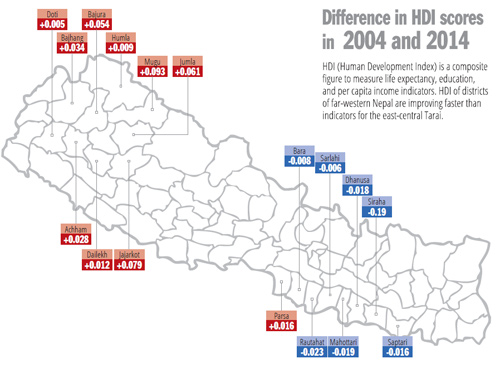
The traditional narrative in Nepal’s development and political circles is that the eight districts of the east-central Tarai are the least developed parts of Nepal. They are often bunched together at the bottom of the pile with the under-developed districts of the western and far-western mountains.
Past UN Human Development Reports over the years show that compared to the national average, both the western mountain districts and east-central Tarai have lagged behind in the Human Development Index (HDI) — a composite statistic of life expectancy, education, and income per capita indicators.
Read Also
Inhuman under-development, Manish Jha
More careful examination of the 2014 Human Development Report figures shows that the eight districts of the east-central Tarai (Siraha, Saptari, Dhanusa, Mahottari, Sarlahi, Rautahat, Bara and Parsa) performed better in terms of HDI than the hill and mountain districts of western Nepal (Achham, Dailekh, Bajura, Bajhang, Doti, Mugu, Humla).
Life expectancy and per capita incomes are actually higher in the east-central Tarai districts whereas the literacy rate and average years of schooling are better for the mountain districts of the west.
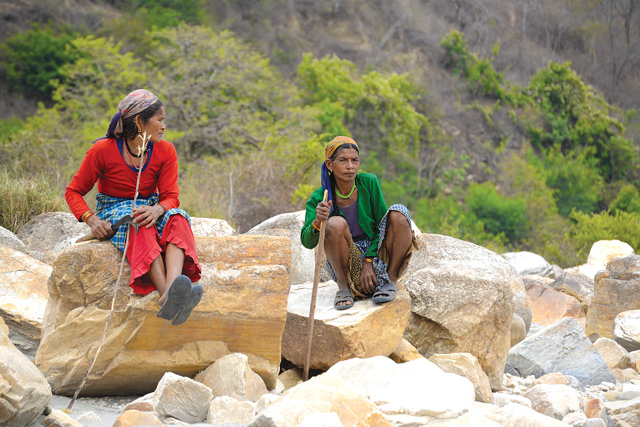
The far-western hill districts of the trans-Karnali have often been the first to suffer from food insecurity, due to the remote topography and out-migration of able-bodied men. This has affected agricultural productivity, leading to poor nutrition especially among women and children.
East-central Tarai districts are less vulnerable — despite an entrenched caste system and gender disparities, these districts are more accessible, and benefit from proximity to the open border with India.
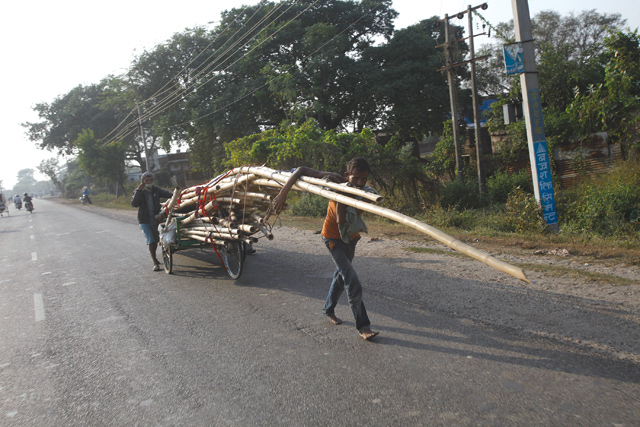
However, while the western hills and mountains are now slowly climbing up in the development parameters, the index for east-central Tarai has remained stagnant over the years. Because of the higher population in the plains, government development outlay per capita is also much lower in the Tarai than in the hills.
“It is not fair to compare the two regions,” says Tula Narayan Sah of the Madhes Foundation. “They are different historically, geographically and population-wise. Although the districts in Far and Mid-West have lower HDI scores, they are making progress compared to the past whereas in the Madhes, the progress has been stagnant.”