
 |
The peace process is stalled, development is at a standstill and the poverty, inequality and discrimination that were at the roots of Nepal's conflict have still not been resolved. Politics and the power play in Kathmandu have taken centre-stage to the detriment of development and service delivery.
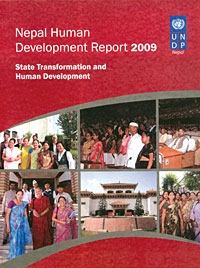
Nepal has the lowest life-expectancy in South Asia, development parameters in the mid-west are at sub-Saharan levels. UNDP's Nepal Human Development Report 2009, which was released on Tuesday, shows just how far we lag behind.
It measures the state of Nepal by indices such as the Human Development Index (HDI), the Human Poverty Index (HPI), the Gender Empowerment Measure (GEM), and the Gender-related Development Index (GDI) and breaks them down across 13 sub-regions and 11 caste and ethnic groups.
Despite improvement as a whole, glaring disparities remain among regions and population groups. Political democracy has been unable to deliver social transformation, and has suffered as a result.
"Nepal is quite probably undergoing the most profound transformation of any society in the world today," the UN's resident coordinator, Robert Piper, said the launch of the report, "but the absence of war will alone neither assure a lasting peace nor deliver prosperity."
Using the Comprehensive Peace Agreement (CPA) of 2006 as a launching pad, the report focuses on socio-economic transformation as a means to achieve human development. 'Without peace, human development is not possible, and without human development, peace is not sustainable,' the report says.
Exclusion and inequality persist and, unsurprisingly, the far-west and mid-west are the poorest as measured by HDI, and GDI mirrors this trend. Once the development regions are disaggregated into eco-development regions, we find that rural and mountain regions are the least developed. Brahmins and Chhetris lead the pack, the best-off being Madhesi Brahmin/Chhetris, the worst-off being Madhesi Dalits, Tarai Janajatis and Muslims.