By 9AM on Sunday 26 April, the National Emergency Coordination Centre at Singha Darbar was beginning to fill up with government officials and politicians. Chief Secretary Leela Mani Paudyal arrived riding on the back of a motorcycle. Nearly 24 hours after the earthquake struck, it was becoming clear that the extent of the disaster was much greater outside Kathmandu.
The earthquake-proof room became the nerve centre, but it was obvious there had been no drills and there was no contingency planning for disaster management. Because the mobile network was functioning, Constituent Assembly members became important not just as sources of information, but even to help Indian Air Force pilots navigate helicopters to remote villages.
Nearly four months after the earthquake there is still the urgent need to help three million survivors with rehabilitation, but also to learn lessons on how to be better prepared for future disasters. Despite the high death toll and destruction, we were lucky the time of the earthquake, its intensity, duration, and frequency of shaking limited the destruction. However, it is clear that better preparedness would have saved many of the lives that were lost.
Despite international experts urging the government for the last seven years to set up a Disaster Management Authority and have contingency plans, preparedness was woefully inadequate. Valiant rescues were carried out by the army and police, but the government machinery appeared shocked and overwhelmed.
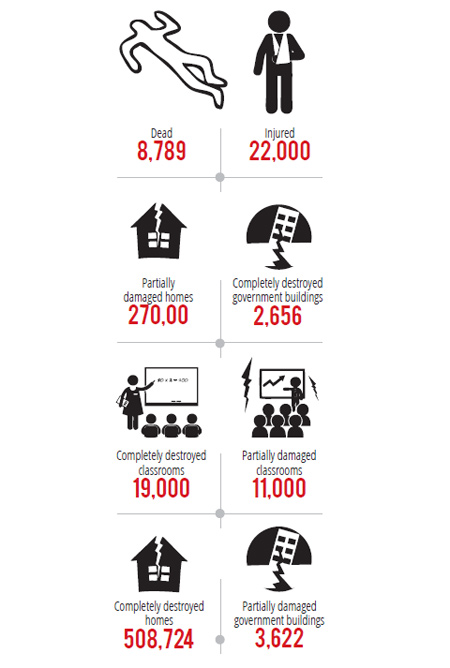
Nepal’s topography made it difficult initially to even assess the damage, let alone deliver relief supplies. Even countries with better resources would have found it difficult to deal with the destruction of over 700,000 homes. And given Nepal’s political instability and poor governance, it was actually surprising to some international relief agencies that the government performed as well as it did in the first two months.
For all the failures we associate with the government, more than 3,000 injured were evacuated by helicopter in the first three weeks. Few actually died because of the lack of emergency care, 25,000 injured got free treatment in hospitals, food and medicines reached most affected areas.
This is not to say there weren’t shortcomings. There was bungling, poor coordination, needless bureaucratic delays, and confusion due to ministries working at cross purposes. Nepal’s international image was tarnished by the decision to tax relief supplies, or force donations to go to the Prime Minister’s Relief Fund. The government appeared ungrateful and uncaring in turning back much-needed aid.
One commodity in short supply post-disaster were facts. The Ministry of Information and Communication that should have been holding press briefings every evening was nowhere to be seen. In its absence, rumours flew, there were wild distortions in the international press, the scale of the disaster in Kathmandu was exaggerated and the destruction in the districts initially under-reported. Many examples of local officials working night and day never got out.
The Nepal Army and Armed Police Force had better public relations, and highlighted their achievements in rescue and relief through the media. But the government was blamed anyway as if the army and the police are not a part of the government.