
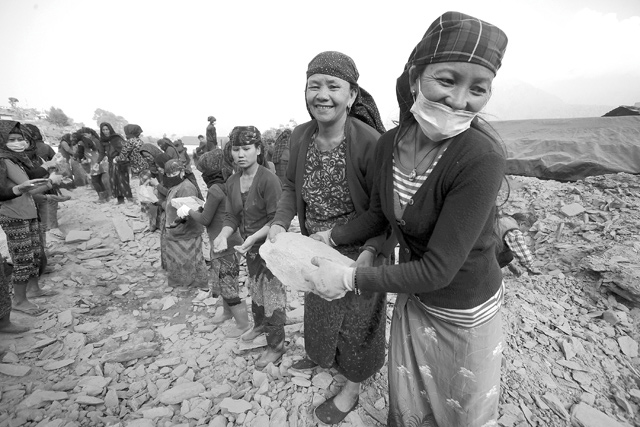
How soon the earthquake has been forgotten, and the country has drifted back to politics as usual. The constitution is finally taking shape, but the attempt by the four top parties to ram through boundaries of six provinces in the draft last week set off a political earthquake. Aftershocks are still being felt, especially in western Nepal.
The delineation of boundaries was ad hoc, haphazard and arbitrary. If this is what we had to fight and die for in a ten-year war and suffer another decade of peace, then we might as well just have stuck to the five north-south development zones and devolved political power to them. We would have saved 17,000 Nepali lives, time, money, and a lot of heartache.
However, the 25 April earthquake did give Nepal’s politics a mighty jolt and woke up our rulers from their slumber. The public’s disillusionment with politicians was so great they had to try to hurriedly pass the constitution and use that as an excuse for regime change. Hence the 16-point accord. The opposition, including Pushpa Kamal Dahal of the UCPN(M) and Bijay Gachhadar of the MJF(L), are so desperate to get on board the unity government that they are trying their best to quickly quell the anger in the west and the grievances of the Tharu people to move ahead with the constitution.
Since the government of Prime Minister Sushil Koirala is not known for multi-tasking what has fallen by the wayside in all this is the formation of the Reconstruction Authority and the delay in the appointment of its head. The lives and livelihoods of three million people in 14 districts affected by the earthquake depend on it.
As our coverage graphically illustrates nearly 2,000 widows are still waiting for help four months after the quake. More than two million people are living in tents and tin shelters. Two months after successfully concluding the International Conference on Nepal’s Reconstruction (ICNR) and getting a pledge of $4.4 billion, the government has gone back to sleep.
The appointment of the CEO to the Reconstruction Authority has been deadlocked because of a tussle between the ruling NC and the UML over their party candidates – obviously because the agency’s head has ministerial rank, a powerful mandate and control over a huge budget. Nothing new after all. But it is costing us our recovery.
As our analysis shows, the earthquake was stark proof of our lack of disaster preparedness, which in turn was a result of political and governance failure over the past ten years. We were fortunate that the earthquake spared much of the densely-populated areas of Central Nepal the catastrophic destruction that seismologists had been predicting. But better readiness would have saved many of the lives that were lost.