
Timeline by Ayesha Shakya
The Battle of Sari Bair was the last major offensive of the Gallipoli campaign. By now around 25,000 casualties had been suffered by the Allied forces alone, and none of the main objectives had been achieved. The general assault on the peninsula had failed.
On 15 August 1915, Hamilton finally sacked Stopford and a number of division and brigade commanders. The command of IX Corps was given to Major-General Beauvoir De Lisle, commander of the 29th Division until Lieutenant-General Julian Byng could travel from France to assume command. In all, three new generals were brought in from the Western Front to revitalise the dispirited command. The generals still did not recognise the full extent of the disaster for which they were largely responsible, although Hamilton, uncharacteristically, now admitted that the Turks had the ‘moral ascendancy’ and asked for 45,000 reinforcements to bring his existing force up to strength and a further 50,000 as fresh divisions.
Even in London, doubts were now being expressed about the Dardanelles ‘expedition’. But fighting continued throughout the second part of August. The Allies continued to attack the hills and ridges, against stiff Ottoman opposition and continued to suffer both the incompetence of their leaders and heavy casualties. Cox’s Indian Brigade, with its Gurkha battalions, for example, was now only 1,500 men strong.
As the shape of the new front line firmed, Hamilton planned one further attack to try to link the Suvla landing to Anzac. This required the capture of a group of hills: Scimitar Hill and the ‘W’ Hills from Suvla, and Hill 60 from the new Anzac sector. The attacks were to commence on 21 August. At Suvla, de Lisle had the 29th Division and the 2nd Mounted Division which had been moved to Suvla as additional reinforcements.The 29th Division was to attack Scimitar Hill while the 11th Division was to take the W Hills on the south of the Anafarta Spur. The 2nd Mounted Division was in reserve near Lala Baba on the far side of the salt lake.
Scimitar Hill was captured briefly, but the attackers were driven off or killed by the defensive fire from the Ottoman troops, who dug in higher up the spur.
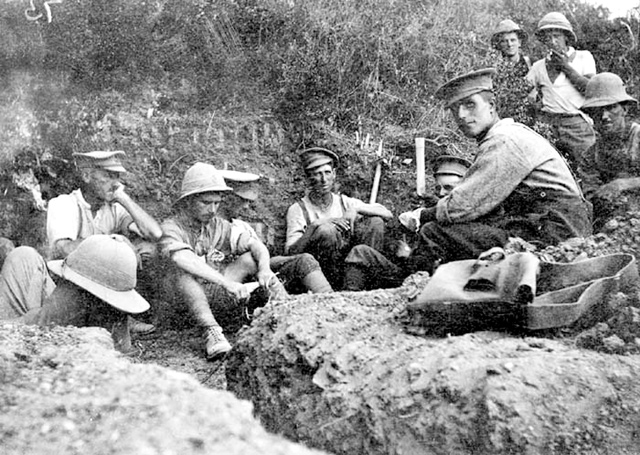
Furthermore, the undergrowth ignited in the August heat as a result of flying sparks, bursting into flame and burning many of the wounded. The 2nd Mounted Division were then called to join in the assault and advanced, marching in extended formation, straight across the salt lake, under fire the whole way. For a second time the hill was captured, briefly, before being lost for a second and final time. The attack of the 11th Division towards the W Hills was also held up by strong Ottoman defences.
By 20 August, after the Battle of Scimitar Hill, in which 5,300 casualties were suffered among the 14,300 troops who took part on the Allied side, the British commanders began to turn their attention to consolidating their meagre gains. The attack on Hill 60, which began in the afternoon of 21 August, went on for more than a week. This was the last battle of the Gallipoli campaign and is described by Carlyon as being ‘as heroic and pathetic as any battle of Gallipoli’. The Indian Brigade was involved in this last futile assault.