
9 August 1915
The plan of the attack, as concocted by General Godley, had involved numerous other battalions, and a brigade of four battalions under Brigadier General A H Baldwin now set out to reinforce the forward unit of Gurkhas pinned down below the summit of Hill Q, but again the guides lost their way and this force failed to advance very far. Baldwin’s column was still a long way from the crest whence they should even now have been sweeping along the whole ridge of the mountain. And instead of Baldwin’s support came suddenly a salvo of heavy shells. So, when the naval barrage designed to wreak havoc on the Ottoman positions lifted at 5.20 am on 9 August, only survivors of the first advance were able to make an assault on the hill top.
These were: the 1/6th Gurkhas, the North Staffs, the Warwicks, the South Lancs, the 1/5th Gurkhas, which had managed to join the others, and a Maori battalion – all much reduced in strength by now. They now launched their attack. John North, in his book Gallipoli: the Fading Vision, comments that ‘the lonely advance of the British and Gurkha skirmishers to the crest of the ridge when the battle was already lost must always remain one of the most gallant episodes in the whole campaign’.
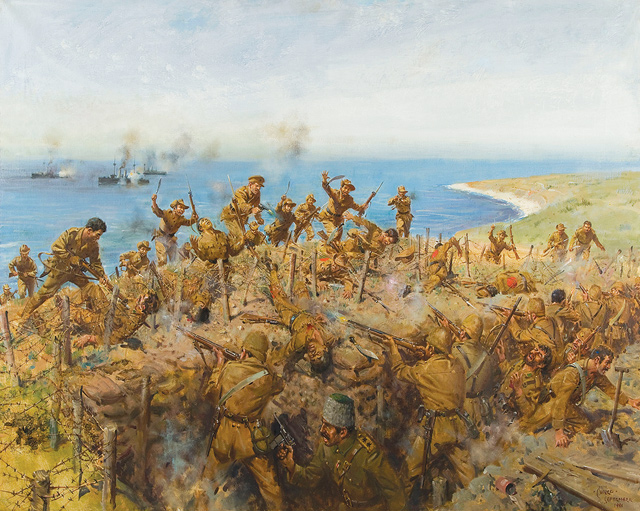
Major Allanson of the 1/6th Gurkhas recorded, after the barrage ended:
‘I had my watch out, 5.15. I never saw such artillery preparation; the trenches were being torn to pieces; the accuracy was marvellous, as we were just below. At 5.18 it had not stopped and I wondered if my watch was wrong. At 5.20, silence; I waited three minutes to be certain, great as the risk was. Then off we dashed, all hand in hand, a most perfect advance, and a wonderful sight. At the top we met the Turks; Le Marchand was down, a bayonet through the heart. I got one through the leg, and then for about what appeared to be ten minutes we fought hand to hand, we bit and fisted, and used rifles and pistols as clubs. And then the Turks turned and fled and I felt a very proud man; the key of the whole peninsula was ours, and our losses had not been so very great for such a result. Below I saw the Straits, motors and wheeled transport, on the roads leading to Achi Baba.’
The Gurkhas succeeded in driving the enemy off the hill and for about 15 minutes occupied the crest, preparing a gap for General Baldwin’s column of four battalions to exploit. But the reinforcements – Baldwin’s four battalions – never came. And as the 1/6th advanced towards Sari Bair and Maidos from where one can see a large stretch of the Dardanelles, suddenly when they were about 300 feet down, they were shelled. Allanson believed it was the Royal Navy, mistaking them for the enemy, although that has been contested.
He recalled:
‘As I looked round I saw that we were not being supported and thought I could help best by going after those who had retreated in front of us. We dashed down towards Maidos but only got about 200 feet down when suddenly our own Navy put six twelve inch shells into us and all was terrible confusion. It was a deplorable disaster; we were obviously mistaken for Turks and we had to go back. The first (of the shells) hit a Gurkha in the face … the place was a mass of blood and limbs and screams, and we all flew back to the summit and our old position just below.’
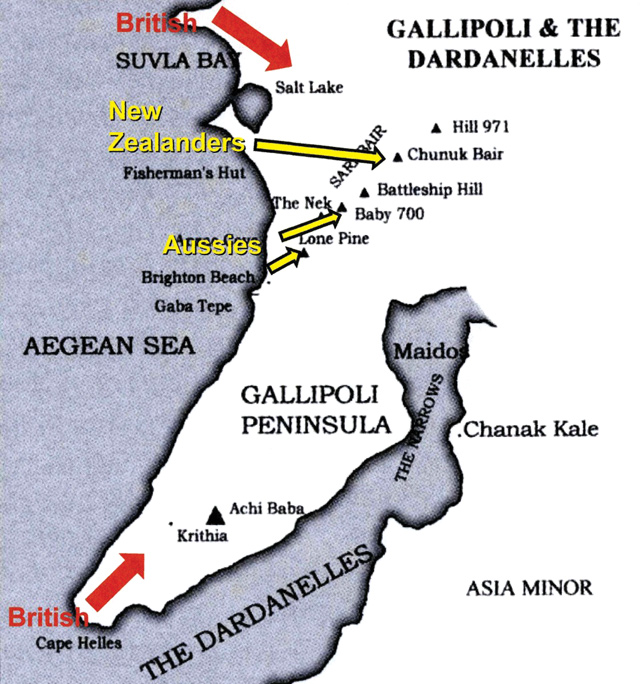
This, combined with heavy fire from the direction of Abdel Rehman Bair and an Ottoman counter-attack, drove them from the summit. The position won at such cost after three nights and two days of fighting was lost, never to be regained. They were obliged to retreat to their earlier position of the night before, below the crest of the Hill. For the whole of the following day, the Gurkhas and the British troops were marooned on the rocks below the peak, under the baking sun with no water and running low on ammunition. The wounded, of whom there were many including Allanson himself, were in a parlous state. Allanson and all the British officers except one having been either badly wounded or killed, it was Subedar Major Gambir Singh Pun who effectively commanded the battalion, together with the Medical Officer Capt Phipson.