

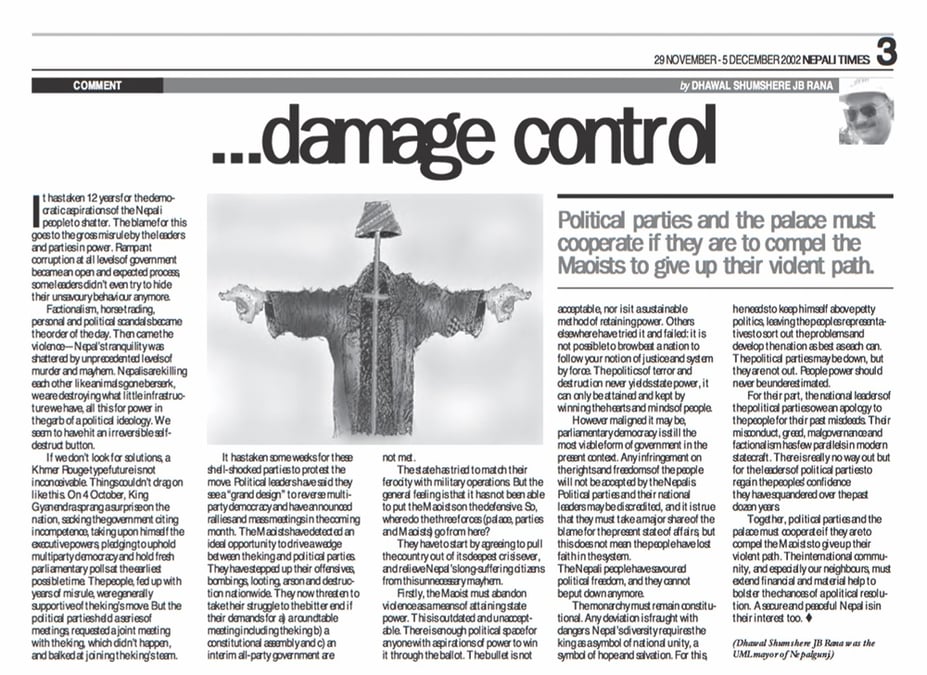
Back in 2002, king Gyanendra dismissed Prime Minister Sher Bahadur Deuba and consolidated his power saying Deuba was unable to hold local elections and bring the rebels to round-table negotiations. The Maoist insurgency was still at its peak and the palace massacre had just decimated the royal family.
Writing for Nepali Times, columnist Dhawal Shumshere JB Rana, the newly elected MP from the RPP in Banke-2, said that the political parties and the palace must cooperate if they are to compel the Maoists to give up their violent ways.
Six years later the monarchy was abolished. Now, two decades on, Nepal is forming the second government under the federal structure but true devolution remains as elusive as ever.
Excerpt of the report published 20 years ago this week in issue #121 29 November – 5 December 2022:
It has taken 12 years for the democratic aspirations of the Nepali people to shatter. The blame for this goes to the gross misrule by the leaders and parties in power. Rampant corruption at all levels of government became an open and expected process, some leaders didn’t even try to hide their unsavoury behaviour anymore.
Factionalism, horse-trading, personal and political scandals became the order of the day. Then came the violence–Nepal’s tranquility was shattered by unprecedented levels of murder and mayhem. Nepalis are killing each other like animals gone berserk, we are destroying what little infrastructure we have, all this for power in the garb of a political ideology.
If we don’t look for solutions, a Khmer Rouge-type future is not inconceivable. Things couldn’t drag on like this. On 4 October, King Gyanendra sprang a surprise on the nation, sacking the government citing incompetence, taking upon himself the executive powers, pledging to uphold multiparty democracy and hold fresh parliamentary polls at the earliest possible time. Political leaders have said they see a “grand design” to reverse multi-party democracy and have announced rallies and mass meetings in the coming month. The Maoists have detected an ideal opportunity to drive a wedge between the king and political parties.
From archive material of Nepali Times of the past 20 years, site search: nepalitimes.com