
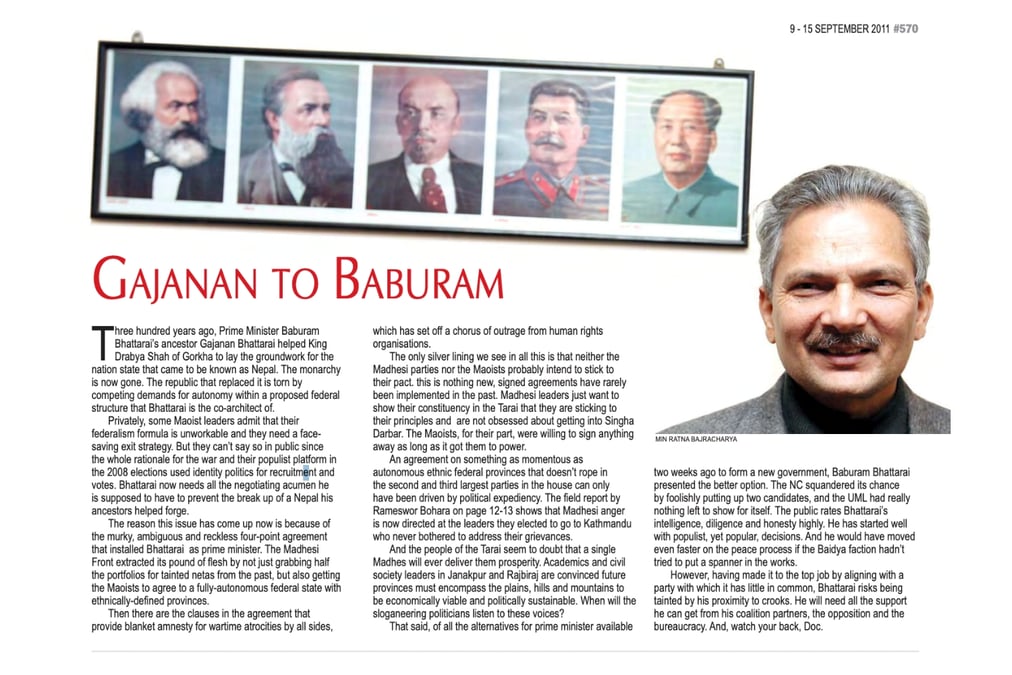
Chief Maoist ideologue Baburam Bhattarai was elected Prime Minister on 29 August 2011 as the leader of the Maoist party which got the Madhesi Alliance vote to reach a majority in Parliament through a controversial four-point agreement. This promised half the ministerial portfolios to the Alliance, declaring general amnesty for wartime atrocities, and a federal state with ethnic provinces that would be fully autonomous.
The editorial in #570, titled ‘Gajanan to Baburam’ (right), referred to Bhattarai’s ancestor who had helped King Drabya Shah to lay the foundations for what came to become the Kingdom of Nepal.
The piece pointed out that all the elements of the agreement were unlikely to be implemented as it did not involve the NC or the UML, and that Madhesi leaders were only trying to prove to their voters that they were sticking to their principles of a Madhes state.
The general feeling was one of optimism though, because Bhattarai, despite risking ‘being tainted by his proximity to crooks’ (as a reporter commented) was seen as an intelligent leader with a PhD and integrity. He worked 20-hour days in Singha Darbar, flew economy when he travelled to New York, and rode a Made in Nepal Mustang jeep. Some liked what they saw, others saw it as a publicity stunt.
Diwakar Chhetri’s front-page toon in #569 showed Bhattarai seething in his Mustang as it was stripped for parts by Madhesi leaders who grabbed the seats, steering wheel, and wheels.
Dewan Rai’s ‘Getting Down to Business’ featured ‘The Doctor’s Checklist’, detailing the delicate political balancing act Baburam had to play with the Madhesi Alliance, NC and UML, and within his own party, plus the Herculean tasks of completing the peace process within 45 days and making progress on the constitution.