
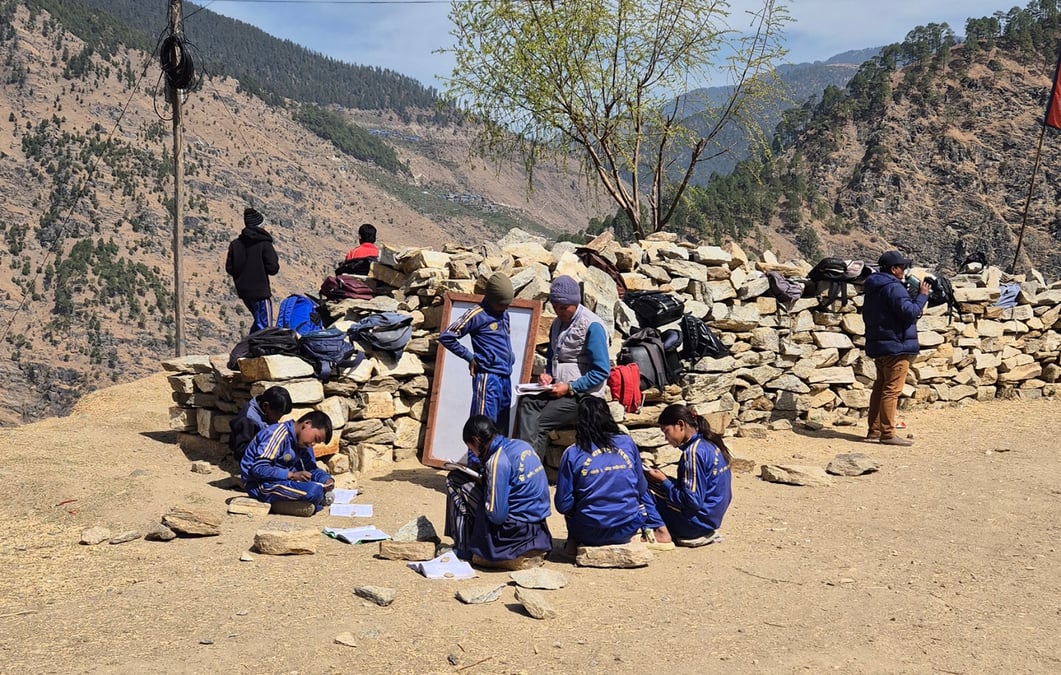
On a freezing recent morning in Kalikot district, the classroom is too cold to be in. So the teacher moves the lesson outside, into a small patch of sunlight against the school wall (pictured, above).
Twenty children huddle close together on the dirt. There are no materials to pass around, no charts on the walls inside, no books. The teacher recites, the children repeat. The teacher writes on the board, the children copy.
This is what learning looks like in some of Nepal’s most underserved communities. It is not cruelty, it is just the only instruction method anyone has ever shown the teachers in the remote mountains.
So, when the new RSP government’s Education Minister announced last month that written exams from Grades 1-5 would be done away with, I felt both relief and caution.
Relief, because those exams never measured what mattered. Caution, because the teachers are just not prepared.
The old system was broken, it had to go. Exams that reward rote memorisation do not measure retention. Nepal’s students deserve better than that.
However, the question is not whether we should move away from exams, but if we have built anything reliable to replace them with.
In 2024, we conducted diagnostic assessments in four schools in Kalikot. This was a low-pressure exercise so children would not be frightened.
The results were stark. Around 80% of students from Grades 2-6 in these remote mountains could not demonstrate basic literacy in either Nepali or English.
About 85% could not complete basic numeracy exercises. Dalit students failed at the highest rates. The children had not been idle in class, they had attended school, sat through lessons, and been marked present.
The system had recorded them as students. But they had not learnt much.
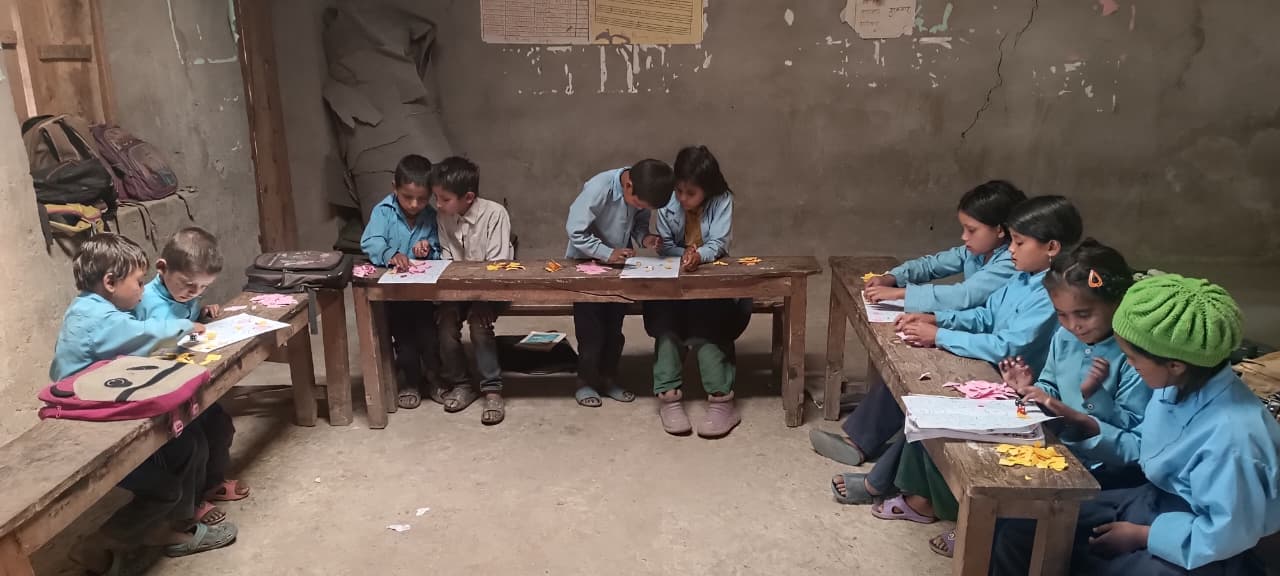
INVISIBLE FAILURE
This is what invisible failure looks like. The parents are mostly illiterate, and have no tools to question what their children are, or are not, learning. Teachers may be committed, but lack the training to assess anything beyond rote recall.
Some do not want their own shortcomings exposed, so assessments are soft, marks are generous, and sometimes teachers quietly help students through the very exams meant to assess them.
The result is a system that produces passes on paper and learning gaps in life. But removing the exam does not solve this problem. Without even the weak signal of a written test, the gaps become harder to see. Continuous assessment by teachers sounds wise in theory, but try to visualise that in a bare classroom in Kalikot with 20 children, and teachers with no regular training, no external oversight.
On paper, there is assessment. In the child’s mind, the foundations of reading and arithmetic may be missing, and no one will know until it is too late to fix.
I grew up in Kathmandu where the school calendar revolved entirely around exams: quarterly, monthly, weekly. I memorised, cheated, and chased marks, never once pausing to ask what I was actually supposed to be learning.
That system failed me in its own way, but it produced a visible number, however hollow, that at least told someone, somewhere, whether a child had passed or not. The reform must replace that indicator with something more honest, not simply remove it and move on.
What should concern us most is inequality. Nepal’s better-resourced schools, urban, private, better-staffed, will find ways to adapt. In Kalikot, Rukum, or the Tarai, reform lands differently. Teachers there have themselves started from a disadvantaged position.
Many schools do not even open the government-mandated minimum of 180 school days. When someone in the village dies, the classes are off. No exam reform, and no replacement assessment, changes any of that on its own.
A child I met in one of these schools told me she wanted to become a nurse. I asked her why. She said a nurse had once saved her mother’s life, and she wanted to do that for others. That child’s dream does not need an exam, it needs a system that takes her learning seriously enough to actually measure it, honestly, regularly, in ways her teacher can act on and her community can understand.
Nepal does not need to go back to 100-mark final exams. But it cannot afford to replace them with nothing but good intentions. The government’s no-exam reform needs to arrive in Kalikot with simple, standard tools that teachers can use to check whether a child can read a paragraph or solve a basic sum.
It needs training that builds teacher capacity from the ground up, not one-off workshops, but sustained support. It needs a monitoring system that lets municipalities and provinces see what is actually happening in classrooms so that when a student cannot read, someone is accountable.
And it needs parents, even illiterate ones, brought into the conversation so that what happens inside the school gate is no longer invisible to the families it is supposed to serve. The exams may be gone, but the harder work has just begun.
Shalav Rana has worked in community development and education support across Nepal for over two decades, including in Karnali Province.