
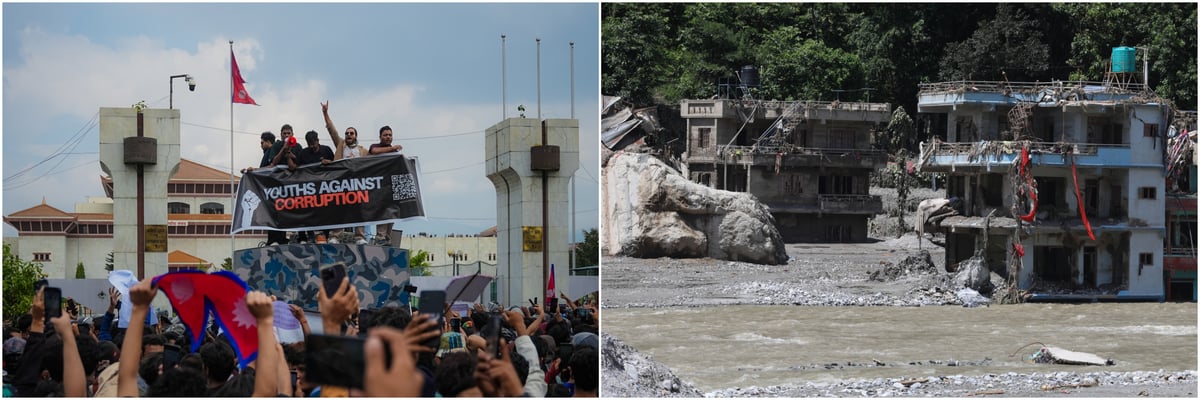
Its sheer scale may have been a shock, but the Trisuli Disaster last week was not unexpected. Climatologists and seismologists have been warning of such calamities for decades. But an accountable and open government can prevent a disaster such as this from turning into a catastrophe.
After a week of intense glare, the international media spotlight is already moved elsewhere. Officials pandering to demands from foreign reporters for access will now have to deal with questions from the domestic press about swift and equitable relief distribution, temporary shelters, education and health needs of the displaced, and longer term rehabilitation.
But the aftermath of this flood coincides with the first anniversary of the 8-9 September 2025 GenZ movement and the regime change that it brought about after the election in March. Six months into office, Prime Minister Balendra Shah’s government has to deal with a disaster that presents an even greater humanitarian and economic challenge than the 2015 earthquake. This calamity would be a challenge even for countries well prepared to handle disasters.
This anniversary would have been a time to look into who was responsible for turning what was a peaceful rally against corruption into a massacre of 19 students outside Parliament on 8 September, and the deadly arson and mayhem that followed the next day. It would have been a time to take stock of the performance of the RSP government six months after it was elected to power with a massive mandate.
But all that has to be set aside for now. Nepal is a disaster-prone country, that is a given. Being relatively new in national government, the RSP has been heaped with an enormous challenge, and how it deals with the needs of the neediest now will be its biggest test.
The management of casualties, finding and identifying bodies needs urgency. The stench along the Trisuli is an overpowering proof of that. Local government need help providing food, water, clothes, cooking material for those in temporary shelters. The national government can then turn its attention to long-term rehabilitation and reviving the economy of this energy, trade and tourism corridor.
At least 12 operational and under-construction hydropower plants with a combined generation capacity of 753MW have been destroyed (page 4-5). Aside from the hundreds still trapped in tunnels and powerhouses along the river, loss from hydropower projects alone is estimated at $3 billion. More than 40 bridges, 40 km of highways, 69 schools and numerous health posts have been destroyed. Nearly 19,000 children will need temporary learning centres.
Although climate breakdown and global heating may have been the trigger for this disaster, the question that will have to be asked is why the death toll is so high. And the answer lies in the lack of zoning laws to prevent unregulated settlement along vulnerable floodplains. Infrastructure plans for hydros and roads did not take into account climate impact on an already fragile mountain range.
Once the emergency search, rescue and rehabilitation has been addressed, the new government has to work with local governments to prevent densely-populated settlements along river banks. But this has to be done with the sensitivity that was lacking in the mass evictions of squatters under the Prime Minister’s orders in Kathmandu in April.
Building cascade hydropower plants on a single river basin is an obsolete concept. Projects need to be decentralised to spread the risk from future floods, they should be more but smaller plants, and the energy source must be diversified. This is self-evident for a multi-hazard country with the co-risk of seismicity and climate change.
It is all well and good for the government to demand reparations from the UN’s Loss and Damage Fund, but it is unlikely to materialise with the speed and amount that Nepal needs right away. We are on this on our own, and the test will be in how well we act on moving people and plants out of harm’s way before another disaster on a glacier-fed river.
Prime Minister Balendra Shah appeared in Parliament for the first time since the floods a week ago, an outing which would not have been possible if not for the disaster itself. He read out a short briefing detailing rescue and relief efforts. At a time of great national emergency like this, it would have been reassuring for a country’s leader to speak directly and often to the people.
Before the floods, the government despite its popularity on social media was under increasing scrutiny for its high-handed and opaque decision-making, with the PMO and the ministries working at cross purposes. It was as if the spirit of the GenZ movement was forgotten once the leaders it installed got to power.
Even now, there have been insensitive and unhelpful remarks by ministers about local governments. This is no time for blame game, elected representatives at municipality and ward levels are closest to the people, they are the first responders in a disaster and have the local knowledge to help in rescue and rehab. Sidelining them for political reasons is not the way to go at a time like this.
Twelve years ago was a 7.8M earthquake, 2024 was the Kosi Flood, last year it was the violence and destruction of 8-9 September. It is always one battle after another as Nepal lurches from one crisis to the next. This is a chance for the RSP to actually prove that it is different from those it replaced.
Sonia Awale