

Kanchi is a young woman full of vitality and humour. She speaks, on repeat, of her desire to soar across the sky. To leave. Her admirer and potential lover reminds her that a real world exists outside of that dream.
Kanchi is Everywoman. She is a backstage character in the newly-released movie एक मुठ्ठी बादल (My Share of Sky) written and directed by Sahara Sharma and produced by Gaunthali Entertainment and Mana Production.
But Kanchi (Asmita Gautam) represents more than what meets the eye. Every woman imagines and desires, as she lives through the mundane.
The film opens with the allegory of the woman wading deeper and deeper into water in an attempt to pluck the flower of Pompeii. The flower becomes a symbol, a conceit that threads through the complex lives of the female characters in the film.
The story spans across two days in the lives of a middle-class Nepali family, as they prepare for the wedding of the second daughter Maili (Anchal Sharma). The celebrations are interrupted by an incident that brings challenges to the fore. As the family reunites, monsters bottled up inside each of its members make cameo appearances.
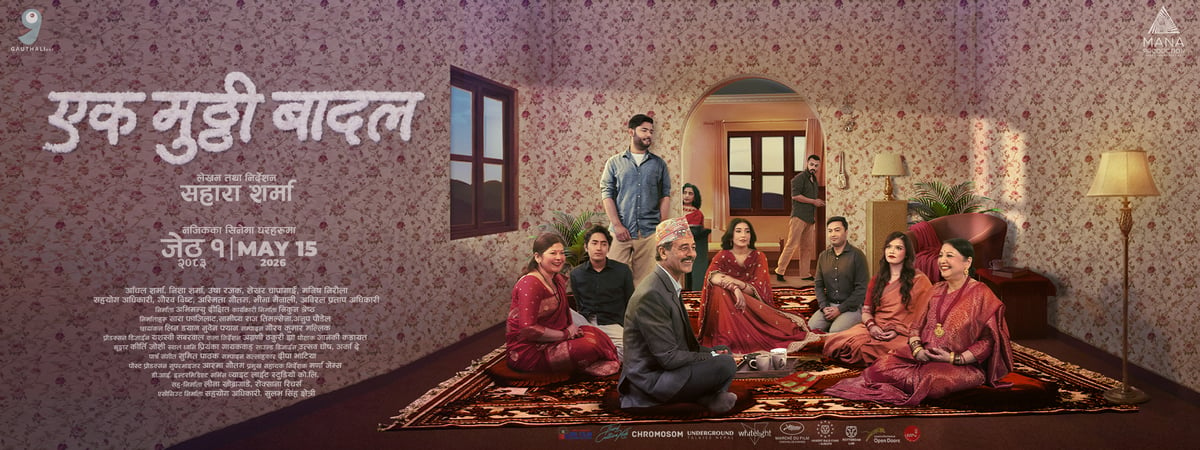
The film’s poster illustrated a pre-wedding scene in a household, and I wondered if it would be something like Monsoon Wedding or an opulent Karan Johar-style celebration. Given my lack of familiarity with Sharma’s debut film, Chasing Rainbows, I was wrong. And gladly so. There’s no opulence here, but middle class realities, where weddings are an occasion to splurge even if everyday life is about making ends meet.
The mother (Nisha Sharma) appears as benign as any maternal figure at first. As the story progresses, we see that she is human and flawed and has sides to her personality that can make the onlooker uncomfortable.
As a snake (which doesn’t appear in the frame) slithers away in the road scene, she watches on on the brink of a smile. There’s a hint of eeriness there, also seen in some other scenes.
The younger actors appear convincing in their roles. Abiral P Adhikari delivers a believable performance as the younger brother, while Usha Rajak is persuasive as Jethi, the elder daughter.
But it is Nisha Sharma who seems to carry the weight of theatre that most Nepali actors transitioning into cinema often bear. Even in the mundanely portrayed but important mother-daughter smoking scene, Maili comes across as the more effortless actor.
She shakes her leg nervously at one point during the conversation and then touches her knee lightly with her hand to keep it from shaking. It appears like an improvised scene and will likely go unnoticed in the larger scheme of things, but it speaks for itself.
Kanchi’s character, despite being interesting, and with the potential for a sub-plot, drops abruptly. But a loss like this is salvaged by some surreal scenes set in liminal spaces.
Jethi sets out in the night to search for her husband, and ends up at a hospital which serves as a portal to another world, like a utopia for nursing mothers, who are also casually playing cards. Woven in mythical lore, it is a scene of intrigue.
Another surreal moment unfolds in the toilet, where Maili, going through the rollercoaster of emotions, meets a bride. My personal wish was for the film to have ended with the toilet scene, where we see Maili looking up at a fragment of sky—one of the most striking shots, captured by Linh Dan Nguyen Phan. The film has some arresting frames that evoke the spirit of great cinema from the past.
There are intimate moments, treated intimately. When Jethi touches her breasts to prepare to breastfeed, but ends up caressing herself, it is not stimulation but a woman seeking comfort. The gaze is not sexual, and therefore refreshing.
This female gaze is also reinforced in the song,
, by Shreya Rai, background score as Maili says a private goodbye to her parents’ home, which she will soon leave as a bride. The lyrics and the music are both heavy, bitter-sweet and steeped in longing. This is the song that stays with us, even though is the more popular and catchy number from the film.एक मुठ्ठी बादल is likely among the first few Nepali films that boasts of a women-led international co-production, with a majority female cast and crew. For that reason alone, this film deserves to be seen by Nepali women (as well as those who do not identify as women), if only to witness how representation and perspective can shift and how stories need not always be larger than life. They can remain grounded in the scarcity, desire and contradictions of middle-class existence.
“I hope the audience leave the film feeling witnessed rather than pitied. I want them to carry away the realisation that their interior life is not a private failing, but a shared and legitimate world,” says Sahara.
The backstory of the father comes to us in snatches and so does those of the mother, the driver, the son-in-law and others. None of them become fully fleshed out. And so, it makes sense that the characters go by familial names, rather than official. Not even the wedding poster names the bride and the groom. They exist as social symbols, rather than as individuals.
The film also gestures towards a deeper exploration of the mother-daughter relationship, but repeatedly retreats after getting too close, making some conversations seem facile. But there are moments of unexpected humour, again, teased out of the mundane.
The subtitles could be improved. Nepali subtitles do not appear in the monologue scene, where Maili suddenly switches to English, much like most city-bred, foreign-educated Nepali youth do.
The theme of hyperfocus on making marriages work and keeping societies whole, is not something the film tries to dispel. The fallacy persists and is carried forward in a gorgeous scene by the lake, where the nose pin comes into discussion again.
What is a nose pin, but a suggestion of beauty that symbolises the social status/caste of a woman as well as fertility? It is a way of proclaiming what a woman represents in the cycle of family life: the giver of life, the embodiment of beauty and the representation of where the men in her family stand in society.
The nose pin thus evolves into a sustained metaphor. It becomes the representation of what women do not necessarily desire but must learn to live with because it comes with a lure. Because that is how we have been raised—to learn to make peace with what cannot actually bring us peace.
Desire then, is a faint glow to be fanned gently but never to be stoked fully. And so one must remain and dream of skies and clouds and flowers. As Sahara says: “You are no longer even asking for the sky, but only for what you can hold in your hand, and even that dissolves.”
(एक मुठ्ठी बादल released in theatres across Nepal on 15 May)