
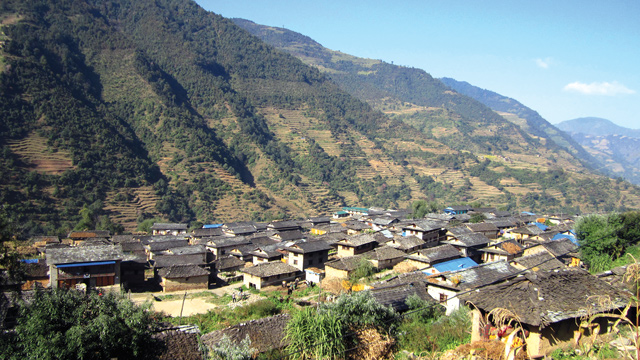
In May 1979, after a violent student movement, King Birendra agreed to hold a referendum on the monarchy. When staunch royalist Pashupati Shumsher Rana spoke in Thabang of Rolpa district during a nationwide pro-Panchayat campaign, village leader Barman Budha Magar told Rana to his face that they would vote against the absolute monarchy. Despite being charged with public offence, Magar went on to form a unanimous consensus in favour of democracy.
It’s that kind of anti-establishment psyche that gave this tiny hamlet the moniker ‘rebel village’. It has a 60-year history of rising up against the Kathmandu rulers, and was also the birthplace of the Maoist movement in the early 1990s.
Resham Kumar Shah, a local school teacher, says Thabang’s roots go even further back, before the unification of modern Nepal. “In 1869, when the rulers of Rukum came to collect taxes in Rolpa, Thabang people chased them away,” he says, “locals are proud of their rebel legacy.”
And when the village acts politically, whether to vote in or boycott elections, it is often unanimously. In 1959, when Nepal held its first parliamentary election, every citizen in Thabang voted for Khagu Lal Gurung, a communist candidate.
The next year, after King Mahendra dissolved Parliament, villagers boycotted elections. In 1981, during elections for the National Panchayat Council, instead of casting ballots, villagers replaced pictures of the king and queen with images of communist leaders like Marx, Engels and Lenin in local government offices.
Because of its proclivity towards rebellion, people in Thabang are also used to resisting security forces often sent in to quell ‘anti-system activities’. In October 1996, the government launched ‘Operation Romeo’ to nip the Maoist movement in the bud, but the failed operation in which police randomly barged into houses, destroyed food and raped women only radicalised villagers even more. “That really fuelled anti-establishment sentiment here,” recalls Shah.