
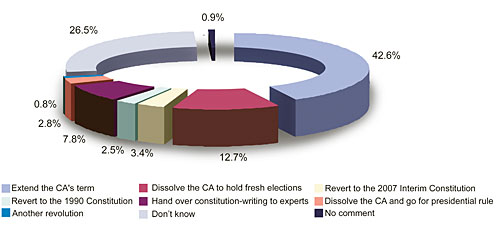
 What should be done if the Constituent Assembly (CA) is unable to complete writing the constitution by May 28? |
In early April, Himalmedia conducted the latest in its series of nationwide public opinion surveys. The poll team, overseen by professor of political science at Tribhuvan University, Krishna Khanal, interviewed 5,005 respondents in 38 districts. This included a one-day poll (7 April) in 28 urban areas to aim for accuracy in a fast-changing political scenario.
The intention was to gauge public opinion and measure the gap between what the majority of Nepali people want and the preoccupations of the political parties, the relative popularity of those parties, and the level of trust people have in political personalities.
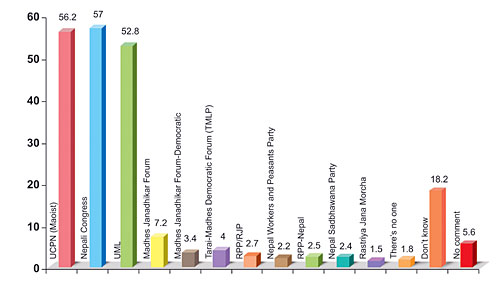 Which three parties would you choose to lead Nepal to prosperity? |
The most dramatic, but perhaps not surprising, outcome was how the public's trust in the political leadership has plummeted since the elections in 2008. To the question 'Since the demise of Girija Prasad Koirala, which political leaders do you trust to take the peace process forward and finish writing the constitution?', respondents most favoured Maoist leaders Pushpa Kamal Dahal and Baburam Bhattarai with 38.7% and 29.7% respectively. But apart from Madhav Kumar Nepal (23.4%) and Sher Bahadur Deuba (20%), no other leaders have really made an impression on the public, with 27.8% choosing 'don't know'.
The poll also sought answers to public perceptions of the Maoists. While they were seen to be most responsible for creating obstacles in the peace process (30.1%), 26.8% strongly believed they would renounce arms and violence for good and 40.7% had some belief this would be the case.
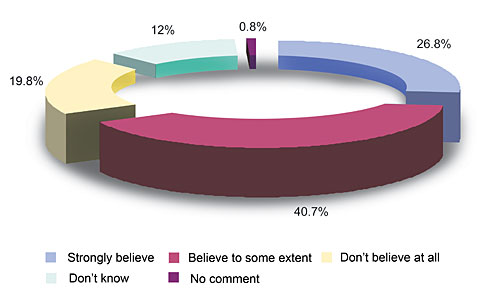 To what extent do you believe that the Maoists will permanently give up arms and violence and join the political mainstream? |
Most Nepalis expressed concern about the constitution not being written on time. About half blamed the CA members, 35.8% felt it was the government's fault and 31% said the Maoists were responsible. The most popular course of action was a constitutional amendment to extend the term of the CA (42.6%), followed by CA dissolution and fresh elections (12.7%). Most rejected presidential rule (2.8%) or a return to the 1990 constitution (2.5%). There was almost no support for a new uprising (0.8%).
To resolve the power-sharing deadlock, 24.4% favoured the Maoists leading a new coalition government while a further 20.7% favoured a UML or NC-led unity government including the Maoists. Only 16.4% wanted the Madhav Nepal government to continue, with negligible support for handing over power to the president (or the former king, for that matter).
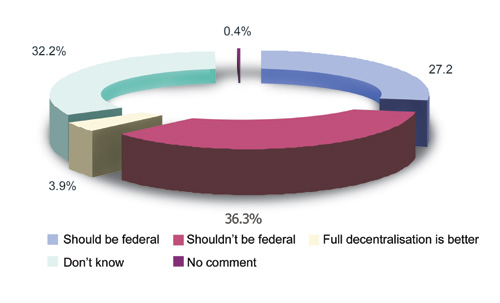 Nepal has been declared a federal state. What do you think? |
Respondents appeared to be almost equally divided in assessing the army chief affair of last year that led to the resignation of the Maoist-led government. Although 41.6% professed ignorance, 22.4% felt the president's move was correct, 19.9% thought the Maoists were right, and 14.8% thought both were wrong. Unsurprisingly, Tarai respondents were more supportive of the president's move.
Nearly a third of Nepalis don't know how to resolve the dispute over the assimilation and rehabilitation of Maoist guerrillas. A quarter said only those who met the military's criteria should be integrated into the national army, and 18.3% felt there should be wholesale integration into the army as the Maoists want.
In the future constitution, a majority (70.8%) wanted Nepali to be the language for official government business, although Nepali as lingua franca received 79.2% support in the hills (including indigenous groups) and 61.2% support in the Tarai.
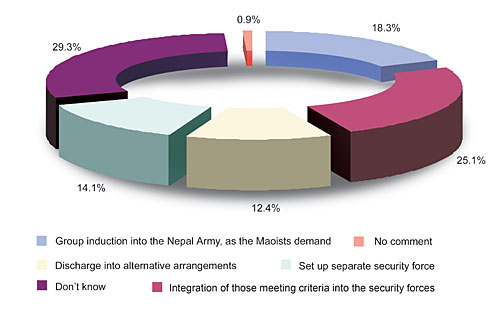 How should the Maoist combatants in the cantonments be managed? |
The country seems divided over federalism, with those against it making up 36.3% of respondents and those for it making up 27.2%. But 32.2% didn't know. Slightly more people in the Himal and Tarai were against federalism, including many from ethnic communities. If federalism is to go ahead, however, about equal numbers (25%) favour federalism along ethnic/linguistic and north-to-south territorial lines. Interestingly, 16.1% favour retaining the current development region or zonal system, which to a large extent is demarcated from north to south. The One Madhes proposal of the MJF, however, was opposed by 65% of respondents, although nearly half the respondents in the Tarai supported it.