The fifth edition of PhotoKTM has come to an end. The theme of the annual month-long festivity this year was the natural world with a focus on co-existence and nature. There were over 60 participating artists from 16 countries. One of them was Mónica Alcázar-Duarte, a Mexican-British multi-disciplinary visual artist whose work acknowledges her indigenous heritage while exploring current ideals of progress.
In 2022, Alcazar-Duart was awarded the Wayfinder Award from National Geographic, as well as a residency with Light Work through the Autograph Gallery in London. Her work has been exhibited and collected throughout Europe, Mexico and the United States in places such as the Museum of Modern Art in New York, Autograph Gallery in London and Wilhelm Hack Museum in Germany.
Alston D’Silva, an educator, critic and media scholar based in Kathmandu recently spoke to Alcazar-Duart about her recent PhotoKTM exhibition. Read the excerpts:
Alston D’Silva: In your earlier project Second Nature where you explored the biases in algorithmically generated representation of Mexican women, you have reflected that technology adopts language related to nature, “enabling it to sit comfortably in our minds”. More immediately in Ikamo-Tlalli (Earthless), your exhibition at PhotoKTM 5, you juxtapose an articulation of natural abundance with exploitation and extraction. Can you speak about your sustained engagement with this concept of the Anthropocene? How does the history of space exploration direct us into a trajectory of more climate altering activity? How does the site of your work, the island of Ascension, engage with the activation and suppression of indigenous knowledge and history?
Mónica Alcázar-Duarte: The case of Ascension Island, located in the South Atlantic Ocean, is particularly poignant when referring to notions of colonialism in science. It became an experiment for Charles Darwin, Kew Gardens (the Royal Botanic Gardens founded in 1840 that collected flora specimens) and the Royal Navy.
In 1836, during his second Beagle voyage through the Galapagos, Darwin briefly visited Ascension. He is quoted referring to the island as a cinder. In 1847 his friend and botanist Joseph Hooker, who would become Kew Gardens’ director, agreed to engage in the shipment of trees, plants and some animal species to the island. This was all possible thanks to the help of the Royal Navy.
This experiment, changing the island’s ecosystem, is the first terraforming action, a man-made ecosystem that was approximately 12 years in the making. Today the island has three different ecosystems: rainforest, a volcanic mountain range and a desert ecosystem, the rainforest being the main result of the terraforming process.
Ascension is used today as a reference for what could be achieved one day by a human colony on Mars. The cultural mythology around this kind of idea exists as an attempt to reduce the gap between the fantasy of Mars as a second home to humanity and the reality of it.
With Ikamo-Tlalli (Earthless) I seek to show how wide the gap is between the idea of bringing life as we have it now on Earth to Mars, and the reality of what this process would require. The balance of ecological systems as we have had them on Earth took 4.5 billion years to evolve. All the technology, ingenuity, and advancement of our civilisation will never catch up with natural processes such as this magnificent occurrence. But unfortunately, at this point in time we believe that we will become demi-gods and, in some corners, scientists are seriously considering ideas of geoengineering, terraforming, and so on. I see these approaches as the legacy of a certain attitude developed many years ago in which Nature is there to be probed, poked, and owned. As part of the colonial project that took place around the world, and that was enhanced by the Industrial Revolution, indigenous ideas of stewardship were supplanted by ideals of ownership and production, of efficiency and resources, towards Nature and our position within it.
Read also: Reliving analogue photography, Suman Nepali
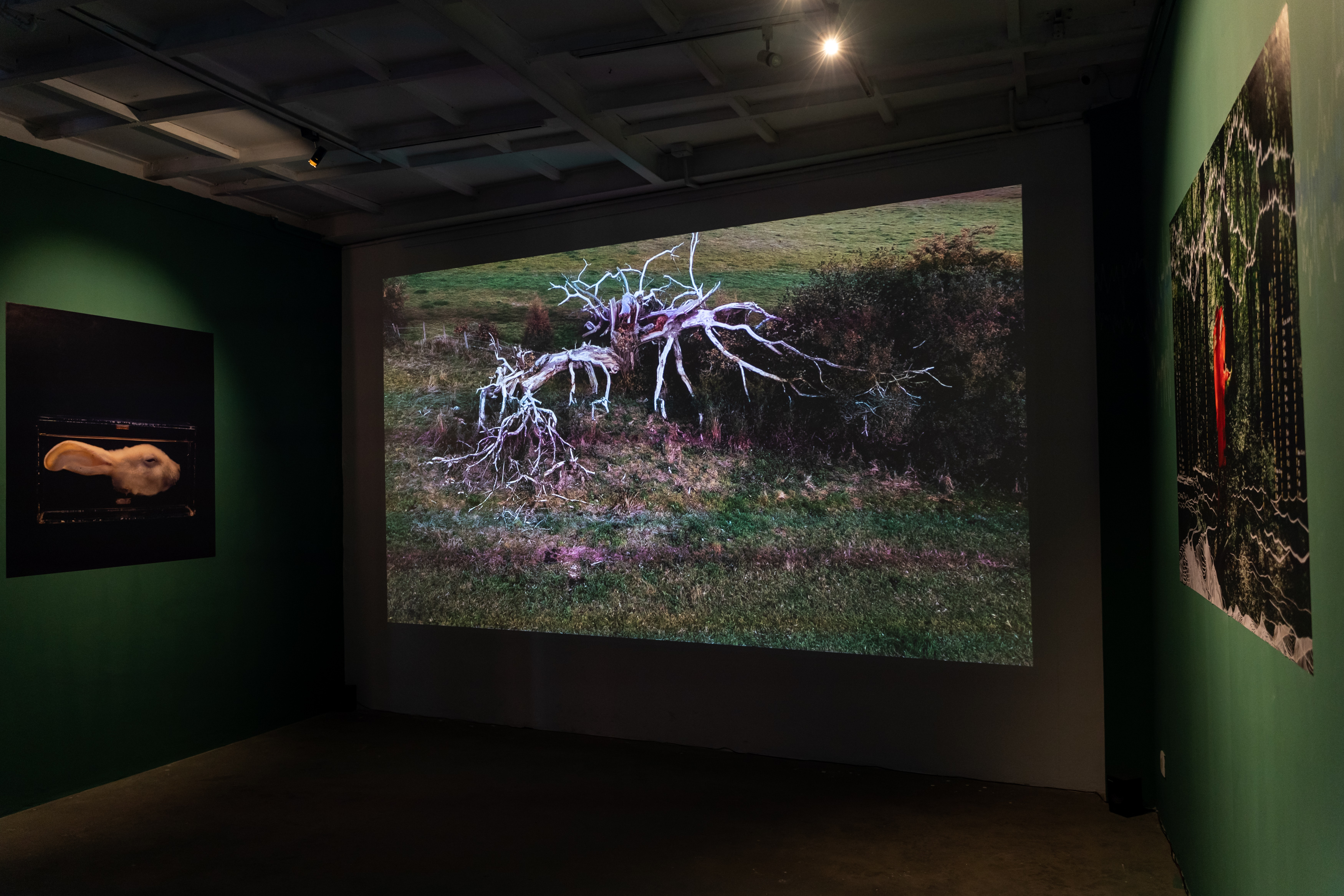
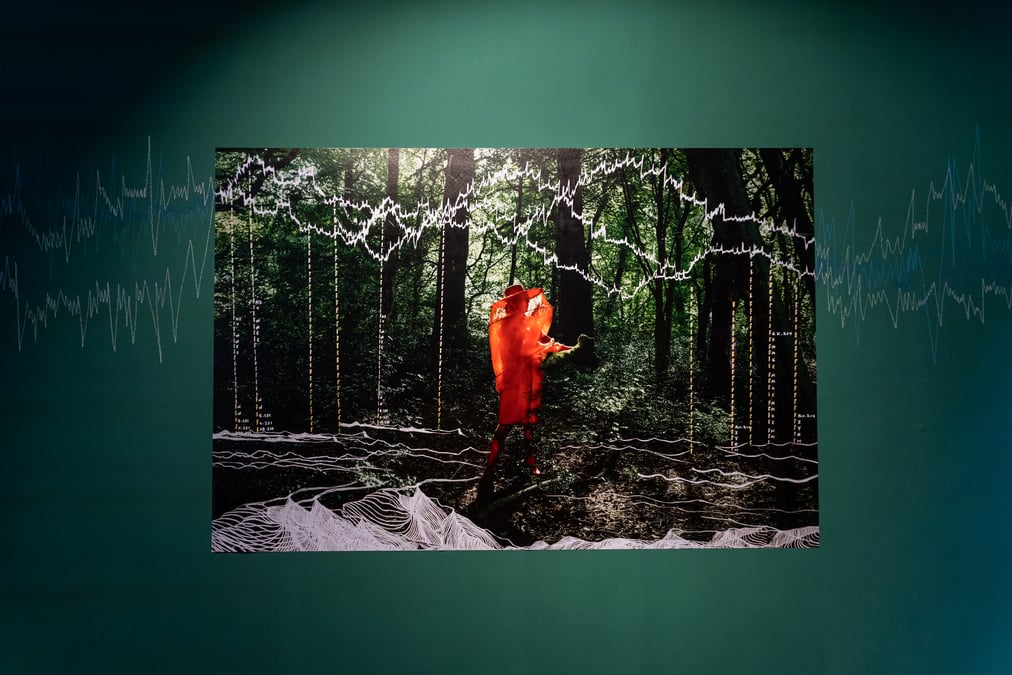
Your work assembles the output of myriad research methodologies—artistic, archival, algorithmic, among others. For instance, you include a reproduction of stock crashes generated by AI bots overlaid on a photograph of yourself in an apiary outfit, and across from it is a grim archival photograph of a decapitated animal head presumably from a natural history collection. How does your work engage with rational systems of knowledge production across time? These interventions appear less straightforward than outright rejection, as you appear to make space for technological imaginaries to converse with ancestral knowing and emancipatory impulses—minus capitalism. Is that an accurate characterisation of the intervention your work attempts? What strategies does your work suggest to bring forward indigeneity and ancestral knowledge into the din of scientific discourse and technological confabulation?
I think of my work as ‘work in progress’. The projects that I work on usually take years to develop. This is not only due to the amount of research that goes into the projects, but also because I acknowledge my evolving standpoint. I say this because I believe it is important to recognise that we don’t hold all the answers and that we are ‘in-process’ just as much as our work is.
Having stated this, early on when I started work on the space exploration project, I realised that it was going to take several years for the project to unfold. It was quite likely that technology would change and my point of view towards it all would evolve. As I said, I evolve as the work grows. This is not a lack of commitment to the ideas, or even to making a statement. It is more like a philosophy of what I would like to see as humility towards the seeking of knowledge.
In the case of the work shown during PhotoKTM, I decided to test the combination of themes that I have been working on since 2014. And one of these themes involves the use of language as a tool for decolonial thought. The use of Náhuatl (an indigenous language from the central part of México) comes at a time when I find out that my grandmother quite likely belonged to an indigenous community. I concluded this from a photograph she showed me, and a story she told me. The amount of denial I encountered in my family afterwards was what piqued my interest and prompted my now insatiable study of post-colonial and decolonial thought. This denial signalled something other than the question about my indigenous heritage. It indicated a legacy of erasure that has been internalised by us all in such a way that we think this is the order of things, this is the way things work. This disables any possibility for a different form of enquiry, or knowledge building, or shift in paradigms.
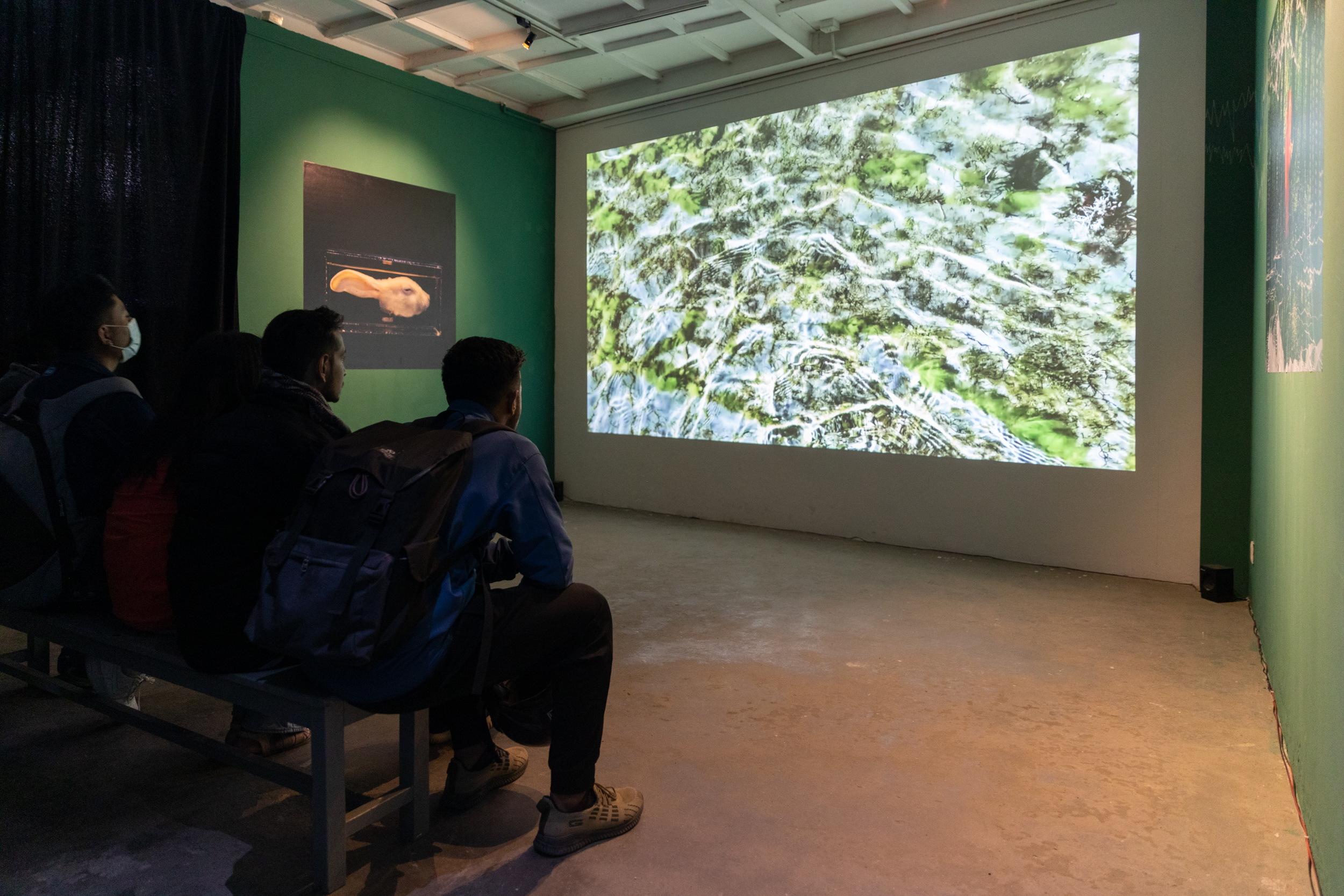
In my case, the needed paradigm shift relates to ecological thought. What I mean is, if we have English as the language of Science, and Science as the language of the future, any other mode of expression, investigation, assertion, is excluded and diminished. It is rendered ineffective and outdated. This becomes problematic at a moment in time in which we find ourselves struggling to see a way through ecological crisis, not quite understanding that what we need is a different series of imaginaries for the future. These imaginaries, as I am calling them, must emerge from a different way of being and an understanding of the natural world and our position in it. I do not want to pretend that I have an answer, but I am clear that we can’t remain inactive. I prefer to participate, take part in conversations, prompt questions and seek answers together. Making this type of work is part of a process of mourning what we have already lost and what is not coming back, like the little rabbit encased in formaldehyde and ethanol as a specimen of study in the installation part of PhotoKTM. But it is also my way of using the energy that mourning brings with it.