
“In dark times, will there also be singing? Yes, there will be singing, about the dark times.”
German playwright Bertolt Brecht’s words echoes and remains relevant, particularly in South Asia, as underscored by prominent artists at Resisting Together: Art and the Artist in South Asia, a recent online gathering.
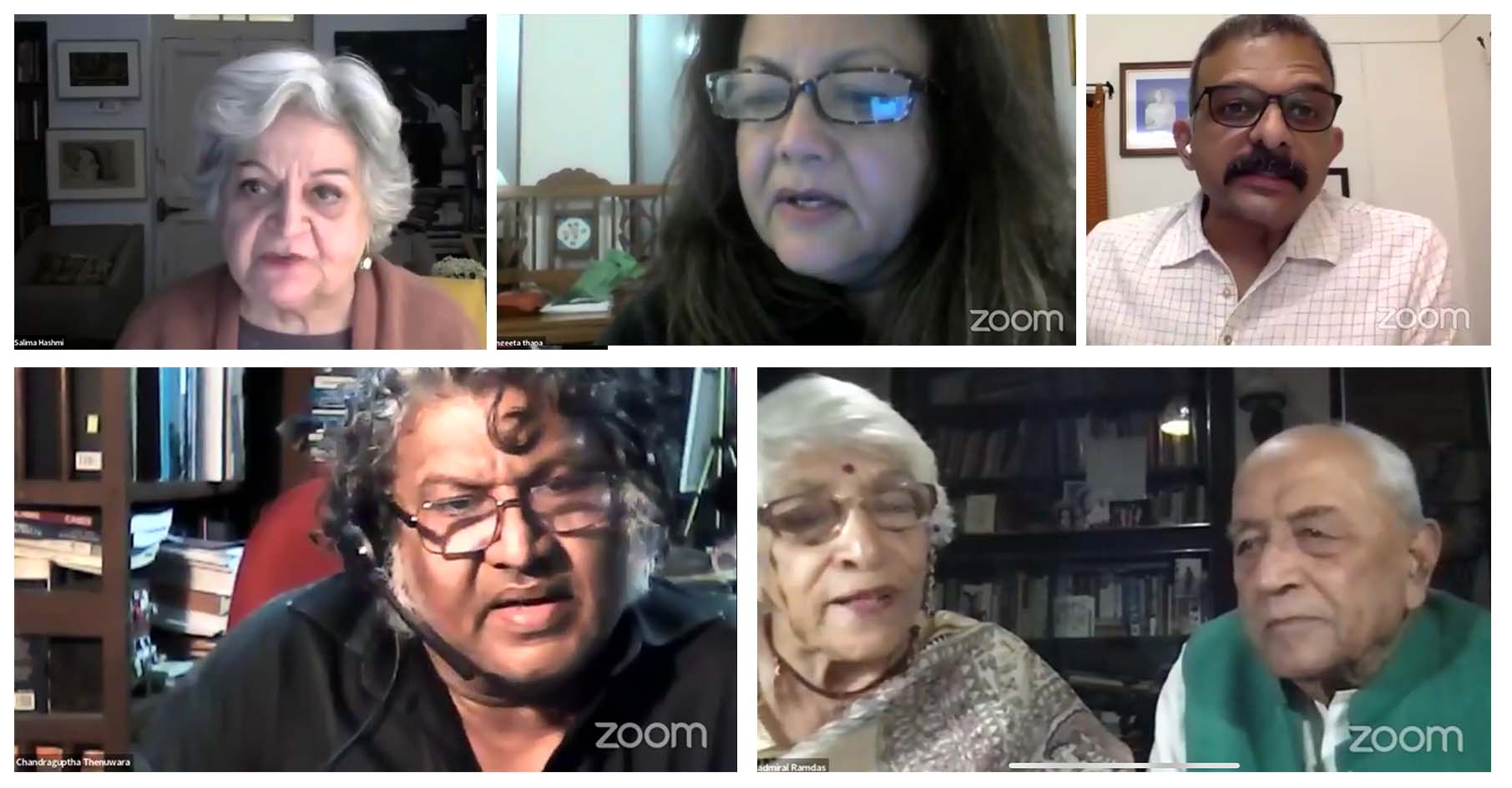
The discussion, organised by the South Asia Peace Action Network (Sapan) highlighted how the arts and resistance shape each other especially as the region’s regimes drift towards authoritarianism.
The deliberations highlighted how political turmoil and violence have catalysed creativity with many artists grounding their work in response to the challenges.
“There is an artist in each one of us,” asserted event host Kavita Srivastava, a human rights activist and feminist in Jaipur.
As revolutionary poet Faiz Ahmed Faiz once said about the artists’ role in time of turmoil: “Even though I run no state, I command no power, I am entitled to feel that I am my brother’s keeper, and my brother is my whole mankind.” said the well-known revolutionary poet Faiz Ahmed Faiz, talking about the role of the artist in resisting injustice.
Faiz felt closest to those who were “the insulted, the humiliated, homeless and the disinherited, the poor and the hungry and sick at heart.”
Faiz’s daughter, noted artist and educator Salima Hashmi shared his words during her presentation to the meeting. She demonstrated how art is not about a product, but engaging with and critiquing where we live, how we live and what we can do.
Her own evocative painting Poem for Zainab emerged in response to a horrific case of domestic violence in the 1990s in which a woman was violated by her cleric husband.
From Kathmandu, art curator Sangeeta Thapa of the Siddhartha Art Gallery said: “South Asia is an ancient culture but we are also new nations, and that comes with its own trials and tribulations. The Maoist insurgency was a time of great sorrow, but also marked the beginning of a new age of artivism and collaboration.”
The upcoming Kathmandu Triennale to be launched on 11 February aims to touch upon indigenous voices.
From Colombo, the Sri Lankan artist Chandraguptha Thenuwara said that Sri Lanka’s 30-year long civil war had physically ended, but many issues remained unsolved and questions remained unanswered.
He also spoke about the misuse of the International Covenant on Civil and Political Rights (ICCPR) Act to stifle freedom of expression. The struggle within the arts for a new language led to the establishment of the Heywood Institute, now the University of the Visual and Performing Arts. “Without changing mindsets, we can’t go forward”, he said. “Artists must respond to the politics of hate, religious extremism and militarisation.
Artist and cultural activist Lubna Marium in Dhaka talked about the difficulties of surviving as an artist “without ever subscribing to any political party or any regime”. She has been engaged in this struggle for 50 years in Bangladesh, where she runs one of the largest dance companies in the country.