
Kathmandu’s poor air quality has become so serious that with the onset of winter there is growing public outrage about its health implications.
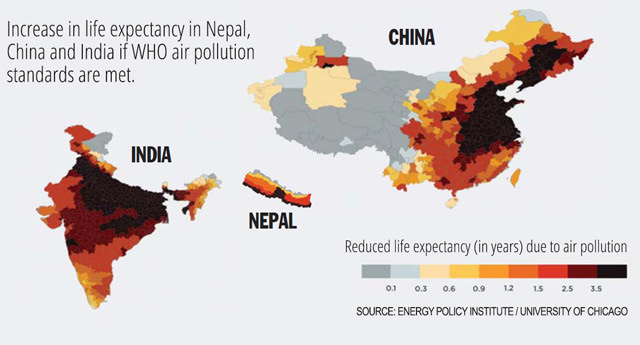
Findings released this week by the Energy Policy Institute at the University of Chicago add further proof that air pollution is emerging as the world’s single largest environmental health threat – and Asian countries are most at risk.
The study has mapped air pollution data to show where it is worst. Deteriorating air quality in Kathmandu Valley due to suspended roadside dust particles, vehicle emission, brick kiln soot and transboundary pollution from India is shortening the average lifespan of people here by up to four years. Pollution levels in Kathmandu are sometimes worse than in cities in China and India.
The findings were published in the Proceedings of the National Academy of Sciences last month based on an analysis of pollution data from 154 Chinese cities from 1982-2012 compared with mortality data covering 78 million people from 2004-2012. Researchers found a strong correlation and concluded that life expectancy is reduced by about seven months and one year with every additional 10µg/m³ of partciles that are 10 and 2.5 microns diameter respectively.
The results greatly strengthen the case that long-term exposure to particulate air pollution causes substantial reductions in life expectancy,” said Michael Greenstone, an author of the paper and director of the Energy Policy Institute (EPIC) at the University of Chicago.
Researchers studied China’s Huai River Policy, which has provided free coal for indoor heating during winter months for residents in cities north of the Huai River since the 1950s. They found the policy lead to an increase in cardio-respiratory diseases that have decreased life expectancy in Beijing by 3.1 years, compared to cities to the south. The policy contributed to the increase of particulate matter concentration over time, with PM10 concentrations five times higher that the World Health Organisation (WHO) safe limit (20µg/m³).