
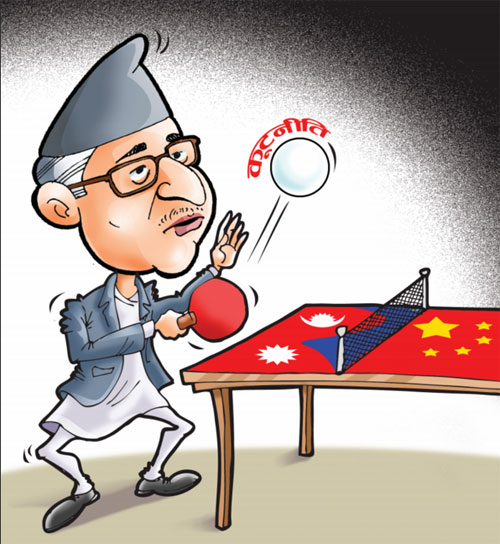
After his fence-mending visit to India last month, Prime Minister K P Oli embarks on an official visit to China this weekend during which he will also attend the Boao Forum for Asia in Hainan.
Although he bungled the fast-track constitution that led to a breakout of violence in the Tarai, and he was unable (or unwilling) to get the Indians to lift their five-month blockade, we have to give the man credit -- somewhat grudingly -- for being an astute politician. He has pulled it off.
First, he wangled an invitation to New Delhi (where to say that he wasn’t particularly liked would be an understatement), craftily exploiting the Narendra Modi government’s need to find a face-saving exit from a purposeless and counterproductive blockade. To the domestic gallery, Oli projected himself as a Nepali leader who, for once, went to New Delhi on his own terms and gave nothing away.
The fact that the visit was largely symbolic and the agreements signed were merely for delayed and pending projects seemed not to matter. The deal to buy an extra 80MW of power from India was no breakthrough, but the PMO spinmeisters presented it as such. Oli played the nationalism card to the hilt, and although the blockade hit Nepal hard economically, it bolstered the prime minister’s domestic standing.
It is therefore a much more confident Oli who on Sunday is getting on board a plane that the Chinese government is reportedly sending out to Kathmandu to fetch him. He will meet President Xi Jinping, extend an invitation for him to visit Nepal later this year and discuss deals on trade, transit and development.
There will be those who will be tempted to make much more out of this visit than is warranted. This is not the time for Nepal’s leader to thumb his nose at India. New Delhi's paranoid nationalists would also do well not to take the visit as proof of Chinese inroads into Nepal. Even if the Chinese were making inroads into Nepal, New Delhi has only itself to blame. What is a blockaded Nepal to do?
Even so, Prime Minister Oli would be well-advised not to play the China card. It hasn’t worked since King Mahendra used it in the early 1960s soon after the Sino-India War to chart a path of geostrategic equidistance between China and India.