
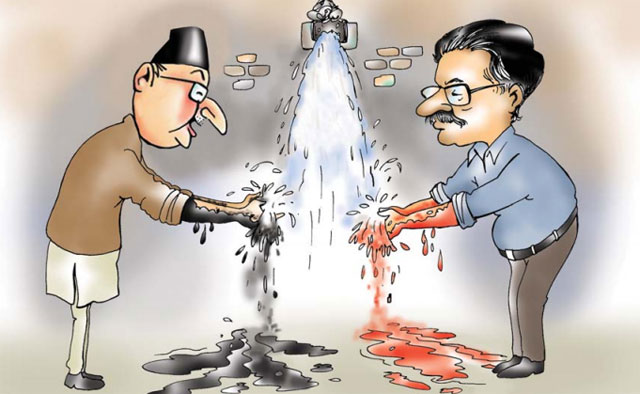
Earlier this month, Prime Minister Oli managed to save his coalition from an attempt by the opposition NC to woo away his Maoist partners in government. The wily Oli acted quickly to convince Maoist Chairman Pushpa Kamal Dahal not to abandon him, and within 24 hours staged a ‘counter-coup’ to avert an overthrow of his government.
The two signed a 9-point Agreement the content of which makes clear the extent of the paranoia among the comrades in the former rebel movement about being hauled over the coals for war crimes. It is apparent that certain verbal points of agreement were not reduced to writing, including Oli’s pledge to step down after the wholly unaddressed budget announcement and let Dahal become prime minister for the second time.
Even so, the fact that five of the nine points address issues of transitional justice show just how worried the Maoists are about having to answer for the crimes against humanity they committed during the conflict from 1996 to 2006. One of the points obligate the UML and Maoists to amend the laws on transitional justice within 15 days, so that they ‘reflect the spirit of the Comprehensive Peace Accord’ — an euphemism for immunity from prosecution. The two leaders also agreed to include provisions to grant amnesty and pardon, dismiss 'political' cases, and register land titles that were handed out by the Maoist government during the conflict.
The UML gave in to these Maoist demands solely to prolong its hold on power -- that much is clear. But the compromise points involving transitional justice violate the peace agreement itself, existing laws of the land as well as international human rights conventions and norms. The agreement, once more, proves just how much the Maoists -- especially its leader Comrade Prachanda -- are still haunted by the ghosts of the people they murdered. The 9-point Agreement may have extended the life of the coalition, but it slaughtered justice.
The agreement drives home the fact yet again that as far as justice is concerned, the peace process has been an unmitigated failure because war crimes by both sides have been wholly unaddressed. The Truth and Reconciliation Commission and the Commission on Enforced Disappearances are politically-driven fig-leaf bodies that have been set up for the sole purpose of exonerating the perpetrators of atrocities.