

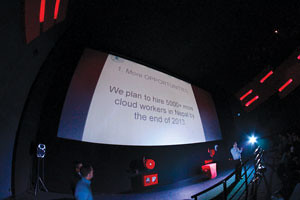
CloudFactory already employs 600 workers, most of them are college-aged along with 80 staff members, and it aims to hire 5,000 more by the end of the year. The company is based around the twin resources of crowd-sourcing and the Internet. The organisation sources for large-scale digital projects from across the globe, and then breaks them down into simple tasks that are then distributed to its pool of workers.
“We are thrilled to provide work opportunities for so many people in Nepal by the end of this year,” said Mark Sears, CEO of CloudFactory at a company event called ‘We LOVE Nepal’ at City Centre Mall last week. About 300 of his employees were treated to a free screening of Captain America to thank them for their hard work.
But Sears doesn’t intend to stop there, his long-term goal is to ‘connect’ one million people in Nepal and other countries through the Net and generate income for people who could in turn do social service for their communities.
“There is so much potential in Nepal,” says Radhesh Pant, the CEO of the Nepal Investment Board who attended the event. “But someone needs to step up to make the most of it, and it starts with people like those in CloudFactory.”

CloudFactory’s example is not just the usual corporate social responsibility, it hopes to integrate a sense of community in its workers, a new corporate model where its employees are not just workers, but also pillars of the community.
Sushant and others like him know the road ahead is not smooth, with power cuts and political disturbances, integrating their professional work at CloudFactory with community action will be difficult. But it is an example of the talent pool existing in Nepal, and an innovative way to create jobs and a sense of commitment to the community.