Buddhism spread from Nepal to the Korean peninsula two millennia ago, but in the past 60 years Korea has been exporting two of its dominant ideologies to Nepal.
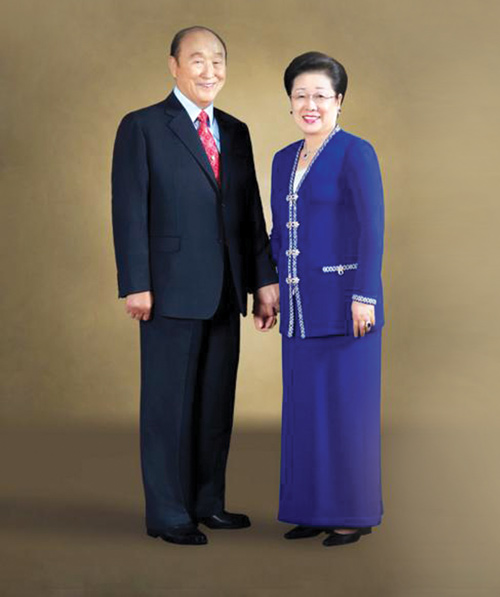
Nepal’s communists, notably the Workers Peasants Party with its stronghold in Bhaktapur, have been inspired by Kim Il Sung’s Juche Idea. And South Korea’s Unification Church of Sun Myung Moon has now got a sizeable presence in Nepal’s religious and political life.
Although it has been in Nepal since 1975, ‘Unificationism’ got a political foothold after Moon’s visit to Kathmandu and the establishment of the Universal Peace Federation (UPF) in 2005. It now has 12,500 members in 30 churches across Nepal.
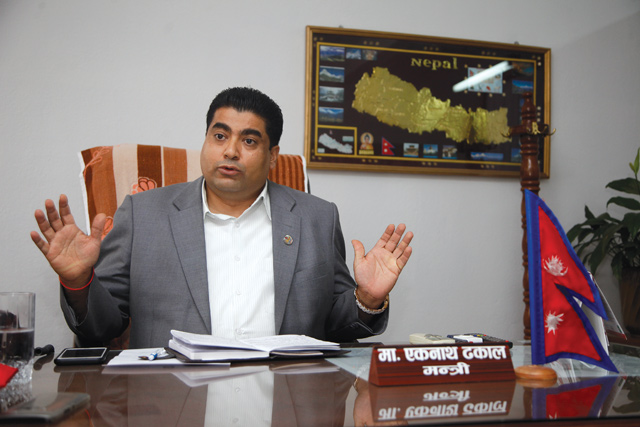
“Ours is a national political party with a clear ideology, but I am a Hindu, associated with the Unification Movement,” said Ek Nath Dhakal of the UPF South Asia and leader of the Nepal Family Party who is in Prime Minister Oli’s cabinet as Minister of Peace and Reconstruction. (See Interview, below.)
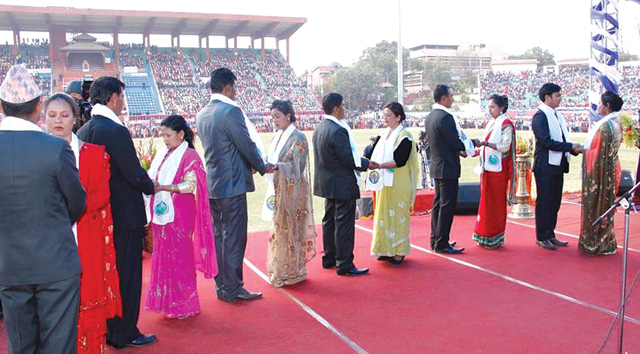
The UPF’s motto here is ‘world peace through the ideal family’ and it tries to steer young Nepalis away from immoral activities through training sessions, and in ‘family education’ which can be interpreted as evangelical outreach. Worldwide, Moon’s Unificationism makes headlines whenever it stages mass weddings like the one at Dasrath Stadium in Kathmandu (pic, above) last year in which 70,000 couples got married simultaneously.
UPF’s ‘ambassadors for peace’ program recruits public figures in Nepal to promote reconciliation, conflict resolution and building peace. Even President Bidya Bhandari is listed among 8,500 UPF ambassadors for peace.
“Rev Sun Myung Moon’s peace philosophy is powerful message to us in Nepal because there are so many ethnic, religious, and political conflicts. He said we are all family, sisters and brothers under God,” explained Deepak Sapkota, who heads the Dhading chapter of Family Federation for World Peace and Unification (FFWPU, the official name of the Unification Church). “We want Nepal to be the centre of God’s kingdom of heaven in the world.”
Indeed, the FFWPU mentions Rev Sun Myung Moon’s special desire for Nepal to serve as a ‘model peace nation of God’. However, UPF functionaries deny that their movement is a ‘church’, preferring to call it a ‘peace movement’. Indeed, its head office in Bhagwati Bahal in Kathmandu doesn’t have a cross.
“It is a movement above all religions. It works for harmony among different religions to build world peace,” explained Binod Dangi, 40, the Secretary-general of UPF Nepal. Dangi started following Unificationism as a student in 1995, and says he is still a practicing Hindu and Moon’s philosophy doesn’t necessitate conversion.
During a meeting last week, Dangi wore a ‘Blessing Ring’ with the Unificationism symbol. He said: “The unification movement is to turn us into true Hindus, true Christians, true Buddhists or true Muslims by finding the best path to make one’s religion 100 per cent one.”
Moonie politics
A religious group that mixes business and politics
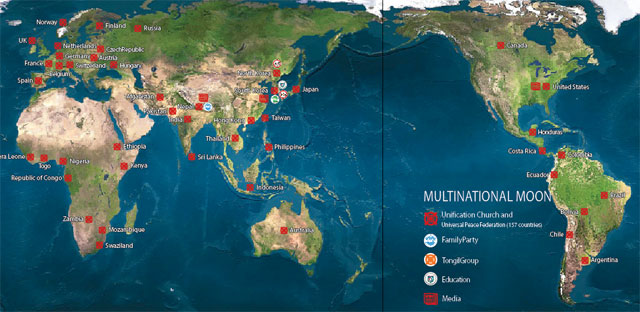
Korea’s Sun Myung Moon and his philosophy of Unificationism has branches, owns companies and even runs newspapers all over the world, but Nepal is the only country where it is involved in politics.
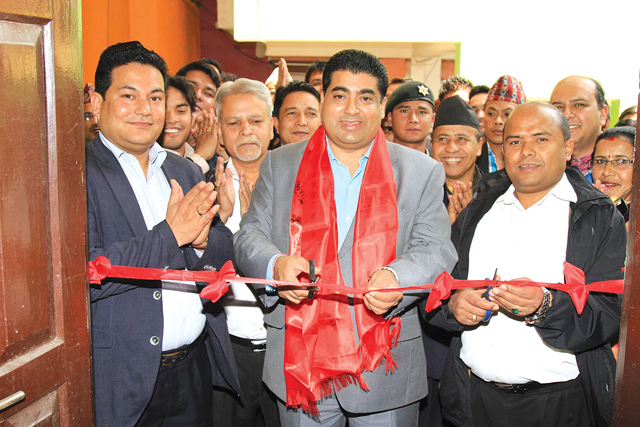
Founded in January 2008, the Nepal Family Party crossed the election threshold with one seat in 2008 and two seats in the 2013 Constituent Assembly election. Ek Nath Dhakal, the current Minister of Peace and Reconstruction, is the first elected Moonie leader in the world. (‘Moonie’ is a slightly derogatory term for followers of Sun Myung Moon.)
In South Korea, a similar political party failed twice in the past decade to get a single seat in the legislature. The Unificationist party there had an electoral platform emphasising education and family values, and to prepare for Korean reunification.
Minister Dhakal admitted in an interview (see below) that his party is inspired by Rev Moon, adding: “The Nepal Family Party has a new ideology in Nepal’s traditional political arena, it is inclusive and forward-looking that focuses on peace and family values.”
Dhakal said Nepal needed a new party which can embrace diverse elements of society and bring different political parties together for nation building. “We keep very good relationship with all politicians,” said the 42-year-old. “Our size may be small but our ideas and influence are big.”
Minister Dhakal clearly has connections among Nepal’s political parties. On a recent trip to Korea to attend a Unification Movement program, Dhakal had a dozen Nepali MPs in tow. A senior UML leader told Nepali Times on condition of anonymity that the Family Party has most top political leaders "in its pockets".
When asked, Dhakal said: “I don’t want to mix politics and religion, and I was appointed as a Peace and Reconstruction Minister because of my contribution to the Prime Minister’s election.”
There is speculation that Unificationism is a front for Christian evangelism, and the politics of patronage. Moon’s famous and controversial remark about theocracy 1973 feeds such assumptions: ‘The separation between religion and politics is what Satan likes most’.
Moonies were also involved in the 1976 Korea Gate scandal in which the South Korean National Intelligence Service was found to have worked with the Unification Church to gain political influence in the United States.