
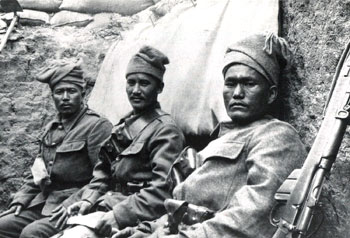
In April 1915, Nepali Gurkha battalions (‘Gurks’) and Allied forces were deployed in what would prove to be a disastrous campaign to take control of the high ground of the Gallipoli peninsula in order to threaten Constantinople, the capital of the Ottoman Empire. This is the first installment of a series of flashbacks of the involvement of Gurkhas in the First World War.
Timeline by Ayesha Shakya
The First Landings
Late April 1915
By the end of 1914, the war on the Western Front was deadlocked. There were strong arguments for an offensive through the Balkans or even a landing on Germany’s Baltic coast, instead of more costly confrontations in France and Belgium.
These ideas were initially sidelined, but in early 1915 the Russians found themselves threatened by Ottoman forces in the Caucasus and appealed for some relief. The British government, encouraged by Winston Churchill, decided to mount a naval expedition to bombard and take the Gallipoli Peninsula on the western shore of the Dardanelles, with Constantinople as its objective. The British hoped to link up with the Russians, knock Turkey out of the war and possibly persuade the Balkan states to join the Allies.
The naval attack began on 19 February 1915, but bad weather caused delays and the attack was abandoned after three battleships were sunk and three others damaged. Military assistance was clearly required, and General Kitchener appointed an old friend from the Boer War, General Sir Ian ‘Johnny’ Hamilton, to command the proposed amphibious operation.
On 12 March, Kitchener told Hamilton: “We are sending a military force to support the fleet at the Dardanelles, and you are to have command. You will be given the 29th Division from the regular British Army, two divisions of Australian and New Zealand troops currently in Egypt, the Royal Naval Division and a French contingent in all, about 70,000 men.” Hamilton and his staff left London that afternoon at 5pm on Friday 13 March by train, crossed the Channel in a destroyer and travelled to Marseilles where the light cruiser Phaeton was waiting.
At sea, Hamilton considered the brief instructions he had been given and a few rough notes, together with a textbook on the Ottoman army, written in 1912, and two small guide books. He comments in his Gallipoli Diary 'that his knowledge of the Dardanelles at this point, as headed towards the eastern Mediterranean, was nil. Of the Turks, nil. Of the strength of his own forces, next to nil.'
As he sailed east, renewed efforts to sweep the Straits of the Dardanelles clear of mines began on 18 March, but several vessels were sunk by gunfire from the Ottoman batteries, while others hit mines. The operation was suspended on 19 March and cancelled the next day due to weather. The enemy proceeded to strengthen their defences.
On 24 March, Hamilton arrived in Alexandria. He reviewed the situation and came to the conclusion that he was likely to be outnumbered and outgunned. He wrote to Kitchener, requesting more men and more ammunition and asking in particular for the deployment of the 29th Indian Brigade under Major General Vaughan Cox, a request he likened to ‘going up to a tiger and asking for a small slice of venison’.
‘I am very anxious’, he wrote, ‘if possible, to get a brigade of Gurkhas, so as to complete the New Zealand Divisional Organisation with a type of man who will, I am most certain, be most valuable on the Gallipoli peninsula. The scrubby hillsides on the south-west faces of the plateau are just the sort of terrain where these little fellows are at their brilliant best… each little “Gurk” might be worth his full weight in gold at Gallipoli.’