Concerns about air pollution and unsafe drinking water have overshadowed another health hazard with a pernicious long-term impact on Nepali children: the alarmingly high concentration of lead within homes, schools and outdoors.
Two recent studies that analysed blood samples of children in Kathmandu and Birganj showed most of them had a Blood Lead Level (BLL) several times the threshold deemed safe by the US Centres for Disease Control and Prevention. In Kathmandu, 64.4% of children aged 6 months-3 years had a BLL above the danger mark of 5µg/dl (micrograms per decilitre). Children aged between 10-15 in Birganj fared much worse: all had an elevated BLL, with 84% showing lead in blood > 10 µg/dl.
“This is a frightening scenario indicating that two in three children in the Valley will grow up to be individuals with limited mental and intellectual capacity,” said Imran Ansari, a paediatrician at Patan Hospital. “Imagine what this will do to our country.”
Scientists have found a strong correlation between elevated BLL and decreased IQ. A survey of primary school children in Kathmandu in 2013 estimated every additional 10 µg/dl lead concentration in blood resulted in a drop in IQ of 2.35 points.
“The situation is particularly serious because lead gets bio-accumulated in the human body and is rarely discarded, and when pregnant women are exposed to lead it can affect the unborn child,” said Sujan Raj Panthi at the Nepal office of the World Health Organisation (WHO), which commissioned one of the studies. “Our major concern is that the sources of lead are easily accessible to children, in paint in the school and household, in dust and in shiny, colourful toys.”
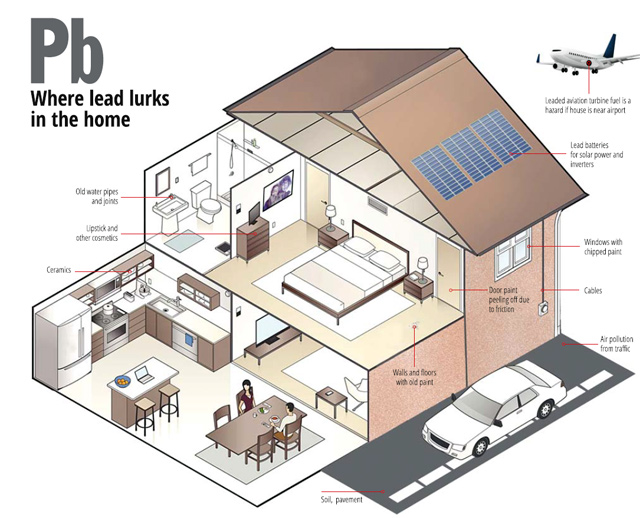
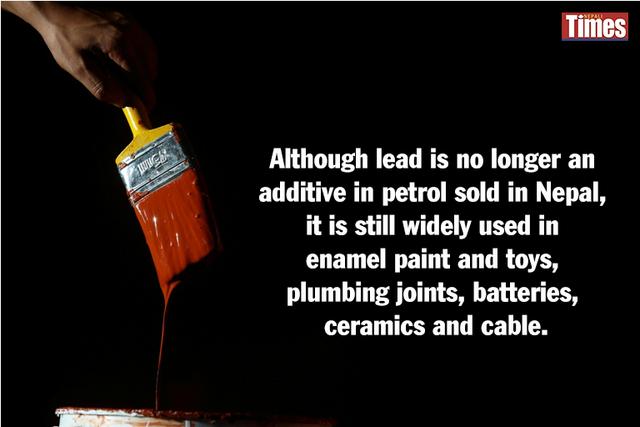
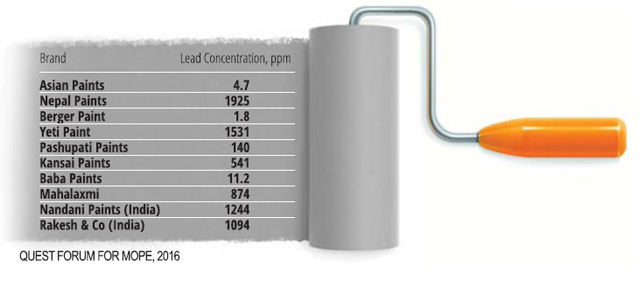
Although lead is no longer an additive in petrol sold in Nepal, it is still widely used in enamel paint and toys, plumbing joints, batteries, ceramics and cable. Effective June 2015, Nepal set the standard for maximum lead concentration at 90ppm, however, paints sold here still have lead levels much higher than the limit, some with concentrations several thousand times more than the safety threshold.
Multinational paint companies in Nepal comply with international standards for lead, but poor enforcement means many local and Indian brands flout the rule (see box below). Nepal's toxic chemical standard for toys, including lead, comes into effect on 15 July. However, there are few facilities for routine testing, kits are not available, and warning labels are not enforced.
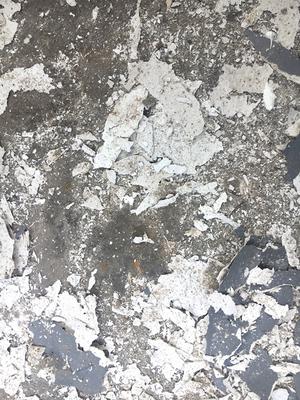
Many households and schools surveyed in Kathmandu recently were found to have unacceptable concentrations of lead indoors. Dust pollution and post-quake debris containing chipped old paint are just two reasons why it can be hazardous for children to play outdoors as well.
“Lead contamination is not a priority because it doesn’t have immediate impact, but in the long-term it can have damaging consequences. We need more test kits and screen children regularly,” said biochemist KD Mehta at the BP Koirala Institute of Health Sciences in Dharan.
Imran Ansari at Patan Hospital agrees that more testing kits and regular nationwide lead inspections are needed. His clinic gets children with abdominal pain every day and although he suspects lead toxicity, the hospital lacks kits for proper diagnosis. “Lead toxicity doesn’t have a defining symptom, but we don’t have predefined diagnostic tools for follow-up,” Ansari said.
Experts stressed public awareness about lead in the environment alone will not do the job when the overall environment is full of lead paint and paint dust. Existing regulations on lead content in paint, disposal of batteries must be monitored for compliance.
UNICEF Nepal representative Tomoo Hozumi said: “Lead can cause permanent adverse effects on children’s health, cognitive functions, even academic performance, impacting on the nation’s human resource. To prevent this silent calamity, national regulatory frameworks need to be urgently established to stop lead paint and products coated with lead paints in Nepal.”
CHILDHOOD LEAD POISIONING
A Blood Lead Level (BLL) study this year of children aged 6 months to 36 months in three Kathmandu hospitals showed that 64.4% had BLLs greater than or equal to 5 µg/dl (micrograms per decilitre). Even at low levels, lead exposure can cause learning and behavioural difficulties. Children with BLL equal to or more than 5 µg/dl can suffer irreversible neurological disorders.