
|
|
| MORE THAN THE SUM OF ITS PARTS: Legalising the trade in products derived from farmed tigers will only fuel illegal poaching. |
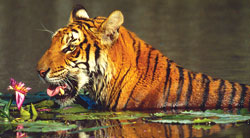
A meeting in Kathmandu beginning on 16 April, will see many of the world's top conservationists and wildlife trade specialists discussing China's new, persistent effort to open up the trade in tiger parts.
China's government is close to lifting the 1993 ban on the trade to appease influential businessmen who have been breeding tigers in 'farms' regardless of the ban and now find themselves saddled with thousands of animals.
There is talk that Thailand-which has its own vested interests in controversial 'tiger farms'-may quietly support China's effort to open up the trade. After visiting conservationists recently disagreed publicly with economists who support Beijing's pro-trade line, several of China's tiger farmers came out in the open with a press conference demanding that the ban be lifted. China's other argument is that millions stand to gain from the medicinal properties of tiger bone.
This comes despite a significant proportion of Chinese traditional medicine practitioners moving away from prescribing tiger bone. Tests in China have proven that tiger bone is not much different to the bones of pigs, dogs or goats-and is almost identical in composition to a high altitude rodent found in plenty in China.
The trade in endangered wildlife is ranked third after arms and drugs. It is run by powerful international criminal syndicates. Thailand is one of the centres of the trade-both as a source for species and as a conduit; almost every other month shipments of endangered species bound for China, are detected and seized in Thailand as they pass through from Malaysia and other countries.
If the ban on trading in tiger parts is lifted, parts from wild tigers killed in the wild for a handful of baht, ringgit, or rupees will certainly be laundered through legal channels. Tiger parts and products are already surreptitiously and sometimes openly traded out of these farms. And farmed tigers will always be more expensive than poached ones, doing little to dampen the profitability of poaching.
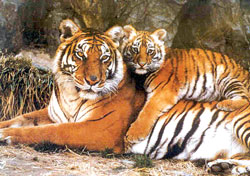 China's 1993 ban was crucial in ensuring that tigers still exist in the wild today, albeit in very small numbers. It is estimated that there are possibly a little over 5,000 tigers left today in the forests of Asia. Most are in India which possibly has close to 2,000. Thailand has around 400.
China has been lobbying international opinion to get the ban lifted. Securing the approval of key tiger range countries like India, Russia, Thailand, Nepal, Bhutan, Myanmar, and Malaysia, is important to China. In all these countries the tiger is clinging to the edge of extinction. India's populations are small and isolated.