
Yash Ghai and Jill Cottrell (left) are constitutional experts who have advised the governments of Kenya, Somalia, Iraq, Afghanistan and Nepal on their new constitutions. They are authors of Creating the New Constitution: A Guide for Nepali Citizens and more recently, The Millennium Declaration, Rights, and Constitutions. 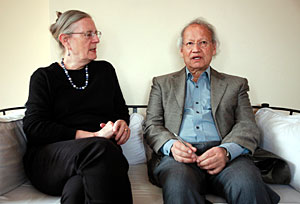
Nepali Times caught up with them on their brief return to Kathmandu this week under the auspicies of International IDEA.
Nepali Times: You were involved as a constitutional adviser in Nepal since 2006. How does it feel to come back to see that the process is still stuck?
Yash Ghai and Jill Cottrell: It is sad, when the country needs to move forward on many fronts. We feel anger at the reluctance of the traditional elites to engage in serious discussions with the marginalised groups on their concerns. Anger also at the betrayal of the people whose struggle enabled the four major political parties to grab power.
Were we perhaps a bit too ambitious in expecting the peace and constitution process to move so fast?
No. The country was ready for a move to a new political order. The monarchy had been vanquished. The civil war had come to an end. A popular uprising had rejected the old system and defined the agenda of reform. Some broad consensus had been established between the Maoists and the major political parties. But by the same token these political groups hijacked the jana andolan. Despite the earlier enthusiasm of the Maoists for fundamental social reform, they and their new political partners had little interest in change, as is obvious from their numerous 'x' point agreements. Politics quickly slipped back to the post-1990 constitution style, with intense rivalry among these elitist political groups dominated by a handful of old warriors. The exclusion and marginalisation of the Janjatis, Dalits and women continued.
Two levels of politics emerged: one between the Maoists and the three parties, focused largely on the self-interest of their leaders, complicated by intra-party disputes, and the other between them and the marginalised groups, where the former were the masters and the latter supplicants, almost always triggered by violence and other forms of disruption. This prevented a proper national discourse on political and economic reform. In the arrangements for the interim administration and for constitution making, the four parties excluded others and ensured their total control of the Constituent Assembly and prevented it from becoming a truly national gathering.
Still, it wasn't supposed to be easy.
Transition from war to constitution is seldom easy, but it is our impression that the issues that have bedevilled the process have not much to do with the aftermath of the war as such--after all a Comprehensive Peace Accord preceded the adoption of the Interim Constitution—and much to do with political rivalries among the elite. And their arrogance, manifested in their contempt of experts, and of people's participation in public affairs.