

Over the last two decades, most things have got worse in Nepal but perhaps few things have got worse faster than air pollution. So much so that some Nepalis have lives cut short by up to 7 years.
Twenty years ago, environmentalist Bhushan Tuladhar wrote about Kathmandu’s rapidly declining air quality and its adverse impacts on public health in Nepali Times.
Two decades down the line, Tuladhar is still at the frontlines of clean air advocacy and is pushing electric public transport. Garbage burning, brick kilns and cross-border pollution have all increased, making air pollution one of the biggest crises of our times.
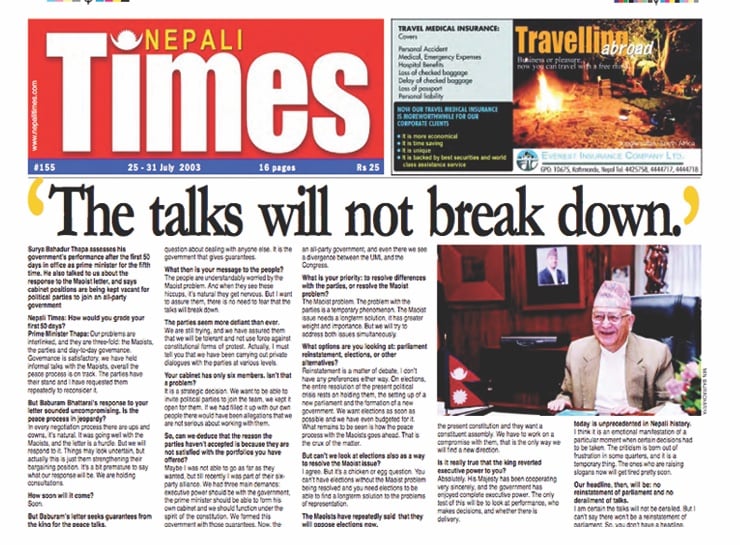
Excerpts of the report published 20 years ago this week on issue #155 25-31 July 2003:
Just before this year's monsoon arrived in mid-June, the Putali Sadak station recorded 461 micrograms per cubic meter concentration of dust particles less than 10 microns, also known as PM10.
This is almost four times higher than the national ambient air quality standard (NAAQS) which is 120 micrograms per cubic meter for particles that size. The WHO guideline for PM10 used to be 70 micrograms per cubic meter (WHO does not have a guideline value for PM10 anymore because it says there is no safe limit for such fine dust. These numbers should be sending out alarm signals to anyone breathing Kathmandu's air.
The data also indicates that the air quality has deteriorated significantly over the past few years. In November 1993, Environment and Public Health Organization (ENPHO), a local NGO, took several 24-hour measurements of PM10 in Putali Sadak and reported an average value of 92 micrograms per cubic meter. Ten years later, the figure for PM10 in November had shot up to 270 micrograms per cubic meter.
From archive material of Nepali Times of the past 20 years, site search: nepalitimes.com