
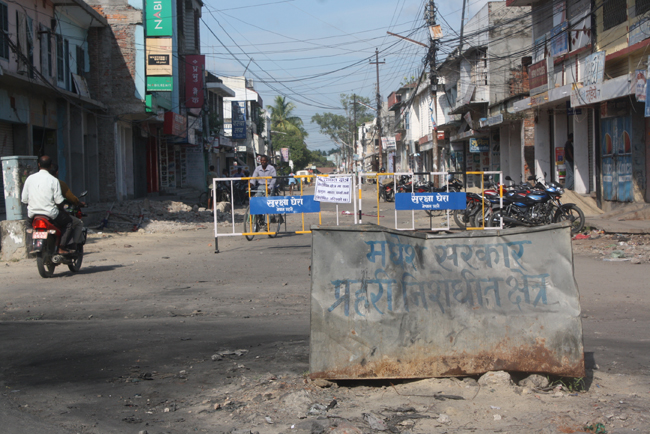
Photo: Anurag Acharya
When I met Sadbhavana Party leader Rajendra Mahato in Janakpur recently, he was a worried man. He had come down to a grieving town to attend the final rites of nine protesters killed by police a few days ago.
In what looked like a revenge killing, protesters had dragged an injured policeman out of an ambulance and lynched him. The area was under a curfew and the streets were deserted.
“Even if we call off the protests now, people will only turn against us, they won’t stop. But by letting this continue, we know more people will die,” Mahato said. When I asked him if there was a way the movement could be peaceful he said it was up to Kathmandu.
But insiders in the Madhesi Morcha were desperately looking for ways to counter what they say are the government’s “terror tactics” to discourage them from taking to the streets. Sure enough, the streets and highways had a heavy security presence.
Today, the tables have turned. Not a single protester has died in more than three weeks, not because the police have exercised restraint but because the protesters have effectively crippled the state while staying at an arm’s length from their reach.
Until a few weeks ago, the protesters regularly clashed with police in the highway between Birganj and Parwanipur as they tried to cut the supply line to Kathmandu. The road from Jaleshwar and Janakpur also witnessed regular clashes. But the protesters have now moved over to the ‘no man’s land’ between Indo-Nepal border, preventing the imports from entering Nepal as police watch helplessly.
Is the Indian government deliberately aiding these protests? Before jumping to any conclusion, we must first understand the mood on the Indian side of the border. People there have close kinship ties with people on the Nepal side. They share their anger and frustration against Kathmandu and have actively helped the protesters. With the high-stakes Bihar elections approaching, it is unlikely that BJP government will want to antagonise its voters by appearing unsympathetic to the movement. Call it unfair, but that is the hard geopolitical truth behind the border closure.
It is very tempting to conclude that we are in the mess because the Indians are angry at being snubbed during the final hours of constitutional drafting. We must reflect on history to understand this facet of Indian foreign policy in Nepal.
Almost two decades ago, Indians granted shelter to rebelling Maoist leaders at a time when political ties with the government in Kathmandu and with Royal Nepal Army which was fighting the insurgents were robust. The Maoist movement had spread down to the plains in western Nepal making India, which has its own Maoist insurgency, vulnerable to cross-border activities. India’s policy then was simply geared at keeping Nepal’s Maoists from establishing any contact with their Indian comrades.