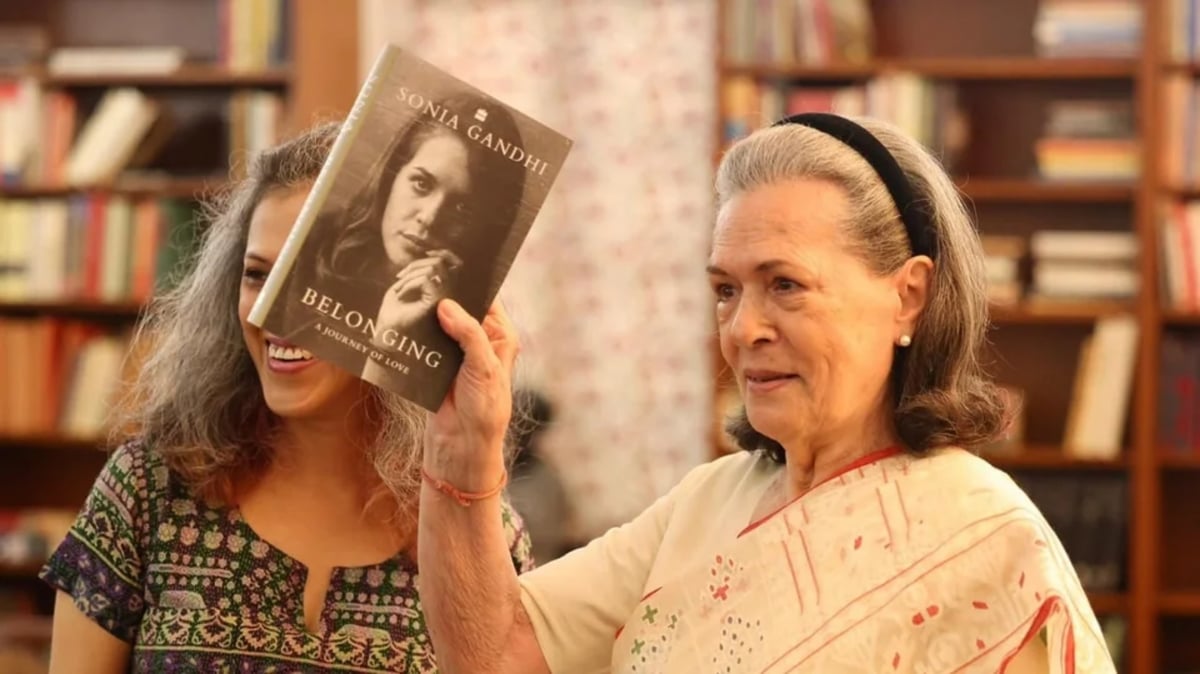
Sonia Gandhi’s Belonging: A Journey of Love is undoubtedly one of the more consequential political texts to be published in India and for that matter, in South Asia in recent years. Its publication has generated an unusual degree of anticipation, political argument and commercial interest.
As any book perceivably impregnated with an acute sense of politics, it was highly anticipated by Gandhi’s supporters as well as those without any specific political affiliation while her detractors summarily trashed it even without reading a single page, which they continue to do right up to the present.
Yet, having approached it as someone who has followed Indian politics closely from across the Palk Strait for several decades and as someone who also lived in India for more than ten years, I find the book more interesting as a political commentary than as a definitive contribution to understanding modern India.
There is much to appreciate in its narrative, not least its relative candour and readability. But there is also much to question, particularly concerning the relationship between personal recollection, political responsibility and historical accountability.
Autobiographies are hardly ever neutral accounts of personal experience. They are exercises in remembering, selecting, interpreting and, sometimes, rehabilitating as well as erasure. Their authors write from within specific political, social and institutional locations. Their loyalties, relationships, anxieties and ambitions inevitably influence what they remember and how they present it.
Sonia Gandhi is no exception. Her account is necessarily mediated by her relationship with the Nehru-Gandhi family, her own political inheritance, the Congress Party and the historical controversies surrounding both. She is not simply remembering a life; she is also negotiating the historical legacy of a political dynasty that has shaped, and been shaped by, modern India.
The problem, therefore, is not that Gandhi presents a perspective. Every autobiographer does. The more important question is whether the reader can distinguish the difference between personal recollection, political interpretation and historical explanation and what each of these might mean.
The extraordinary attention surrounding the publication was partly created by events preceding its release. Penguin Random House India, initially expected to publish the Indian edition, did not proceed with the arrangement. Reports suggested disagreements over proposed editorial changes and deletions, particularly concerning references to Narendra Modi, the RSS, communal relations and India's contemporary political circumstances.
Gandhi reportedly refused to accept the suggested changes. Penguin disputed the suggestion that its decision was a consequence of her refusal. HarperCollins subsequently took over the Indian publication, and the book appeared on 10 November.
Whatever the precise circumstances, this episode generated considerable speculation about political pressure, publishing independence and the increasingly complicated environment for public criticism and political engagement in India. The controversy effectively provided the book the kind of publicity that even an extensive promotional campaign might not have achieved. Partly helped by this situation, its commercial reception has been remarkable.
Reports indicate that Blinkit ran out of stock in some locations, while major bookstores experienced exceptional demand. Crossword has reported substantial pre-orders and successive re-orders. This is not merely a publishing success; it is evidence of the continuing public fascination with the Gandhi family and the political history associated with it. But controversy and sales should not be confused with literary or historical merit.
One must accept however, there is, something refreshing about Gandhi's narrative when compared with many autobiographical accounts. Such accounts frequently become exercises in self-justification, retrospective hero-making, the systematic transfer of responsibility to others and quite often, complete erasure of unpleasant and violent political episodes.
Political failures become conspiracies, military controversies become misunderstood operational necessities, and inconvenient historical incidents are either ignored or reconstructed to suit the author's preferred legacy.
Gandhi's account is considerably more lucid, accessible and, in many respects, more honest. She writes about family tensions, personal vulnerabilities, grief, political disagreements and the complicated circumstances surrounding her entry into public life. Much of this, we know to be factual based on other publicly accessible accounts.
Her recollections of the assassinations of Indira Gandhi and Rajiv Gandhi, her own health struggles, and her difficult transition from private individual to political leader give the book an emotional texture that many political autobiographies lack. Her account of the grenades discovered in the family home following Operation Blue Star, for instance, offers an unusual glimpse into the personal consequences of events normally narrated through military and political histories.
Her discussion of why she declined the prime ministership in 2004 is also important, although readers familiar with the political circumstances of that period will naturally want to place her recollections alongside other accounts.
The book becomes considerably less convincing however, when it approaches the more uncomfortable episodes in the political history of the Congress and the political dynasty in which she has become a part. Gandhi revisits the Emergency, the 1984 anti-Sikh violence, the Shah Bano controversy, the Babri Masjid demolition and the Bofors affair.
She also offers her assessment of the almost cryptic political relationship between herself and Narendra Modi, describing the deterioration of even the conventional courtesies usually exercised between political opponents. Some of these recollections are revealing.