
 MIN RATNA BAJRACHARYA |
When Sunil Pant started Blue Diamond Society in 2001, Nepal's gay and transgender community was entirely underground. There was no legal protection, and police brutality against 'unnatural' sexual behaviour was the norm.
The turning point came in 2007 when the Supreme Court granted basic rights to all sexual minorities, passed an anti-discrimination legislation and ordered the government to use gender-neutral terms and pronouns in all official documents. It also recognised third gender as a new category entitled to citizenship.
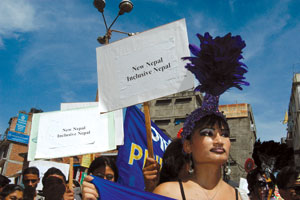
After the 2008 election, Pant became the first openly gay CA member. Nepal's oldest school, Darbar High School, admitted a transgender student. And pride parade has become the highlight event during the annual Gai Jatra festival (pictured above). While the most developed and 'progressive' countries are still divided over gay marriages, Nepal is on its way to becoming the first country in Asia to legalise same-sex union.
Pant agrees that the progress and achievements of the community have been unprecedented: "India started its gay rights movement in the early 1990s and it took more than 20 years to repeal Section 377 of the Penal Code and decriminalise homosexuality," he says, "in comparison we have managed to introduce equal rights for sexual minorities in 11 short years. There has been a big drop in discrimination and abuse."
Roshan Mahato, coordinator of the Federation of Sexual and Gender Minorities, played an active role in improving the curriculum in universities to make instructors and administrators more sensitive to the needs of sexual minorities. Today courses in sociology and anthropology in government universities are incorporating gay and lesbian studies.
However, Nepal's archaic bureaucracy and the lack of political will are still obstacles to further progress in the rights of the LGBTI (lesbian, gay, bisexual, transgender and intersexual) community. Soon after the SC passed the verdict to allow citizenship for transgenders as well, the Home Ministry, under Maoist Krishna Bahadur Mahara, issued a circular that ended this practice. Today, when third gender people request citizenship they are first met with stares for their 'unusual appearance' and then the habitual 'we don't have permission from above'.
"Until one of the leaders has a transgendered family member, or until the community becomes a large vote bank for the parties, the citizenship issue is likely to drag on," Pant admittted.