
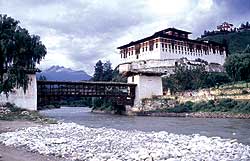
 Describing his arrival in Bhutan in Lands of the Thunderbolt (1923), the Earl of Ronaldshay wrote: With our passage through the bridge, behold a curious transformation. For just as Alice, when she walked through the looking-glass, found herself in a new and whimsical world, so we, when we crossed the Pachhu, found ourselves, as though caught up on some magic time machine fitted fantastically with a reverse, flung back across the centuries into the feudalism of a medieval age.
Bhutan is not an ordinary place. It has one foot in the past and one in the future. Its far-sighted leaders recognise the necessity of being part of the modern world, but they realise that once their forests and culture are destroyed, they can never be recovered. They have maintained their traditional culture, yet they have adapted what they need from modern technology. You'll find monks transcribing ancient Buddhist texts into computers and traditionally dressed archers using the most modern high-tech bows and arrows.
Bhutan is a country of rolling hills and towering crags, with only small patches of cultivation and very little deforestation. It is often compared to Switzerland, not only because they are similar in size, but also because many parts of Bhutan look like the Swiss Alps, with green hills, houses that look like chalets and snow peaks sticking out of nowhere.
Bhutan holds many surprises and a visit to the country is a splendid adventure. English is widely spoken, and you can easily converse with school children and many other people. The Bhutanese are very curious about life outside their mountain kingdom and are eager to hear stories about your country and how you live.
There are Western-style hotels and food throughout the country, but the best facilities are in Thimphu, the capital, and the town of Paro where the airport is located. If you travel to eastern Bhutan, be prepared for simple hotels and less familiar meals. To see the best of Bhutan, you should spend a week or more on foot, trekking through the great forested wilderness that covers most of the country.
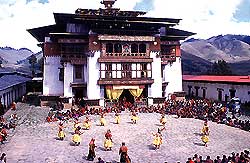 Bhutan is a land replete with myths and legends, and many tales contribute to its undeserved reputation of being an impossible place to visit. While certainly isolated and remote, it is not in fact a difficult place to visit. There is no limit to the number of tourists who can visit and you do not need any special influence or 'pull'. Subject to some well-defined restrictions, it is actually easy to arrange a trip to Bhutan. You can even organise a journey as an independent traveller; you do not have to travel in a group.
Bhutan is a little-known country, and not much information is available. Sometimes it is inaccurately described as a 'living museum'. It does visibly maintain its traditions, but its temples and monasteries are active and viable institutions that are very much a part of the modern world. It is not a nation of saintly, ascetic, other-worldly monks; you will find Bhutan to be full of well-educated, fun-loving and vibrant people.
There are numerous contradictions in the various sources that describe Bhutan's history. Facts and figures are often missing or confusing. There is no authoritative list of place names, no list of mountain peaks, and population figures are based on estimates.
The statistics and description of historical events presented here are based on credible sources, but many of these 'facts' are open to interpretation. Much of the information about temples, monuments and local history was provided by monks, caretakers and school teachers, who do not always agree with each other-or with the history books about events, dates and other information.
Travel within Bhutan can be frustrating, but it is always an adventure because the unexpected continually happens. Sometimes this utter fortuitousness causes problems; at other times the surprises are the joy of friendship, understanding or unsurpassed beauty that will bring you back again and again. If you visit Bhutan, you will become one of the few who have experienced the charm and magic of the country, and you may become a proponent of the kingdom's tourism policy and its efforts to maintain its distinct identity.
Free mountain flight!
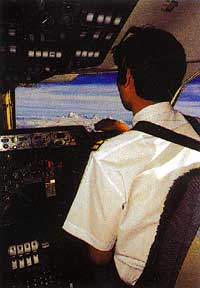 Two of the little-known secrets of Himalayan aviation are the flights from Kathmandu to Lhasa and Paro. Both flights essentially have free mountain-viewing thrown in for the price of a ticket and the scenery out of the plane window is one of the most spectacular anywhere on earth.
The Lhasa flight on the China Southwest Airlines' 757 is dramatic because it flies through the Arun Valley gap between Makalu and Kangchendzonga and offers great views from both sides. The Kathmandu-Paro flight, meanwhile, is on a high-wing BAe 146 aircraft and flies along the eastern Himalaya past five of the world's highest mountains. The views are from the left hand window seats on the flights to Paro and on the right on the flight back. Avoid the centre of the aircraft where the engines block the view.
Soon after takeoff from Kathmandu, as Flight 205 circles over Kathmandu Valley, one gets great views of the city and the mountains beyond. The jet flies slower and lower than larger airliners, so you get more time amidst the mountains while you aren't flying too high for the mountains to be dwarfed.
Soon, you are flying shoulder-to-shoulder with Gauri Shankar which may not be an eight thousander but makes up for it by being a strikingly pretty mountain with its fluted ridges and its double summit, which seem to rotate as we fly past.
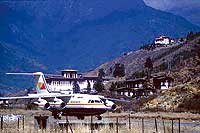 We are now above the tiny airfield of Phaplu, and then over Tumlingtar, the pilot makes a slight course correction heading southeast to cross the Nepal-India border in Ilam. Back in the cabin, passengers are craning their necks on the left side to watch the Kangchendzonga massif only 30 km away. Darjeeling, Kalimpong, Gangtok can be seen in the green hills below as if a map were given. Soon, the plane begins its descent towards Paro, crossing the Bhutan border and turning due north to head up heavily-forested valleys.
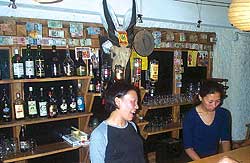 Thimphu is not noted for its restaurants, but there is decent food to be found in most hotels, especially when there is a tour group in residence and they lay on an extensive buffet of Western and Bhutanese dishes.
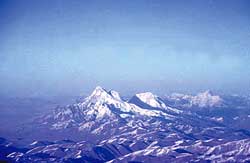 Trekking in Bhutan differs from the Nepali experience mostly dictated by geography. The hillsides in Bhutan tend toward the near vertical, which means fewer farms, villages and camp sites. Because geographical considerations make the distance between these greater, trekking days tend to be longer.
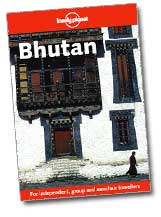 Excerpt from the Lonely Planet's Bhutan guidebook by Stan Armington which won the best Travel Guidebook in the 2003 Pacific Asia Travel Association (PATA) Gold Awards. Armington lives in Kathmandu and has also written the Lonely Planet guides, Nepal and Trekking in the Nepal Himalaya, which won the PATA Gold Award in 2002 and is in its 8th edition.