
 |
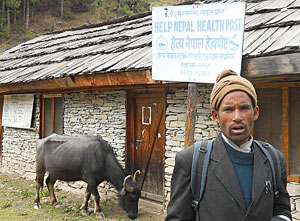
Birkha Bahadur Rokaya (pictured) walks off the trail to where a fallen tree branch has clogged a stream, causing water to form a puddle on the trail. Despite the cold drizzle, he tugs at the branch until the stream gets unclogged and water drains away from the trail. Footprints indicate that other travelers have chosen simply to walk around the puddle.
It is a small gesture, but it shows why Birkha Dai is such a compassionate community organiser in the remote village of Murma of Mugu. He was instrumental in getting the village to build a health post here with the help of the Help Nepal Network (HeNN), a community organisation of Nepali individuals all over the world.
Having been a fundraiser for HeNN based in the United States for over six years, I am now in Mugu to see for myself the health post that the organisation helped build. It is a long 'L' shaped house with stone walls, a wooden roof and a blue-and-white sign. A neat, grassy yard lies in front with a fenced vegetable patch along the side.
The child mortality rate in Mugu is three times the national average, with most children dying due to diarrhoeal dehydration, acute respiratory infection or vaccine-preventable illnesses. Seven years ago, Birkha Dai approached HeNN for funds to construct a health post in his village because he knows first-hand of the cost of poor health care: four of his children died of infections when they were young.
HeNN agreed to provide Rs 500,000 for the health post, and Murma residents chipped in with land and labour costs. The health post now treats up to 20 patients a week and has run two health camps. Retention of health workers is a big problem in remote Nepal, but the health assistant and a midwife, paid for by HeNN, remain available around the clock.