
|
|
What makes God laugh?
People making forecasts!
We smile at this joke because we think we know what's different between the way we plan for life's events and the way those events occur. But we don't.
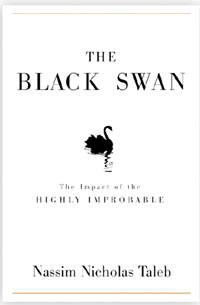
We make plans linearly, as if digging a tunnel under a vast field. But events that have the largest impact on our lives, writes Nassim Nicholas Taleb in his book Black Swan, occur randomly outside of that tunnel. Since our mind is not designed to handle everything that goes on in the field, we don't allow room for unexpected events, and when those events do happen we are caught unawares, only to make up explanatory narratives later.
For example, think how you first met the person you later married, or how you were derailed in your career, or how you lost or made money on the Nepse Index. Could you have predicted any of those events before they actually happened? No, but after they took place, it was easier to give explanations why. Take another example: Two weeks ago, Bear Stearns, a New York bank with 80-plus years of history, collapsed in a matter of days. No one could have predicted its demise even a month ago.
Taleb, a contrarian former Wall Street trader, argues that our world is disproportionately shaped more by what happens to us once in a while than by what happens to us regularly, and that life is ultimately a cumulative effect of a handful of significant shocks. Taleb calls these shocks Black Swans, which can be beneficial or harmful.
Taleb defines Black Swan as an event that's an outlier. The probability of its happening is so low that nobody expects it, and it remains outside the reach of all available statistical models. But once it happens, it carries such a large impact that it completely rearranges the existing order. You can think of the royal palace massacre of 2001, the 9/11 attacks, and the 2004 Asia-Pacific tsunami as three Black Swan events.