
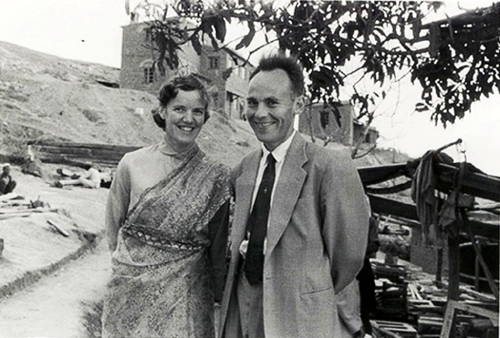
 Odd Hoftun with his wife Tullis in Tansen at the half-built hospital he helped set up in 1959.
After a lifetime devoted to developing Nepal’s indigenous capacity to harness water resources, what does Odd Hoftun have to say about the power cuts in Kathmandu?
The sprightly 82-year-old Norwegian is surprisingly upbeat. “Look, so much political change has take place in Nepal since 1990, it takes time to digest it all and move ahead,” he said this week in Oslo during the launch of his biography Kraftverket (The Hydropowerplant). “You just need a new generation of technocrat politicians to take charge and move forward.”
The book was launched on the 25th anniversary of the Norway-Nepal Association in Oslo last week, following three years of research by author Peter Svalheim. Hoftun went to Nepal as a missionary in 1958 and helped build the Tansen Hospital, which half a century later still stands as a model community medicine centre. Hoftun soon realised that to tap Nepal’s enormous hydropower potential and use it to drive development, indigenous capacity had to be built. He started work at the Butwal Technical Institute and later the Butwal Power Company (BPC), which worked on successively larger hydroelectric projects like Tinau, Andhi Khola and Jhimruk.
Today, BPC is part of a larger consortium of joint Nepali-Norwegian energy companies that built the Khimti project. Norway's SN Power International is now working on the Tama Kosi 3 power export project in collaboration with India’s Tata Group. The step-by-step growth of engineering capacity is just what Hoftun had envisioned 50 years ago: to make Nepal self-reliant, to spread the risk, and take on ever larger projects as the technical capacity of Nepali engineers improved.
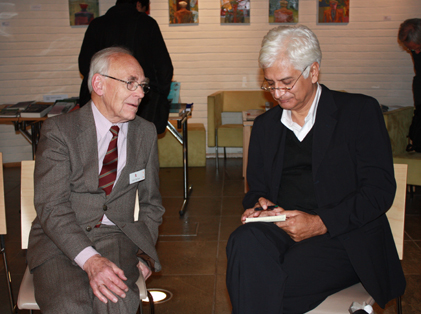 Hoftun at the launch of his biography last week. PHOTO: MANOHAR PRADHAN
The book, which will soon be translated into English and Nepali, also follows Hoftun’s life in Nepal through the tragic loss of his anthropologist son Martin in a plane crash in Kathmandu in 1992, to the setting up of the research centre, Martin Chautari, in his name. The centre holds regular discussions on the social sciences, media, education and policy issues.