
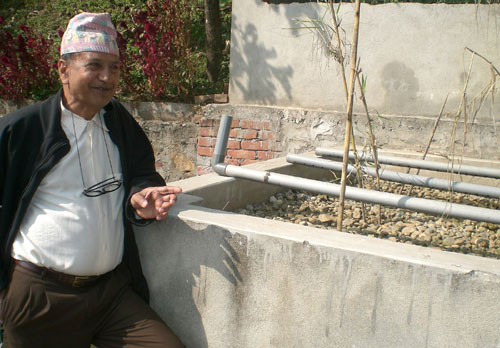
 100 YEAR PLAN: Homnath Adhikari of Namsaling in Ilam at a pilot waste-water treatment plant that he helped set up.
While the rest of the country is a political cesspool, Ilam shows visitors that the Nepali word ‘eelum’ must stem from the inherent industriousness of its inhabitants. Bhupi Sherchan noted this long ago when he visited the district, hence the famous verse: Nepal bhari ali ali Ilam chharna man lagyo...I want to sprinkle a little Ilam across Nepal.
Indeed, if Kathmandu had the same commitment to waste disposal and water treatment as Ilam's municipalities, the Bagmati would not be the sewer it is. If the national power utility was as efficient as Ilam's community micro-hydro network, there would be no load-shedding. If the rest of the country showed the same management skills as Ilam's farmers, who have made Nepal the world's biggest exporter of cardamom, there would no national food deficit.
Ilam is blessed with fertile soil, copious rainfall, and a temperate climate but that is not why it is the most developed district in Nepal. Proximity to Darjeeling and a traditional emphasis on education have given Ilam one of the highest literacy rates in Nepal, and there is a work ethic that takes the visitor by surprise.
"If you think about it, I would say quality education has been the single most important factor in Ilam's development," explains Homnath Adhikari, director of the Namsaling Community Development Centre (NCDC). Adhikari says inspiration to do something for rural upliftment came when he was a primary school teacher in Namsaling 30 years ago. "There was a Peace Corps volunteer who got us together and told us to plan for where we wanted Ilam to be in a hundred years time," Adhikari recalls, "and that got us thinking about what kind of Nepal we wanted for our great-grandchildren."
That Peace Corps volunteer was Barry Bialek, who is now a physician in Boulder, Colorado. He heads Engineers Without Borders, which collaborates with NCDC in Ilam on a waste treatment plant, safe drinking water, telemedicine, latrine building, and projects to improve farm productivity.
NCDC is also involved in biodiversity conservation and the revival of community forestry along the border with India, where there has been serious denudation because of poaching from across the border. It has even installed a giant fog collector in Danda Bajar to augment drinking water supply.
Says Adhikari: "You could say Ilam is a model for other districts in Nepal, and although we are an NGO we work very closely with the district development committee. Our job is to complement the government's own efforts, fill the gaps, and build the government's capacity." Indeed, district development committee officials and NGOs from Dolakha and Myagdi are trying to replicate Ilam's experience.
Another Ilam NGO is the Mahila Jagaran Sangh that works with 9,000 women in a microcredit scheme that generates income for families. The group's ‘Khutruke’ program now has Rs 30 million in savings and lends to women for small enterprises and dairy and tourism projects while also investing in community micro-hydro.
NCDC's partners include Norway's Development Fund, ICIMOD, WWF, UNDP and SNV. NCDC with the Alternative Energy Promotion Program (AEPC) has installed more than 220 kilowatts of subsidised small hydro-projects. This has earned Ilam the moniker of ‘Peltric district’. The power supplied to 203 households saves Ilam Rs 700,000 worth of diesel and kerosene per year and has brought down the cost of milling rice, reduced indoor pollution and increased income, by allowing villagers to work at night. And, unlike Kathmandu where the current four hours of power cuts are only a taste of what is to come, Ilam's villages have power all the time.