
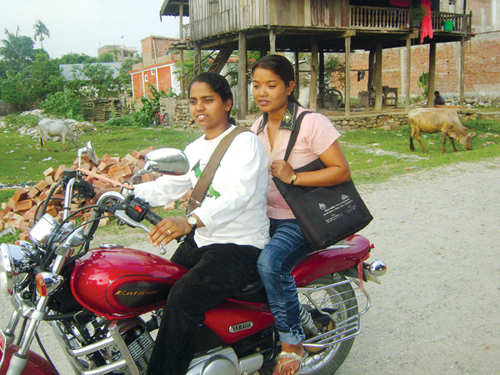
Every once in a while, travelling through Nepal, you come across a sight so incongruous that you have to blink your eyes to believe it.
We were in Gaighat, there was some chukka jam or other, and there were no vehicles on the streets. Neighbourhood children were playing badminton on the dusty road. Suddenly, there was the deep reverberating sound of a heavy-duty motorcycle.
A woman, dressed in jeans and T-shirt was driving past in a 123 cc Enticer. Sitting behind her was another woman carrying a bag. They roared off in a cloud of dust and parked alongside a building down the road. I learnt that she was Najbul Khan Nilam with a colleague from a battered women’s shelter called Muldhar.
Nilam, 33, is an iconoclast. As a Muslim woman living in rural eastern Nepal and being an activist for women’s empowerment is not an easy thing to be. And it is her own personal history has brought her this far. From her childhood, Nilam bore the brunt of the triple discrimination of what women from her community have to put up with it from family, community and society. But there was something in her genes that made Nilam rebel.
She rebelled against her conservative father, who discouraged her from going to school, by enrolling in adult literacy classes as a teenager. Her brother set fire to her salwar kamij, and Nilam started wearing t-shirts and jeans. Then he threw away all her books, and she taught herself to drive a Vikram Tempo and got a job as a driver to earn her own money so she wouldn’t have to depend on her family.
She saw many fellow-Muslim women suffering the same psychological and physical trauma that she went through, and she started helping them. But then she found that women from other communities in Udaypur also suffered discrimination, and decided to set up Muldhar.
The Mainstream Women Service Centre, as it is known in English, now works with Muslim, Madhesi, Tharu and Dalit women of Udaypur district. Nilam and her volunteers (all battered or abandoned women themselves) get a case almost every day: domestic violence, divorce, trafficking.
Supported by very modest grants from donors, Muldhar is now doing the work of an entire government line ministry in the district. Nilam climbs up the stairs to her office, which has mattreses stacked along the side. “It is for battered women who come here who are too scared to go back to their husbands,” Nilam explains.
The phone rings. A ten-year-old girl has been raped by a 67-year-old man in an adjoining village. She rushes downstairs, guns her Enticer and is off. We find out later that she has brought the man to the police station and started legal proceedings against him with the help of a woman lawyer.
The next day, Nilam travelled to Kathmandu with a woman who had been severely burnt in an acid attack by her husband. Nilam is modest about what she has achieved. She says her inspiration is Taslima Nasrin, the Bangladeshi author banished from her own country.
Asked what kind of help she’d like, Nilam says she doesn’t really need money. But having seen so many women die of domestic violence or at childbirth because they couldn’t be taken to hospital in time, she says: “I could do with a maternity ambulance. I’d drive it myself.”
A version of this article appeared in the hard copy of Nepali Times in May 2009.