The young traders from Patan had started walking out at 8 o’clock on Friday morning to join the citizens’ peace rally at Basantapur, giving themselves an hour to get there. At Kopundole they found the main road to the bridge blocked by Maoists. There was a tense standoff, bricks were hurled, and some of the people in the front were beaten with sticks.
The police arrived and set up a buffer. After a while, the Patan resistance team walked back to Mangal Bajaar. There, they spotted a pickup flying a red flag. They got the occupants to alight, and started tipping the truck over. Local shopkeepers, frustrated and angry over the prolonged closure, lent a hand and managed to topple the car. A victory cheer went up, and the crowd soon grew and people started chanting anti-Maoist slogans. This was going to be a pratikar by anti-pratikarwallahs against pratikar-karis, a counter-resistence by resisters against the resistance.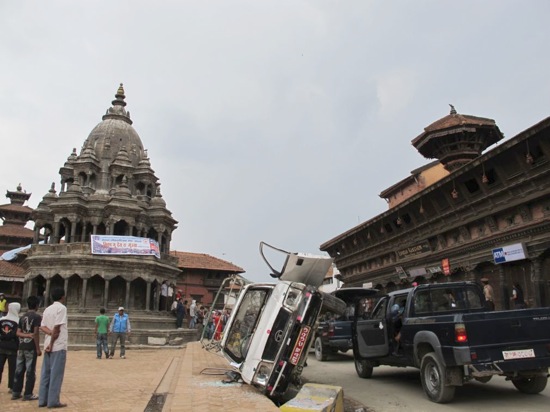
A group of swarthy Maoists in sleeveless T-shirts armed with chains and iron rods came running in from the Lagankhel and chased the unarmed protesters away. Some climbed the parapet of the Taleju Bell and started ringing it: a traditional alarm from the Malla period rung only before impending invasions or other crises. The bell didn’t seem to be in optimum form because it had no resonance emitting only a blunt metallic sound.
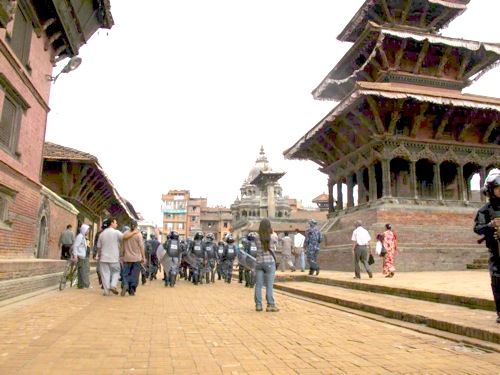
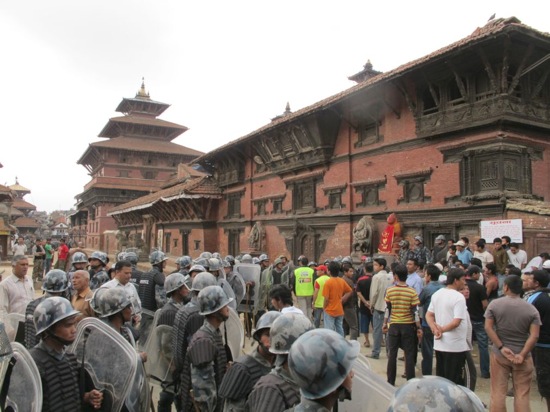
The police soon arrived and started separating the two groups. The Maoists were chased back to Lagankhel and the locals were pushed into the alleys leading to Mangahiti, Bhimsen Temple and Gabahal where they set up defensive barricades and stockpiled bricks. Ward members were conferring in Newari about setting up a warning system in case the Maoists came house-to-house to find the resistance. Patan is where revolutions are born. In 1990, King Birendra is said to have decided it was over for the autocratic monarchy when he saw the red flags over Patan rooftops from a helicopter. In this protest, the Maoists didn’t seem to have the sympathy of the locals.
Nepali flags soon came out, and the ‘white T-shirts’ looked like they were having fun, mustering the courage for the first time in days to say “no” to the shutdown. On the other side, the Maoists were tense and angry, twirling metal chains, waving their iron rods and jostling with the riot police. Throughout these six days, the work of the police has been exemplary, often they have been forced to rescue YCLs from being lynched. Here in Mangal Bajaar on Friday, if it hadn’t been for the police the situation could have easily turned nasty.
A policeman with a hailer told people to be calm and go home. Most were bored. They flocked on balconies, rooftops and sidewalks to watch the tamasha and waited for something to happen. A policeman dropped his riot shield with a clang, making a flock of startled pigeons take wing.
Things were surreally normal. Riot police looking like Ninjas cordoned off the cardinal points into the Square, while devotees fed pigeons, a group of tourists emerged from Sundari Chok listening to a Nepali guide telling them about the exquisite carvings in German. A Korean tourist sat on the steps of the Char Narayan temple reading up on the history of the Malla Dynasty from a Lonely Planet.
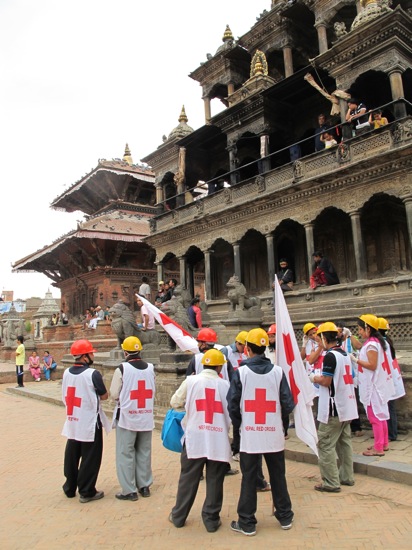
From the sanctum of Krishna Mandir came the sound of bhajans being chanted to the accompaniment of a harmonium, while below a squad of Red Cross workers finished treating locals wounded in the earlier clash. Pretty soon, the Square was filled with the medical personnel in white, TV reporters in fluorescent green vests, the human rights folks in blue. Sagarmatha TV had set up a station on a balcony frequented by tourists to broadcast the drama live.
The dreaded confrontation didn’t happen. I overheard a TV reporter say on camera: “Stithi samanya tira unmukh chha. The situation is returning to normal.” He almost sounded disappointed.