
You read about climate change, you hear about glacial retreat. But it is not until you get up in the air that you get to see for yourself how real it is.
Not long ago, I had the chance to get up on Tara Air’s brand new Pilatus Porter with a Danish tv crew to take a one-hour flight from Lukla overflying the Upper Khumbu. I wanted to share with you some of the pictures from that vantage point:
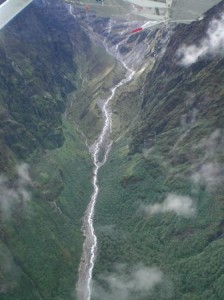
1. Climbing up past Namche I got this extraordinary view of the Phunki Glacier which you don’t notice from the Everest trail because of foreshortening. The glacier has retreated so dramatically up Thamserku’s northern flank that you don’t even see it anymore, just the remains of the lateral moraines and the summit ice cap.
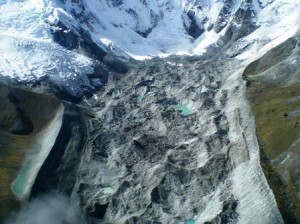
2. The Ama Dablam Glacier, one of the ‘tributaries’of the Lhotse Glacier, is now just a jumble of boulders, sand and melt pools. And there is green grass in the meadows behind the moraine walls!
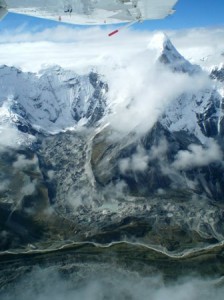
3. A view from higher and further of the north wall of Ama Dablam with its glacier. The stream coming from left is Imja Khola as it finds its way through the moraine complex after leaving Imja Lake.
4. Below the north face of Ama Dablam are these small differently-coloured hanging lakes trapped after the ice retreated up the mountain.
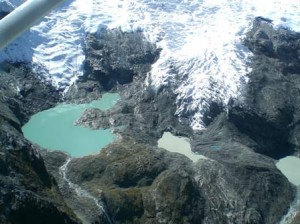
5. The Imja Lake isn’t there in trekking maps of the region from the 1970s. Melting ice and snow in the catchment basin below Lhotse and Ama Dablam have now turned it into a lake nearly 2 km long, 1km wide and 100 m deep. Luckily its terminal moraine has been bolstered by the moraine wall of the Ama Dablam Glacier, so the danger of it bursting and unleashing a catastrophic flood is not as serious as in some other glacial lakes like Tso Rolpa in Rolwaling or Thulagi in Manaslu. Unless there is a major earthquake.
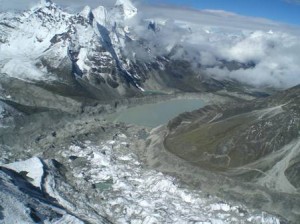
6. The Khumbu Glacier is retreating 50 m a year according to some estimates. At top centre is Everest Base Camp and the houses below left are Gorak Shep.
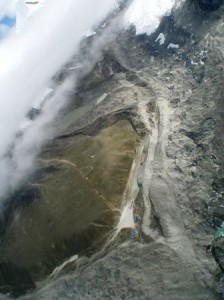
7. The emerald green of Chola Tso, a lake formed by the debris brought down by the Chola Glacier blocking off a side valley during a rapid advance, possible during the last mini-Ice Age. The Chola Glacier is now virtually extinct.
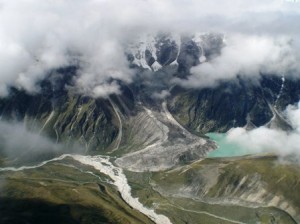
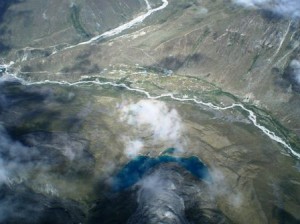
8. Looking straight down from 20,000 ft flying past the summit of Ama Dablam at an inky blue lake formed by collected ice melt that is perched precariously above the settlement of Dingboche.
As dramatic as these pictures are, we know climate change is not just about retreating glaciers. Ice and snow get the media spotlight, water is less glamorous and its depletion is less visible.
Only four per cent of the water in the Ganges comes from the melting of ice and snow in the Himalaya. The rest is monsoon runoff, or sourced from springs in the mountains. The Himalaya, therefore, is not just a frozen water tower but a gigantic sponge that absorbs rainwater and releases it slowly through the year.
We know climate change is melting the Himalayan permafrost, but how do erratic monsoons caused by climate change affect rainfall and the recharging of Himalayan aquifers? We need answers, and solutions to these problems. Time is running out.