
Yet another crash. Yet more tv visuals of police and army searching the scattered wreckage. Once again, bodies being unloaded from the army chopper at the airport. Reporters interviewing grieving family members. The news beamed worldwide.
And once more: the questions about aviation safety. How could this happen yet again? The inevitable speculation about causes: pilot error, air craft malfunction, lax enforcement of aviation rules.
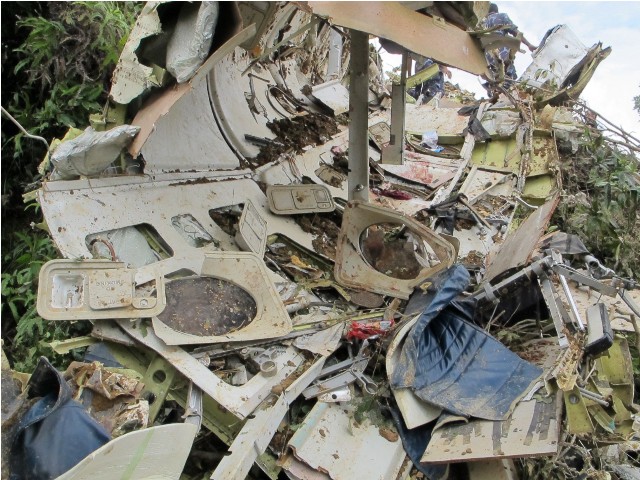
Up on the ridge of Kot Danda on the eastern rim of Kathmandu Valley on Sunday morning, the clouds hung low and those questions sounded banal, almost callous. The lifeless forms of passengers with horrific bruises were being ferried in stretchers to a waiting helicopter. Amidst the wreckage, a ladies’ shoe, a camera bag, bits of clothing and shredded seats.
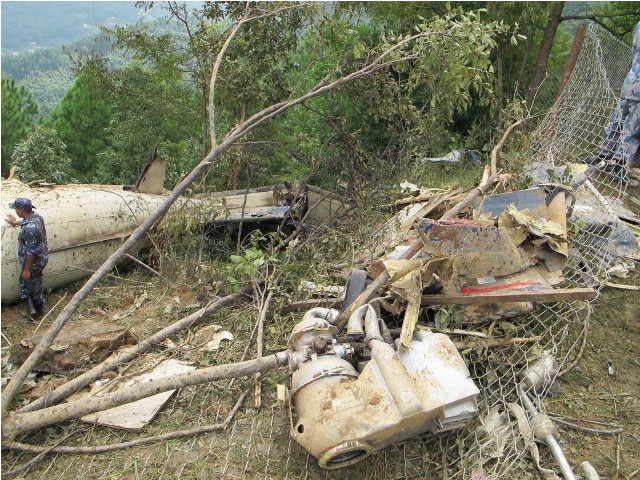
The army rescue helicopter had finally landed nearby after circling to find a gap in the clouds. Hundreds of people from surrounding villages gathered immediately, sometimes blocking rescue vehicles with their motorcycles parked in the narrow road leading to the accident site.
The Buddha Air Beechcraft 1900D with 19 people on board, including three crew, was returning halfway from a Mt Everest sightseeing flight because the mountains were covered up by late monsoon clouds.
There were two other aircraft ahead of the Buddha Air, and the pilot appears to have flown lower than he should have to keep below the cloud ceiling. He was also too far to the east probably to keep distance with preceding traffic. It hit the steep south-facing slope at about 7:21 am.
On the vertical wall of a terrace farm there is a long scar ploughed by the right wing of the plane as it hit. The gash is at an incline, indicating the crew may have been trying to pull up at the last moment.
The aircraft hit the mountain wall, its fuel tanks exploded and the cabin
catapulted up the slope beyond a road. Part of the tail and left wing
disintegrated and fell into some trees. The starboard engine was hurled
40m on another side of the mountain.
Further inspections have to be carried out of both engines, the black box and cockpit voice recorder will give an indication of any malfunction. But the crash had all the hallmarks of what aviation safety experts call Controlled Flight Into Terrain (CFIT).
Nearly all the crashes that have occurred in Nepal in the past 60 years
have been CFIT (see list below). Even in good weather, Nepal’s rugged
Himalayan terrain is difficult to fly in, during the monsoon with the
mountains covered in clouds it becomes even more hazardous.
Pilots being trained in Nepal are told “Never fly into clouds unless you
know exactly where you are because clouds have rocks in them”. It is not supposed to be a joke.
Too many lives have been lost to preventable crashes. Too many lessons have been not been learnt. Too many investigation reports have just gathered dust.
No air crash has only one reason, usually it is a combination of factors. In Nepal it can be weather, terrain, lack of training, pilot error and the lack of equipment. New equipment like state-of-the-art satellite-based ground proximity warning systems on board, or the new RNP-AR approaches to airports in mountainous terrain would make CFIT less likely.
The human factors are not just to do with the pilots, it is about airline policy that recruits pilots depending on whether or not they can afford to pay up to Rs 2.5 million for their simulator training and conversion licenses. Salaries and poor pay mean the best pilots migrate to work in foreign airlines.
The following table is a list of crashes in Nepal since 1990 in which CFIT
is suspected. Most of the accidents occurred in the monsoon and all were
planes that flew into mountains in cloud:
Date Airline Equipment Fatalities Location
30-7-92 Thai Airbus310 113 Langtang
30-9-92 Pakistan Airbus310 157 Lalitpur
31-8-97 Everest Do228 18 Bharatpur
24-8-93 Lumbini DHC-6 18 Kaski
9-6-99 Luftansa Boeing727 5 Kathmandu
5-10-98 Necon Air HS748 15 Kathmandu
27-6-00 Nepal Air DHC-6 25 Dadeldhura
22-9-02 Shangri La DHC-6 18 Kaski
25-5-05 Yeti DHC-6 3 Lamjura
23-9-10 Shree Air MI-17 24 Ghunsa
8-10-08 Yeti DHC-6 18 Lukla
24-8-10 Agni Air Do-228 14 Makwanpur
15-12-10 Tara Air DHC-6 22 Okhaldhunga