Sunil Pradhan May 28, 2012
We want to give our Maoist prime minister the benefit of doubt, this is the quote from the editor of NT. O M G ! Are you really that stupid. The Maoist are nothing but butchers. ( Bagarae as another write put it in your paper ). Please show some wisdom, the Kasaiees that are the Maoist can never be trusted. The C A is dead ! Good ! Look how much the taxpayers will save. Round up these people like a cattle roundup and put them in prison for they are Desh Drohis, enemies of Nepalis. Wipe out the Maoist and other communist from Nepal, so that Nepal can become a better Country. William Shakespare has been proven right time and time again.
Govind Sharma May 28, 2012
Let the Indians be warned in Delhi. Let the Indian Raw agents in Kathmandu be also warned. You have failed. You Indians are disgusting example of failures. You failed in Sri Lanka and now in Nepal. Look at your puppets the Maoist, where do they stand today. The Maoist are despised and hated by the Nepalis. Can you Indians see that picture or do you have thick coloured glasses that prevents you from seeing. How dare you destroy Nepal by unleashing your communist servants in Nepal. One day, you will have to answer for 17 K that died. That is a heavy burdern and a heavy price on your heads. The children of those that were killed will want to avenge the deaths of their loved ones. Former King Gyanendra will also extract his revenge. Bet on that if you can. Communist will die soon forever in Nepal. Like the Cosa Nostra, we will make an offer to the communist they will not be able to refuse. The C A is Dead. Long live Nepal.
Dorji Tsering Sherpa May 28, 2012
The last paragraph in Racing with History by Kunda is very true. "The ones which retain their old men and talking heads will be history. All main parties have a younger generation of leaders who have ideas and a vision for the country, but were never given responsibility. It is time to pass the torch on to a new generation in this race with history" Comments by Shyam Rana that we need drastic economic changes for which we need honest and respectable business men to take the leadership is one of the best option. There are many young leaders in the present political parties who can lead the New Nepal but they should leave their old failed political party and form a new forum of such visionaries in the coming days.
Rabi May 28, 2012
The Indian official in Birgunj by openly asking the Madhesi parties not to agree to anything other than one Madhesh state has given away India’s game-plan in Nepal.
Instigate janjatis in the hills to demand multiple hill states,and keep the Madhesis together for the demand for one Madhesh state.They do not want to see Madhesh splinter into smaller states like Mithila,Bhojpura with distinct identity, the opposite of what they are encouraging in the hills.
Keeping Madhesh as one and the most powerful state and creating many small bickering hill states,they believe is in their strategic interest.
This way they can control the politics and policies of Nepal just by using a handful of influential people in Madhesh, like the Madhesi Morcha leaders.
India’s apparent willingness to see dissolution of the current CA by asking the Madhesi Morcha leaders not to compromise on this (even while other parties including the janjati caucus were compromising on other issues to avert a crisis) indicates the length they are willing to go to fulfill their strategic interest .
Hari Prasad Kafle May 28, 2012
Finally, justice has prevailed. The do nothing C A, built from a rigged and coerced and an intimidated election by the uncouth Maoist led by buthchers like Dahal and Bhattrai has died. This is a good day for Nepal. The corrupted and morally bankrupted leaders of NC and UML are also equally a disgrace for Nepalis. The task at hand now is to erase the corrupted and egotistical Netas, these old and senile and dying Netas, and put them out to pasture. A new generation of young blood, a new generation with bold economic ideas to create jobs and economy MUST take over. If you are reading this, Gagan Thapa and Gokarna Bista, its time for you to show us what you are really made of. Will you just continue to take orders from traitors of Nepal OR will you rise to the occasion and protect Nepal and Nepalis. The Indians should also be ashamed for their outdated policies have failed in Nepal. H. E. Prasad, you are a highly experienced and educated man, I think you should listen to which way the winds are blowing in Nepal these days. You know, its not the 60s, 0r 70s, 80s, 0r even the 90s, FOR GOD'S SAKE we are living in 2012. Its time to tell your Bosses in Delhi to change the course in Nepal, stop supporting corrupted individuals, what goes around will definitely come around. Every one needs to wake up and smell the roses. Jai, Jai, Jai Nepal and May Lord Pashupati always protect us.
Janardan Sharma May 28, 2012
Four years of total failures. Nepali leaders should all commit Harakiri, if they have an ounce of shame in them. How can you face the people ! All you Communist, who follow mass murderers from the old Soviet Union and China, you are all butchers. The Maoist will now split. Indian and China will be vying for more influence. Whats next. Definitely more hardship and suffering for Nepali. Pushpa Kamal Dahal needs to be jailed and held accountable for this crime against Nepal and Nepalis.
Purnima May 28, 2012
Final ethnic cleansing? Come off it - talks about sensational (and irresponsible) journalism.....
Dinesh Aryal May 28, 2012
All the top leaders belonging to UML, NC, UCPN-M, and the Madeshi gangsters should go to jail. They have wasted 4 cherished long years of our lives, down the toilet. Why should they scot free. There has been too many banquets in Baluwatar, and now the time to throw up from this gluttony has come. Koirala, Nepal, Khanal, Dahal, Bhattarai, Paudel, Gachhadhar, all of them are liars, without any shame. These people have ruined Nepal and they must pay for this with everything they have. Only then will people get any justice.
Surya Acharya May 28, 2012
People were happy when Moist emerged as the largest party in CA election surprising many political pundits (despite the visible role of YCL's muscle). The only reason behind was the potential for change. Now people are happy to see CA killed (and marginalized/fractured Maoists) and the only reason is for minimizing the risk of "dangerous changes".
Maoists indeed squandered a rare opportunity. There is no point to blame NC/UML for their failure. It is no secret that CA and federalism was not their original agenda- and the merit of both can still be challenged on a very logical ground. Maoists enjoyed monopoly over setting the agenda with solid backup of Girija'a stupidity. And as a result, on many legitimately contentious issues NC/UML fell into the trap and had to accept Maoist's agenda. Yet, NC/UML showed political magnanimity accepting all those agenda.
The achievement of broader political consensus on the issue of secularism, inclusiveness, and devolution of power (federalism) was something we should be proud of. I do not think, under any scenario, the process would move backward.
The big picture now is solely about Maoists failure. One can dispute who is more responsible to kill CA, but when it comes about who failed most, it is the Maoists.
Until now Moist dictated the agenda and NC/UML just reacted/responded/followed. In the coming days, Maoists will be surprised to feel the strategic discomfort of the scale beyond their imagination as events unfold.
The key factor that explains Maoists' failure is their complete and utter lack of skills to run government. I never imagined that the party that so cunningly manipulated (or got manipulated?) domestic and foreign power centers is so novice and clumsy in the basic art of statecraft.
When their incompetencies and ugly sides became visible, they knew that they would no longer impress the middle class. Then following the "handbook of social engineering", they picked up the new strategy of ethnicity-based identity.
They think this new card can deliver them the Round II. Here they are grossly mistaken. By playing this card, they will be damned if they succeed, damned if they failed.
In his address, BRB setup the election agenda arguing that the choice is "pro-federation vs anti-federation". But overwhelming majority of Nepali see it differently, as national unity vs national disintegration/conflict. As far as the genuine grievances of backward and neglected sections of society is concerned, all have accepted that it should urgently addressed. And for leaders who knows a little bit the art of public policy, this is not a difficult task.
If Maoists do not change their strategies and tactics drastically, this will be the start of their journey down to zero.
But we can not expect much from our "classical" parties, NC/UML.
Now is the right time to start a new political force - combining creative and productive energy of young political leaders, professionals, businessmen, social activists and others who truly care about the future of Nepal and have not yet lost the hope.
SL May 28, 2012
" The ones which retain their old men and talking heads will be history" rightly put.Whats' with these our old generation leaders, they can't even acknowledge the fact that their time was over long time back as they have already shown their incapabilities of addressing country's expectations from time & again. We don't want to see the same face again or witness their game in our political stage, so dear leaders, spare us, its time to pack up & go wherever you may want.
Nirmal May 28, 2012
The only one who seems to be fine is Mr. Bhattarai in this write up. Don't you understand that, thanks to Prachanda's work of genius, he's already converted into the villain of the whole movie? One thing is that people like you could have more sympathy towards him --as If he were the only one person respectable and trustworthy amongst the whole lot of murderers and terrorists-- another thing is how he could be sustained by the faith of his own colleagues and oppositions. The only group I see supporting him is his Madhesi friends and the second class dip0lomatic officials from India.
You're right in presuming that the 6 long months of electoral campaign is an opportunity to know who stands for what given there is an unanimous support to maintain peace and security from all sides. So, let's not waste this from the very first day and help the people to understand each and every complex detail of current Nepali politics. We democrats sir, the idea of reviewing/correcting/writing history doesn't drive us mad because we already work a lot to make a better tommorrow in which people's lives perfectly fit into democracy.
Sanjay Thapaliya May 29, 2012
Look at Bhattarai with a little pity. He deserves a little pity, for now he is still clinging to the chair of PM. This is why I keep saying, The Maoist are crimininals. Even after failing so miserably, they have no shame. How can the Nepalis even think of being led by a criminal gang that poses as a political party. The truth is out there in plain sight for all to see. If Bhattarai had learned anything from his Ph D, he would resign on his own. The 2 individuals that should be arrested immediately and sent to jail, are Bhattarai and Dahal. The only thing in their thick skull is how to kill. India should not be backing this disgraced and mentally downtrodden individuals. Nepal is better today, because the C A is dead. The Nepalis should rejoice that Nepal is still intact. We do not need any election for the next three years. Let the Army provide security and let the Businessmen, who are experts in economy and creating jobs run the show. We need a Nepal Inc. for the next few years to get our house in order. Think about it, come on.
asdf May 29, 2012
Dear Political Parties of Nepal,
DON'T YOU DARE USE THE TAX PAYERS MONEY TO HOLD THE NEXT ROUND OF ELECTIONS AFTER LOOTING US FOR 4 YEARS.
Sincerely,
A Taxpayer.
Kumar Shrestha May 29, 2012
Are Nepali offcilas really COWARDS or do they have the guts to arrest Bhattarai and his co-conspirator, Dahal. If you do not arrest these 2 traitors, 2 criminals, and put them in prison, you will be failing in your duty to Nepal. I hope other leaders are not ( Hizaadas ), that they are gutless in fulfilling their sworn duty. How can 1 criminal man declare election of 28 million, are all Nepalis that stupid. If you want peace in Nepal, get rid of the Maoist thugs, its as easy as that. Now you have the chance to do just that.
Sabita Maharjan May 29, 2012
The Maoist are a bunch of losers. A bunch of cowards. A bunch of criminals. At one point, innocent Nepalis believed in them, now they are hated. That is what happens to liars and crooks. Truth will prevail lies.
Geen grondwet – wel verkiezingen? | Nepal Nieuws May 29, 2012
[...] het volledig artikel, klik hier. Share this:EmailFacebook This entry was posted in Uncategorized by Nepal Nieuws. Bookmark the [...]
Devi Prasad Sharma May 29, 2012
All the Brahmin P M of Nepal are always forced out of Baluwatar. None of them have of the dignity to go away after losing the mandate or the confidence. Maakuney refused to resign, Dahal was forced as well, Jhala Nath said many time he would not resign and now Bhattrai is saying that he will not resign. What a bunch of shamless cowards. The current devlopement has shifted power in favor of the NC, led by old and nearing death personalities. Some power has also shifted to the Royalist and supporters of the Shah Kings. The communist are the biggest losers, which is a good thing for Nepal. The Army has also gained some strength. If Vaidya spilts from Dahal, that would also bode well for Nepal. Dahal has lost credibilty, prestige, morality and self respect. He is now a weakend man no one will take seriously. If the Maoist really spilt that will the end of dahal's dream to become the President. At this rate, things are looking good for Nepal. India should now support honest and respectable leaders in Nepal not crooks and killers.
Nirmala Gurung May 29, 2012
Pot bellied, out of shape, old men have been in charge for too long and they have all failed badly. With the CA dying, a new chapter has been written. We do not need an election that is for sure. What we need is growth in our economy and jobs. Let business leaders assume the much needed leadership in Nepali govt. Wealthy businessmen, already living in luxury do not have to be corrupted and steal from the poor. They can build a better Nepal. We really need a game changer in Nepal.
Sapana Rana Magar May 29, 2012
Whats next for Nepalis. More bandha and strikes. Shortgae of petrol and gas and electricity. Food prices soaring out of control. How are the people going to survive, does any leader care about this. If so, let him come forward in the public arean and admit that. That will be a miracle for our leaders are selfish and cowards. How will the void in the demise of CA be filled. Who will be in charge. Will we allow the same failed and lazy and incompetent and crooked people to take charge. That idea is so disgusting in itself. Where will we find a group of honest and capable leaders in modern day Nepal. So far that has not happened. We Nepalis have lived with insecurity and shortages, and injustice and abuse for ever. Will the equation ever change.?
Gopal Shrestha May 29, 2012
We do not need an election.What we need is a Military rule. Martial Law. If the grouchy old men of Nepali politics want to have another election, then they should spend their own ill gotten looted wealth. Nepali taxpayers are in no position to pay for the election. The money needs to be spent on employment, and education and business devlopement. Bhattrai - go to hell. Nepal is not your personal property. You should be in jail by now, you are free because all other leaders are more cowardly than you. For a Ph D Prime Minister, you are the wrost in the history of Nepal. The Maoist have only brought disgrace and ill fame to Nepal. I think RPP maybe be planning a teaching lesson to the Maoist. Also the C A has died so its past decisions may also have died. Maybe Gyanendra is now thinking that he is still the king of Nepal. Dahal is the culprit, he should be punished.
sarah k c May 29, 2012
Look at India ! Look at China ! They have great leaders and they have become giants in the world. Now look at Nepal right in the middle, that only has morons as leaders. if we had smart leaders, with help from China and India, we also could be on top of the economic world. But no, we have the Maoist, anti business and anti growth clowns. The NC and UML are the same types of idiots. If Nepalis want to move ahead, we must first embrace the economic strategy of our two big neighbours. The status quo MUST CHANGE ! The old fools have to go. besides they are loosers and failures. The death of C A must be the turning point for this change. Neaplis now need to move their buts and go to work and build a prosperous and peaceful Nepal for our children. Is that too much to ask for.
junior analyser May 29, 2012
.When prachanda spoke it always feels so convincing. Now it's been proved that he is nothing more than a clever and loud mouthed brahmin(no race offense i am also a bahun).important thing is people have realised big way , regarding so prevailing head parties' head netas, that everyone new or old are nothing but the hollow ego owning egotistical bastards who dont consider the fact that nepal should prevail to their descendants even after their death.all they can think and do is eat up tax and fill personal tanks..every bad name that can be given- those netas deserve that..and yes new way out is new leadership..not a cent percent trustworthy concept but better one, of course.
Laxmi May 29, 2012
Finally the sun is setting on the horizon for Communist/Maoist leaders. The CA is dead, the Maoist had plenty of good opportunity to rule the country but had too many radical ideas and agendas which were bound to fail. It is good the party is splitting.
nidhi May 29, 2012
you talk about these Maoists following the northern frens but it is all sham. They are lackeys of the southern neighbour and have been executing their will for over 15 years.
nepali baun May 30, 2012
The writer is wrong to say that NC and UML only has high caste men.
Maoist and Madhesis, same story
Bhattrai, Dahal, Baidhya all are Bauns
Yadhavs, Thakur, Tripathi are all high caste leaders.
Shree Shrestha May 31, 2012
Nepalese people spend about US $25 million to feed 601 CA members to write constitution but they failed miserably. People have right to know how much work they did and what need to be done. So government need to publish the constitution even with blank pages. Next election should be for the National Assembly and the House of Representative not for another CA.
Tapan Das May 31, 2012
It is the fault of the Nepali voters not toknowthe origin of the Maoists andtheirmentors.andwhat they stand for. The other parties,NC isoorly organizes and feuding within.The UML is ambiguous not with clear cut views and taking unclear stand. Madesi part y suffer from their past syndrome. Mapist look for their party interest and to get power and capture the state by hook or by crook and establish a authoritarian dictatorship . Quando,Quando,Quando?
GUNJU GIRI Jun 2, 2012
It is rather shocking see these seemingly popular journalists, taking sides, and reporting only one sides news. To start with, none of the national news papers wrote anything about the day where an entire family of King Birendra was finished. Of course, Shah dynasty was not always noble, which is practically imposable, but at least they gave what we call Nepal - otherwise we would either Indian or Chinese 3rd class citizens! Wake up Mr. & Mrs. intelligents, try to appreciate historical facts... And just answer, current useless 601, why is Sujata's son-in-law good for you while Gyanendra's son villain? Can you let people understand it? You don't you care about Nepal's founding fathers, but you lake lecture about Western philosophers? Why?
I don't care what politics you like, but don't play like a little beggar with foreign powers, and try to erase the History. All are so called top leaders are guilty on this, but Maoists dictators are the worse... what to say about 601, they just wanted earn money... they had so much jealousy that in the pas only Monarchy had the privileged (though in reality the same leaders who are now 'truely' republicans were the ones to rip off the country). The point here is that there is nothing to be sad about the death of 601 discussion; that was never going to last first because of its sheer numbers, and second because it was an attempt to copy foreign ideologies that are sold by forgiveness. what short-sighted political didn't realise that their opportunistic behaviour would one day become poison for themselves i.e. they can survive in government until their donors get what wanted, or else collapse. Kangresi and Emale have already become the most corrupt and humiliated parties, but soon the Maoist dictators will meet the same fate, after all they come to power by killing and Indian money... for their smaller parties, they do anything as long as they get money.... Hence we are in a doomsday scenario, where Nepali are only taught to cheat, hate, or even kill each other; not make a peaceful future.
The one way forward to save Nepal and Nepali identity is only by what Japan did after the World War II, do everything to save linguistic and cultural identities of all Nepali, prevent foreign, especially Western consumerism behaviours, but do everything to bring Japanese or Western sort of Economic growth. In particular, political parties should forget absolute ideologies of 'lal salam' Communism or Indian Kangres... there should be purely NEPALI politics based on Local realities - all Nepalese who love their motherland dearly must be able to reshape this country, or else, we will be either Sikkim or Tibet... So, intelligent media personalities, don't give us foreign cra* but only what is best for Nepal from within Nepal!
vija Jun 2, 2012
So we don't have Constitution!The reason we couldn't complete was the inability to make useful decision for the country.Federal states based on enthnicity is Dahal's and Bhatarai's the most unintelectual suggestion and demand and we just need to imagine how long it will drag us into as we needed more than 12 years for these two individuals to understand and accept the uselessness of their war.However,the surprising part in all political games that goes on in Nepal ,is the purposefully closed eyes to actual reasons of this chaoss.Dahal and Bhattarai are just a pawns in the game of chess and that is what no one wants to talk about and media uses all their power to keep it in such a way,hoping that people and life will bring the real individuals with the power into play. If the President is the leader of the country then the country must be divided into Federal states,to spread the power of their political ideology all over the country is the favorite slogan and explanation for ordinary Nepalisfrom Maoist led government.We had and can still have development regions,as it was the best inclusive politics accepting and respecting everyone so why to create this enthnic war?Maoists know very well it is absurd,the main reason behind this created chaoss is need for the time ,is a need for the undivided executive power of the President.Elections is a hope for Dahal and Bhattarai,not that they hope to be one of those,it is the principle,the figure of President is the whole purpose.If Dahal and Bhattarai hope for elections to bring them proof and power then it is absurd too,as it is clear,that they can never be given the power by people of Nepal again,people can be fooled once,but not twice.
However,the 27th of May is behind and we know the reasons of failure,but all the politicians and political parties are sitting on their eggs as if something new must be hatched.The problem itself has been forgotten the day the elections were annouced.So we don't have Federal States based on ethnicity as the main problem now?Has it disappeared suddenly or is there a vacuum for a new version?I am shocked at the party inclinations and taking the bull by the wrong places.Revanges,demonstrations,demands to remove Bhattarai,Bhaidya's continous wish to do tongue bending,Dahal's and Bhattarai's hope to create a new reason and most importantly,get win in the elections by hook or by crook.Anything that was important till 27th of May has no importance now.My question to all those politicians and everyone,how long are you gone pretend not to see?Who would you like to be a President as it seems,everyone has accepted this proposal and NC and UML know very well who will be the next President,they are just scared,that having the President ,they may not be able to cowork.Forget about Dahal or Bhattarai,we all know they are just a pawns in the game of chess or are we scared that people may not accept real power or that it will lead back to the same position 4 years back.I believe it will never happen again,as people are intelligent enough and have grown and developed and understood the need of the today's society in Nepal as Nepal can only develop,being a part of the world ,having unity as the nation.So these empty demonstrations,blame game wh o did what is a waste of time again and again.We are being sidetracked again and again,loosing the whole point of what we really want.Bring wise leader back,who has interests of the country !
gunju giri Jun 2, 2012
Wow, these news people act like dictators, if people express views that is are confirming to what they want others to believe... Way to go... Dikkar chha, your extreme partiality in writing news....

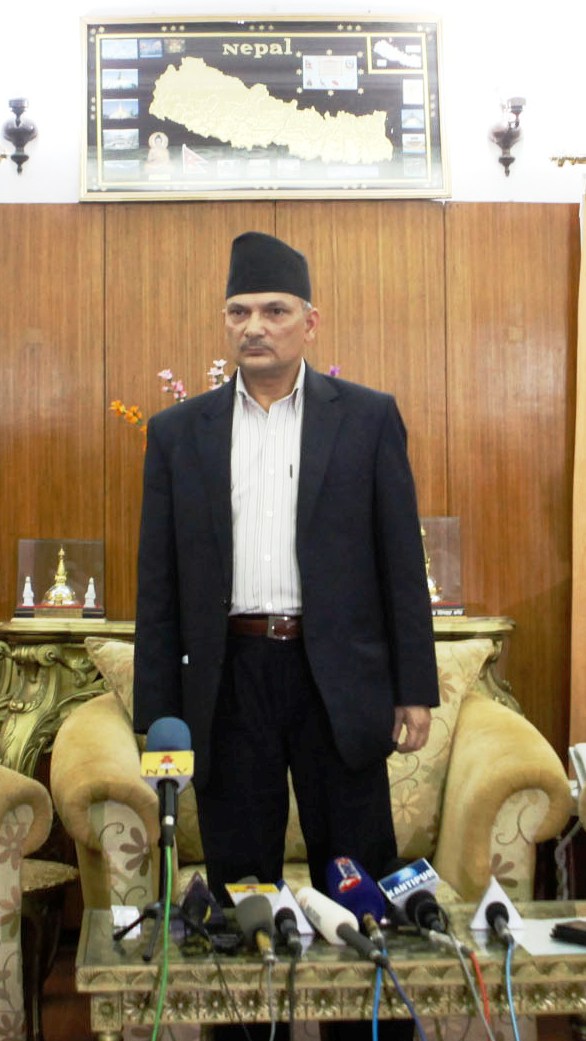 PM Baburam Bhattarai after his address to the nation at midnight, from his official residence in Baluwatar. Pic: Bikram Rai