
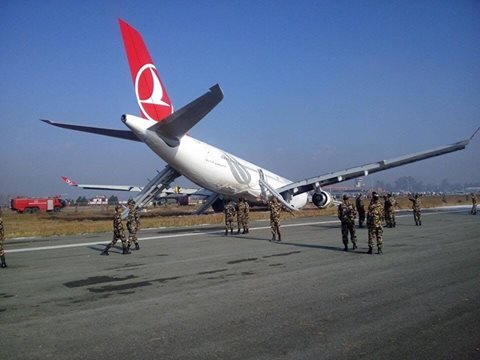
 On Wednesday morning at 7:45 a Turkish Airlines Airbus had a near disaster while landing at Kathmandu Airport. But in blocking the only runway of Nepal’s only international airport, it has unleashed a real and unfolding disaster on the country.
It has been four days since the airport was shut for all international operations, more than 80,000 people have been stranded in Kathmandu and inbound airports. For a country so dependent on tourism and movement of migrant labour, the loss to the economy has been colossal.
On Thursday afternoon, an Indian Air Force C130J Hercules aircraft landed on the northern half of the blocked runway with the recovery kit. Other airlines have loaned spare wheels.
An Indian team that managed to lift the nose of the Airbus 330 jet has not been able to move the heavy widebody to clear the runway. Although the nose of the plane has been raised and rests on a truck bed, the body of the plane is resting on two under-wing airbags and the wheels in the main undercarriages have been replaced. Although the plane was moved by 2m on Saturday morning, the wingtip and tail of the plane are still blocking the runway. Crew is trying to drag the plane into the parallel taxiway and then move it to the east helipad.
Domestic flights have been able to operate, but only with smaller aircraft. Buddha Air’s ATR72, for example, needs more runway length which means it hasn’t been able to fly some trunk routes. Nepal has now been cut off from the rest of the world for four days.
A Turkish technical team is arriving in Kathmandu from Istanbul Saturday morning in a small jet. But it is not clear what it can recommend that hasn’t been tried already. Other more drastic options had been put forward: to dismantle the wing and tail section of the plane to remove the runway obstruction. But even this would have taken days.
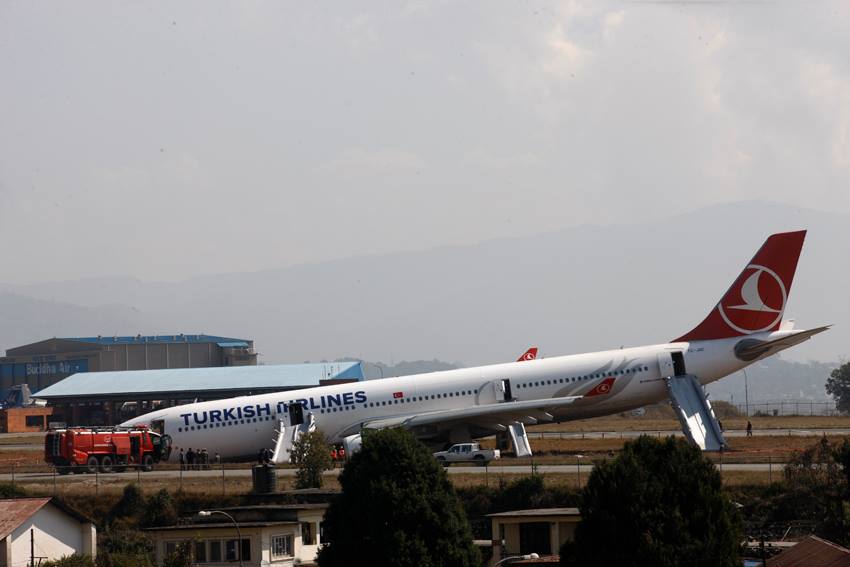 Turkish Airbus 330 with its nose on the ground off the runway at Tribhuvan International Airport on Wednesday.
No one yet has an estimate of the daily losses to the economy from the airport closure, but the hardships for individual passengers has been staggering. Nepali migrant workers are running out of money and have been sleeping on the floors of airports in Kuala Lumpur, Abu Dhabi and other airports. Tourists coming to Nepal at the start of the spring trekking season have been stuck in Hong Kong, Dubai, or New Delhi. Doha alone has 3,000 stranded Kathmandu-bound passengers. One of Nepal Airlines jets is in Bangkok another in Dubai.
A major international conference on hydropower has been cancelled, trekking trips have been scrubbed, many international marriages postponed.
“Making another approach”
The Turkish 726 Airbus 330-300 aircraft had been flying all night from Istanbul with 224 passengers and 11 crew on Wednesday morning. The airline had just trained its pilots to carry out the RNP-AR (Required Navigation Performance -Authorisation Required) approach in Kathmandu, which is a more precise satellite GPS-based landing compared to the steeper VOR-DME landings. Qatar, Korean and Druk also use this approach, which allows jets to land at under 1,000m visibility, compared to 3,000m earlier.
On 4 March, visibility in the early morning was at below minimum and 726 circled over Simara for an hour before making an approach. It had to pull up at the last moment because the pilot coldn’t see the runway. “Runway not visible at decision height,” the pilot told Kathmandu Air Traffic Control when asked about the reason for the go-around.
The plane carried out a standard missed approach procedure, turning west and climbing to 10,500ft and then 20 miles south of the airport. By this time, the crew must have been calculating how much fuel it still had on board, and needed enough for a diversion to Dhaka or Lucknow. The captain opted for an immediate second try.
Tower reported visibility at 3,000m but added casually: “Visibility at 1,000m on southeast of the runway.” By the time the plane was at 5,600ft and 3 miles out a patch of fog had started moving in over the threshold. For some reason, despite poor visibility the pilots decided to go ahead and land.
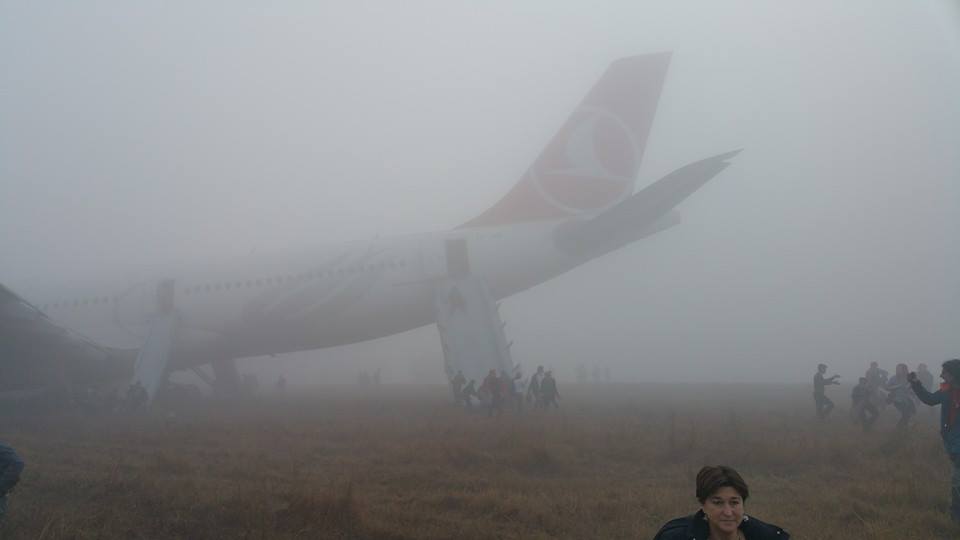 Turkish Airlines crash lands
Passenger accounts speak of an extremely hard landing “20 times more violent than normal”. The plane veered off the runway to the left, the nose gear collapsed and the Airbus 330 came to rest between taxiway D and E. The grass was soggy with previous two days of rain, and probably saved the plane from careening towards the terminal building and exploding along the way.
Photographs and videos of people coming down the evacuation slides that morning show fog so thick that it is hard to see the plane’s tail from even 15m away. Why the pilot decided to go through with the landing, and why the ATC did not warn of the fog patch are questions that will need to be answered.
Pictures from the crash site taken on Friday show that progress has been made in lifting the plane. But at press time on Saturday morning no one could give a reliable estimate of when the runway will be cleared. Hurdles, literally, remain.
Then there are the longer-term issues of expediting alternate airports. Bhairawa and Pokhara expansions are still two and three years from completion. Kathmandu airport, designed for traffic projects 20 years ago, itself needs urgent upgraded.
Even if the airport reopens this weekend, there will be bedlam at a terminal that is chaotic even at normal times. There are plans to allow landings and takeoffs for 24 hours to clear backed-up flights, but runway lights have also been damaged, the tarmac itself needs to be repaired, and two of the baggage belts are unserviceable.
Even if the Turkish Airlines plane is removed and flights resume, the crisis at Kathmandu airport will not be over.
Read also: