
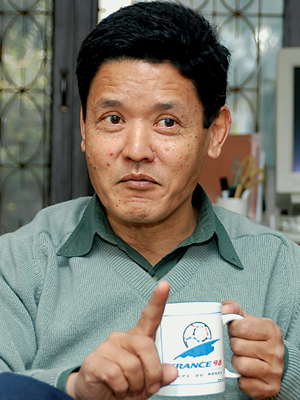
 When Nepal’s top conservationists were killed in a helicopter crash near Kangchenjunga in 2006, Pralad Yonzon lost many of his peers. But he turned his grief into action and set about training a new generation of conservationists through his organisation, Resource Himalaya.
In a cruel blow, Yonzon was himself killed on Monday afternoon when a truck rammed into his bicycle on the Ring Road in Balkhu. He was sixty. It was the mark of the man himself that Yonzon rode a bicycle through Kathmandu’s dusty and crowded streets: he practiced what he preached.
In an illustrious career, Yonzon worked to study the habitat in Langtang of the endangered red panda for his PhD, he made the highest-ever spotting in the world of a tiger at 3,000m in the mountains of Bhutan in 2001. It was a breakthrough in tiger conservation, giving the world the hope that the tiger could be saved. Yonzon was at the forefront of research into wildlife conservation of elephants, monkeys, birds and snow leopards and preferred a people-centred approach. He believed that unless poor farmers living in proximity of wildlife saw the benefits of conservation, species could not be saved.
Yonzan preferred to spend time in the field, rather in the office. He was nearly killed several times in accidents in the wild, but he shrugged at the dangers. He said in an interview after receiving thevMacArthur Award in 2007 that: “We want to help conservation with science-based information.” He donated his prize money of $350,000 to setting up Resource Himalaya Foundation building in Dhobighat.
A mild-mannered man, Yonzon preferred to maintain a low profile. A gold medallist from Tribhuvan University and Fulbright scholar, Yonzan earned his PhD from the University of Maine and was a visiting professor at TU
for the last five years. He was a recipient of the Golden Ark, The National Achievement Award, Young Scientist Award, Joint-Doctoral Research Award (Hawaii) and Mary Totten Achievement Award (USA).
“He dedicated his life, his earnings and his profession to create a conservation oriented organization which has become truly a platform for hundreds of young students, researchers, and practitioners to share and
learn,” wrote Madhav Karki of ICIMOD in a NNSD group post.
In a tribute Dipak Gyawali, who worked with Yonzon in the King Mahendra Trust for Nature Conservation, wrote: “It is said that tragedy is the difference between what is and what might have been. That difference is
just too huge, like infinity, to contemplate.”
His family plans to have a commemoration ceremony at Resources Himalaya on Wednesday. Yonzon, is survived by a wife, son and a daughter.
See also: