
Climbing for the 2014 Mt Everest spring season now seems to be over. The final decision was due to a combination of factors that led to large commercial expeditions and their hired high altitude workers leaving Everest Base Camp last week after the devastating avalanche on 18 April that killed 16 climbers on the Khumbu Icefall.
Mountaineer Alan Arnette tracks activity on Everest, and in a blog declared the mountain ‘functionally closed’ for the season. As of Monday morning, all large expeditions on the southern Nepali side of the mountains have abandoned their climbs.
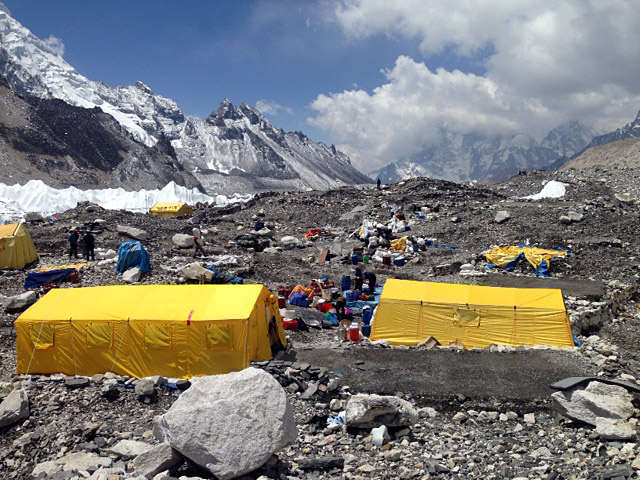 A few tents remain Monday at the normally crowded Everest Base Camp
Photo credit: Ang Jangbu, IMG
Large expeditions were allowed by the government to collaborate in chartering helicopters to retrieve supplies already stored at Camps 1 and 2. Supplies are being allowed to be stored under locked mesh coverings on the Western Cwm until the next season.
As the majority of climbers from large expeditions return to Kathmandu via Lukla, more detailed accounts of their experiences following the 18 April tragedy have started being posted on the Internet. Some speak of bullying and harassment by a small group of Nepalis who still wanted to climb the mountain.
The Nepal government, for its part, says the mountain is still open. It has said climbing will not be refunded, but an official told expeditions at Base Camp last week that their season’s permits will be valid for the next five years. It is unclear whether this applies to individual climbers, or only to the teams as constituted in spring 2014.
Large commercial expeditions, like Himalayan Experience and Asian Trekking, employ most of the Nepali high altitude workers who do most of the rope fixing, ladder setting and ferrying loads to higher camps.
A commercial expedition cannot get through the Khumbu Icefall, and eventually to the Summit, without the help of high altitude workers. Smaller groups could still go, but without fixed ropes and ladders, they will find it much more difficult and costly. The cost of negotiating the Icefall is usually shared by all expeditions.
Nepali workers at Base Camp, most of them Sherpas, felt the avalanche was a bad omen and decided not to climb the mountain out of respect for their friends and family who are dead or missing. However, as anger rose at Base Camp, some younger Nepali staff of various expeditions ratcheted up their agenda and issued a 13-point list of demands that included higher compensation and political demands of representation in parliament in Kathmandu.
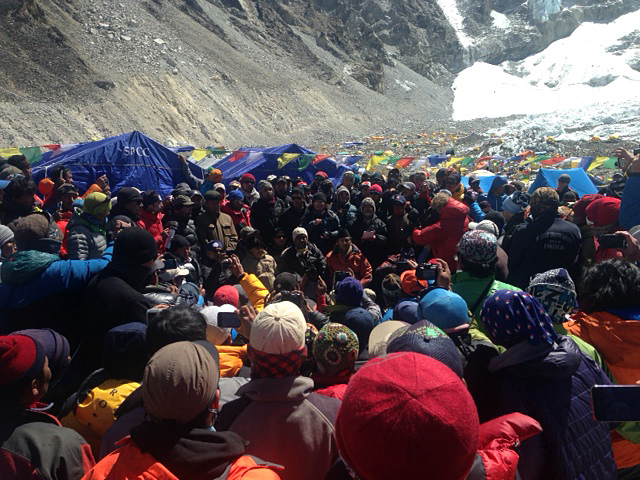 The Tourism Minister headlined a group of government officials who visited Base Camp last Thursday.
Photo credit: Ang Jangbu, IMG
Others such as British guide Tim Mosedale and John All overtly tied the threats to Maoists who have hijacked the tragedy for their political agenda.
For Western clients and Nepali high altitude workers, the decision was not an easy one explained Nepali Sumit Joshi, Himalayan Ascent’s founder. “Emotionally, mountain workers were being pulled from all angles to make a choice: respect for the dead, alliance to the better rights cause, company loyalty, government and association pressure to continue, family pressure and their own safety” he said in a blog post.
The last straw for those still at Base Camp was a series of smaller avalanches that dropped on the same section of the Khumbu Icefall that was hit on 18 April.
Rainier Mountaineering Inc (RMI) guide and 15-time Everest summiteer Dave Hahn summed it up in a blog: “For now, suffice to say that the risks outweigh the possibility of success.”
Matt Miller